Custom Enclosures Made Of Paper

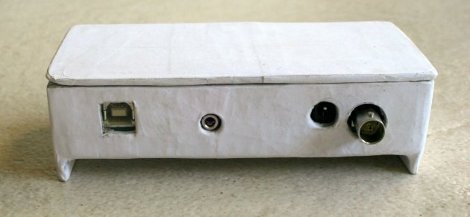
[Sivan Toledo] needed a enclosure for a unique sized electronic project, not finding what he needed in off the shelf solutions, he went to the next best thing, … Papier Mâché!

Using a mold made out of standard corrugated cardboard, he slowly built up layers made of magazine paper, and ordinary “white glue” diluted with water. After getting near the thickness wanted he switched over to typing / copy type paper for a nice clean outer surface. Ports were made in the usual fashion when dealing with soft or thin material, drill a smaller hole, going back with successively larger holes, and then follow up with an appropriate file, all while taking things slow along the way to prevent unwanted results. Finishing up with layers of paper carefully cut into strips to meet the circumferences / edges, along with the final outer surface to make it all even.

The end result is awesome as it stands, but we cant help but wonder what some sanding and paint would look like on a enclosure made like this, though any way you finish it, the idea comes down to custom enclosures that do not need special tools or materials to complete (on the cheap).

Thanks [Drone]
Simple Touch Sensor And Other Lessons

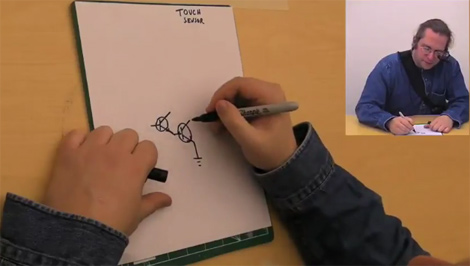
[HankDavis] sent along this link to a video showing a tutorial on how to make touch sensors using a “darlington pair”. In the video we are taken through the idea and how we’re going to construct it.  [Thad]explains in detail how this works in simple terms and illustrates it clearly. Unfortunately they don’t show an actual constructed system, but this is so simple you could toss it together quickly and see for yourself. This is a great lesson on how to get a simple touch sensor into your projects. This video appears to be one of a series of class visuals, and you can find several others on youtube under this account.

Continue reading “Simple Touch Sensor And Other Lessons”

STK200 Pocket Change Programmer

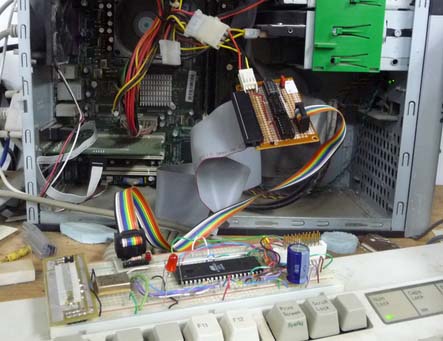
A common complaints of beginners to microcontroller programming is the availability of DIY tools that do not require a parallel port.  Using not much more than a couple of 74xx series chips and some protoboard, [Rue] was able to create an AVR programmer for less than the cost of some chips it can program – giving parallel programmers a run for thier money. [Rue] used Linux treat the ubiquitous PATA/IDE port as a parallel port. By having avrdude treat the programmer as an Atmel STK200, [Rue] was able to upload a blinky program to his AVR microcontroller through ISP. If anybody can think of an even lower cost unconventional solution give us a shout.

Digital Measuring Tape

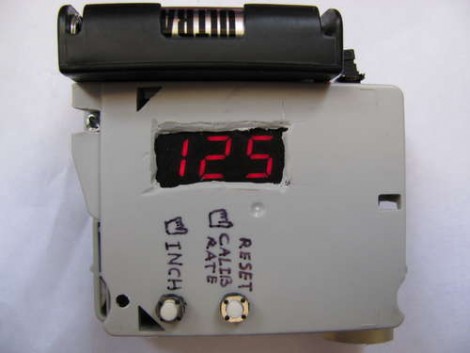
You’ll never come up short with this measuring tape. That’s because there isn’t actually any tape in the device; it measures distance based on the rotation of a wheel. Roll it across the room and you’ll get an accurate measurement of the distance the little bugger traveled. Like the Etch-a-Sketch from Monday this uses the encoder wheel from a mouse as the input. The IR emitter and sensor from the ubiquitous peripheral find a new home on the PCB that hosts the PIC 16F819. It monitors the rotation, turns it into inches, then spits that number out on a 7 segment display. Handy, and cheap!

Printable Wax As PCB Etch Resist

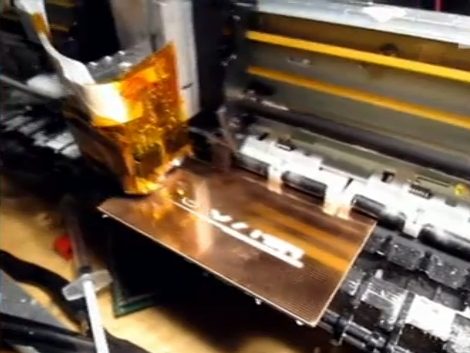
What if there were only two steps for making your own printed circuit board; print, etch? That’s what [Jeff Gough] has been working on and he presented the process in his talk at 27C3. In the first portion of the video after the break [Jeff] talks about various industrial PCB manufacturing processes in a depth you may not have heard before. We found it to be interesting but at about thirty minutes into the clip he begins the presentation of his modified printer. It’s an inkjet that can print wax onto copper clad board. The wax acts as a resist for chemical etchants, and provides very high resolution. He’s using a heavily modified print head, which brings to mind that diy piezo inkjet head which also has wax printing in its future plans. This certainly seems promising and if the process can be simplified it might do away with the toner transfer method.

Continue reading “Printable Wax As PCB Etch Resist”

Make Presents: The Multimeter

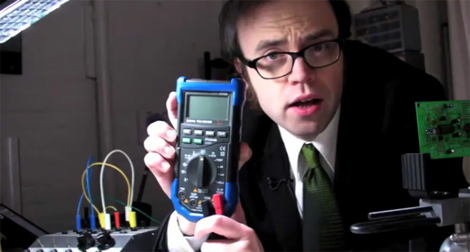
This video falls under the category of things we want to send people when they ask “how do I get started with electronics”, and we get asked that a lot. For those of you who have been working with electronics for years at all, you can skip this entire video. That is, unless you really want to watch an instructional video on multimeters. In the video, which we’ve included after the break, they talk about the differences between different meters, the common uses and how to actually use the meter to get the results you need. Stuffed full of useful information, this video will get those of you who are still reading up to snuff pretty quickly. Now go use your multimeter to do some hacking!

Continue reading “Make Presents: The Multimeter”

Magnetic Digital Scale

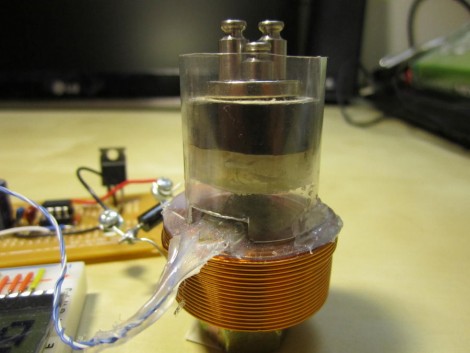
Above you see a solenoid being used as a digital scale. The magnetic field from the coil in the base levitates the platform above, where a load to be measured is place. This floating platform has a permanent magnet in it, hovering above a hall effect sensor in the base. As the distance between that magnet and the sensor changes, the measurable magnetic field changes as well. The hall effect sensor is linear so the measured value can easily be correlated with a weight. In the video after the break [Vsergeev] demonstrates the device using test weights to show off its 0.5 gram resolution. He thinks that with a few hardware improvements he could easily achieve 0.1g accuracy.

Continue reading “Magnetic Digital Scale”