A series of tubes wound up and down as modules in a metal-framed, free-standing wall. The wall is inside a climate-controlled test chamber with a series of differently-colored tubes running behind the free-standing wall.

Cooling Off The Bus Stop

If you’ve taken the bus in the summer, you know it can get hot while you wait on your ride, even if there is a roof over the stop. Researchers at the University of Seville have devised a way to keep you cooler while you wait.

As temperatures around the world get warmer due to climate change, keeping cool in the summer is increasingly not just a matter of comfort. For the prototype in a climate-controlled chamber, 500L of water were cooled with a chiller and used as a thermal reservoir to reduce temps in the bus stop during the day. Pumps circulate the water through panels when a rider approaches the stop, cooling the space by ~8˚C (~14˚F) over a 20 minute period. Pumps for the system and lighting for the stop will be powered via solar panels and keep the system self-contained.

The amount of cooling offered by the system can be controlled by the flow rate of the water. The researchers plan to use Falling-Film radiant cooling in the outdoor version to replace the chiller to cool the water at night. They also say the system can be used for radiant heating in the winter, so it isn’t just for hot climates.

If you want to know how to survive a wet bulb event or want a better way to determine your bus route, we’ve got you covered there too.

[via Electrek]

A DeLorean sitting on patchy snow next to a driveway. It's angled away from the viewer to the left showing off the open engine compartment with bright orange high voltage lines coming out of a square metallic charger box.

A DeLorean With An Electrifying Secret

There are few production cars with as much geek cred as the DMC DeLorean. If you want to kick the nerdiness up a notch without doing a full Back to the Future prop-mod, then the next best thing is to make it an EV.

[Bill Carlson] took a 1981 DeLorean and transplanted the drivetrain from a Chevy Bolt to electrify this ride. With the DeLorean being a rear wheel drive vehicle and the Bolt front wheel, there was some amount of component reshuffling to do. The motor is now in the rear of the car along with the main contactor, charger, and motor controller while the batteries are split between a pack in the original engine compartment and another up front under the hood.

The electric power steering and brake booster from the Bolt now also live under the hood, and the accelerator and steering column from the EV were transplanted into the cockpit. [Carlson] still needs to tidy up the interior of the car which is currently a nest of low voltage cables as well as add the cooling system which will bring this stainless monster up to a hefty 3200 lbs (~1450 kg) versus the original 2850 lbs (~1300 kg). We suspect the total bill came in a bit lower than getting an electric DeLorean Alpha5.

This isn’t the first electric DeLorean we’ve covered here, and if that isn’t cool enough, how about this DeLorean-inspired hovercraft?

Continue reading “A DeLorean With An Electrifying Secret”

Solar Boat Makes Waves

The two best days in a boat owner’s life are the day they buy it, and the day they sell it. At least, that’s the common saying among people who actually spend money to buy a boat. [saveitforparts], on the other hand, looks like he’s going to have many more great days on this boat than that since he cobbled it together nearly for free, and he won’t even need to purchase any fuel for it since it runs on solar power.

The build starts with [saveitforparts] heading out to a literal pile of boats in his yard, unearthing an old single-person sailboat, and then fixing the major problems with its hull. With a new coat of red paint, the focus turns to the drivetrain. Propulsion is handled by an electric trolling motor found at an auction for $8 and is powered by an off-the-shelf battery bank provided by a sponsor of his channel. A pair of solar panels (which were traded for) fitted to outriggers keep the battery bank topped off, and there’s plenty of energy left over with this setup to charge drone batteries and other electronics while out on the lake.

[saveitforparts] reports that the single-passenger solar boat is remarkably stable on the water and fairly quick at full speed thanks to its light weight. He even hypothesizes that it could be fished from. The only thing not particularly stable was towing it to the lake, as the rough roads and permanently-attached solar panel outriggers weren’t particularly congruent with each other. If you’re looking for something similar to carry a few passengers, though, have a look at this much larger version.

Continue reading “Solar Boat Makes Waves”

Pedal Car Vs Ministry Of Transport

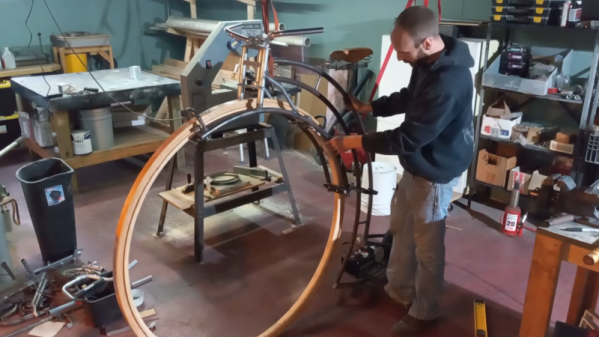
[Tim] from the “Way Out West” Youtube channels has started a fun project — building a wooden pedal-car heavily inspired by “Bugsy Malone”. The kids-sized gangsters in that movie got around in kid-sized pedal cars. Apparently kid-sized [Tim] just loved the idea, but just didn’t have the skills or tools to try to build one. But the time has come, and he has spent years putting together a workshop, tools, and skills.

The goal is a 4-wheeled vehicle that can actually be enclosed, to keep the driver out of the rain. It would be petal powered, with an optional electric assist. It should be made of simple materials, like plywood and epoxy. The design would be freely shared, and the overall cost hopefully kept low. Come back after the link to find the rest of the story, including the monkey wrench thrown into the works.
Continue reading “Pedal Car Vs Ministry Of Transport”

A Magnetohydrodynamic Drive In The Kitchen Sink

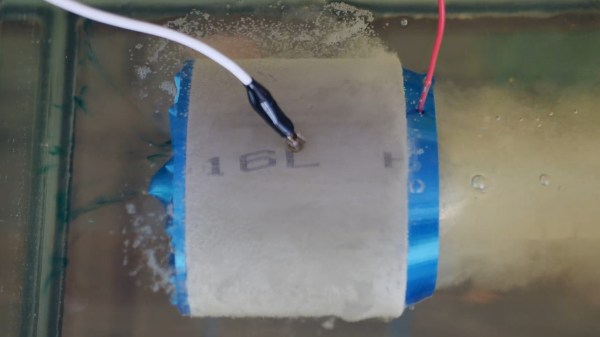
The magnetohydrodynamic (MHD) drive certainly sounds like something out of science fiction — using an array of magnets and electrodes, this high-tech propulsion technology promises to silently propel a craft through the water without any moving parts. As long as you can provide it with a constant supply of electricity, anyway.

Of course, as is often the case, the devil is in the details. Even with the obvious scientific and military applications of such a propulsion unit, scaling MHD technology up has proven difficult. But as [Jay Bowles] of Plasma Channel shows in his latest video, that doesn’t mean you can’t experiment with the concept at home. Even better, getting verifiable results is much easier than you’d think.

Continue reading “A Magnetohydrodynamic Drive In The Kitchen Sink”

The State Of High Speed Rail, And A Look To Tomorrow

In the 21st century, the global transportation landscape is in shift. Politicians, engineers, and planners all want to move more people, more quickly, more cleanly. Amid the frenzy of innovative harebrained ideas, high-speed rail travel has surged to the forefront. It’s a quiet achiever, and a reliable solution for efficient, sustainable, and swift intercity and intercountry transit.

From the thriving economies of Europe and Asia to the burgeoning markets of the Middle East and America, high-speed rail networks are being planned, expanded, and upgraded whichever way you look. A combination of traditional and magnetic levitation (maglev) trains are being utilized, reaching speeds that were once the stuff of science fiction. As we set our sights towards the future, it’s worth taking a snapshot of the current state of high-speed rail, a field where technology, engineering brilliance, and visions of a greener tomorrow converge.

Continue reading “The State Of High Speed Rail, And A Look To Tomorrow”

Truss-Braced Wings Could Bring New Look To Runways Worldwide

Airliners have looked largely the same for a long time now. The ongoing hunt for efficiency gains has seen the development of winglets, drag reducing films, and all manner of little aerodynamic tricks to save fuel, and hence money.

Boeing now has its eye on bigger, tastier goals. It believes by switching to a truss-braced wing design, it could net double-digit efficiency gains. It’s working together with NASA to see if this concept could change the face of commercial aviation in decades to come.

Aspect Ratio Matters

The ASH 31 glider features wings with an aspect ratio of 33.5, and a lift-to-drag ratio of 56. Credit: Manfred Munch, CC-BY-SA 3.0

The key goal of using a truss-braced wing is to enable an airliner to use a wing much thinner and narrower than usual. These “high aspect ratio” wings are far more efficient than the stubbier, wider wings currently common on modern airliners.  But why is aspect ratio so important, and how does it help

If you’ve ever looked at a glider, you will have noticed its incredibly long and narrow wings, which stand it apart from the shorter, wider wings used on airliners and conventional small aircraft. These wings are said to have a high aspect ratio, the ratio between the square of the wingspan and the projected area of the wing itself.

These wings are highly desirable for certain types of aircraft, as lift-to-drag ratio increases with aspect ratio. Any wing that generates lift also generates some drag, but this can be minimized through careful wing design. By making the wings longer and narrower, and thus higher in aspect ratio, the wing tip vortices generated by the wing are weakened. This reduces drag on the plane, and quite significantly so. Continue reading “Truss-Braced Wings Could Bring New Look To Runways Worldwide”