Wearable Raspberry Pi Turns You Into The Borg

The Hoboken hackerspace, MakerBar, recently hosted a very special guest – [Rob Bishop] from the Raspberry Pi Foundation. Wanting to impress [Rob], [Zach] and a few others from MakerBar put together a wearable computer based on the Raspberry Pi in just a few hours.

Putting a Raspi, small Bluetooth keyboard and mouse combo, and a USB charger equipped with lithium-ion battery wasn’t that hard. The tricky part was finding a wearable display. Luckily, [Zach] had a pair of MyVu Crystal video glasses lying around and after a tricky bit of dissassembly, the folks at MakerBar had a completely wearable computer.

Apart from the RCA cable connecting the Raspi to the glasses, the project is completely wireless; with a small webcam also mounted to the display, the Pi in the Face could easily be a platform for figuring out what to do with Google Glass.

[Zach] said the entire setup could be reconstructed for about $100, a fair price for being turned in to [Locutus] of Borg

VFX1 Virtual Reality Headset LinkBox


[Kevin Mellott’s] take on the VFX1 was to update it so it can be used with modern computers requiring just a USB socket and VGA feed.

The VFX1 is a Virtual Reality Headset that hit the market in the first half of the 90’s. The headset was the first of its kind to hit the home market and was ahead of its time. The VFX1 was developed and marketed by Forte Technologies, who’s assets where purchased in 1997 by Vuzix who now produce modern day Video glasses with optional tracking system.

What [Kevin] has achieved is nothing more than remarkable. The original system required a massive ISA card and a link from this card to the Feature Connector on the display card. [Kevin] did away with the ISA card and FCON replacing it with what he calls the LinkBox. This LinkBox has serial or USB out and accepts stereo/mono VGA input or RGB.

The system can now be used with modern day computers including laptops. Those into VR should really check this out.

Continue reading “VFX1 Virtual Reality Headset LinkBox”

Helmet Of Many LEDs Built For Burning Man

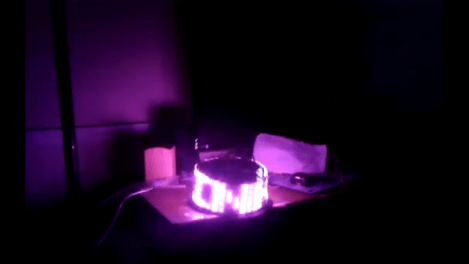
This motorcycle helmet was heavily altered to accept all of the hardware that goes into driving that huge array of LEDs. [Brian Cardellini] built it to wear at burning man. He claims to have been in over his head with the project, but we certainly don’t get that feeling when we see the thing in action. It’s light on build details, but there are plenty of demo shots in the video after the break. The animation and fading action really gets started about a minute and a half into it.

One of the early frames of the video is a shot of the parts order webpage. Since it’s an HD clip we were able to glean a few bits and pieces from that. It includes a MAX7219 LED Display Driver and fifteen 25-packs of Blue LEDs. Now that chip is a great choice, and one of the later shots shows two of them on breakout board driven by an Arduino. The look is very clean since he carved out most of the helmet’s padding to make room for the electronics.

Continue reading “Helmet Of Many LEDs Built For Burning Man”

The Simulacrum, An Innovative Solution To Walking In Virtual Reality

If you’ve been following along with immersive gaming, even casually, you’ve probably considered the difficulty in trying to do a comfortable and believable “walk” in a game. The first thing that usually pops into peoples minds are Omni Directional Treadmills, or ODTs. There are many problems with these, one of the biggest simply being cost. They’re very expensive.

[Zalo] at the MTBS3d forums has been working on his own very cost effective solution called the “Simulacrum”. He has built this for under $100 and it allows for a walking motion to be translated into the game. As you can see in the video below it works fairly well, even when one is out of commission for repairs (hence the limp).

Continue reading “The Simulacrum, An Innovative Solution To Walking In Virtual Reality”

Building An LED Suit

[Rob] has been hard at work designing and building this LED suit which he can wear to parties. He’s got it working, although right now it’s just a pair of pants. It reacts to sound, and has the potential to be controlled from a smartphone via Bluetooth. You’ll find a video description of the build embedded after the break.

The planning started off by selecting driver hardware for the LEDs. [Rob] wanted the suit to pulse to the music in the room so he grabbed an MSGEQ7 chip. When connected to a microphone and opamp this chip will output a signal which can be used as a VU meter. He built the hardware into an Arduino shield, then got to work on the LED driver board. He’s using LED strips, but they’re not individually addressable. Instead he cut loops which wrap around the wearer’s legs. Each loop connects the pins of a TLC5947 LED driver chip which sinks a constant current and offers PWM abilities. He’s using PNP transistors on the high side.

For anyone that’s ever worked in a Tyvek suit before you’ll know they don’t breathe. Sweat will literally be pouring off of you. And we’d bet that’s what cause the short that burned the back of [Rob’s] leg at a recent party. Then again, your light-up pimp coats are going to be hot to wear too.

Continue reading “Building An LED Suit”

Blinking Light Switch

In addition to being a great replacement for that aging eye patch, these specs act as a light switch. By watching your eyelids, they are able to kill the lights whenever you blink.

The installation is a shared experience piece conceived by [Michal Kohút]. He wanted to illustrate the constant blinking we all do but rarely think about. The system uses an Arduino to capture events from the blink sensors and switch the lights accordingly. This way the wearer doesn’t experience a loss of illumination, but the observer does. Check out the video after the break for a quick demonstration.

One of the commenters from the source article shared a video link to another blink-based light project. That one uses electrodes attached to skin around your eye in order to detect eyelid motion.

Continue reading “Blinking Light Switch”