Arduino Code? On My 8051? It’s More Likely Than You Think

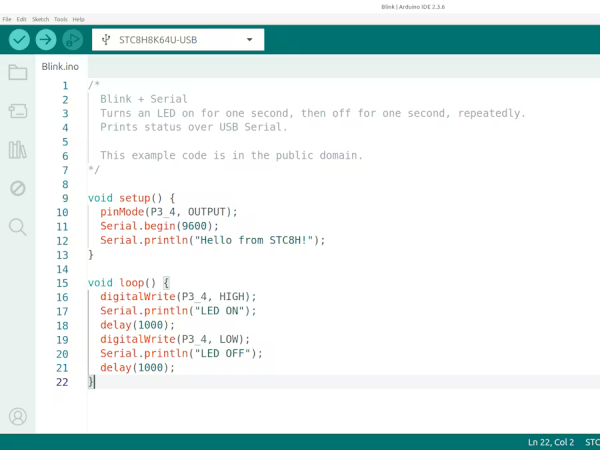
The 8051 was an 8-bit Harvard-architecture microcontroller first put out by Intel in 1980.  They’ve since discontinued that line, but it lives on in the low-cost STC8 family of chips, which is especially popular in Asia. They’re cheap as, well, chips — under 1$ — but lack compatibility with modern toolchains. If you’re happy with C, then you’re fine, but if you want to plus-plus it up and use all those handy-dandy shortcuts provided by the Arduino ecosystem, you’re out of luck. Or rather, you were, until [Bùi Trịnh Thế Viên] aka [thevien257] came up with a workaround.

The workaround is delightfully Hack-y. One could, conceivably, port a compiler for Arduino’s  Wiring to the 8051, but that’s not what [Viên] did, probably because that would be a lot of work. There isn’t even a truly modern toolchain to put plain C on this chip. Instead, [Viên] started with rv51, a RISC-V emulator written in 8051 assembly language by [cryozap]. RISC-V is a lot easier to work with and, frankly, a more useful skill to build up.

Continue reading “Arduino Code? On My 8051? It’s More Likely Than You Think”

Hackaday Podcast Ep 351: Hackaday Goes To Chaos Communication Congress

Elliot was of at Europe’s largest hacker convention: Chaos Communication Congress. He had an awesome time, saw more projects than you might think humanely possible, and got the flu. But he pulled through and put this audio tourbook for you.

So if you’ve never been to CCC, give it a listen!

In the far future, all the cool kids will be downloading MP3s of their favorite podcasts.

Continue reading “Hackaday Podcast Ep 351: Hackaday Goes To Chaos Communication Congress”

Get Roped Into Magnetic Core Memory With This 512 Bit Module

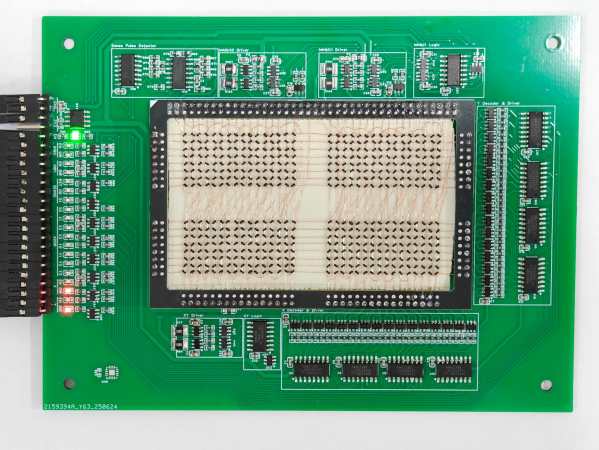
Magnetic Core memory was the RAM at the heart of many computer systems through the 1970s, and is undergoing something of a resurgence today since it is easiest form of memory for an enterprising hacker to DIY. [Han] has an excellent writeup that goes deep in the best-practices of how to wire up core memory, that pairs with his 512-bit MagneticCoreMemoryController on GitHub.

Magnetic core memory works by storing data inside the magnetic flux of a ferrite ‘core’. Magnetize it in one direction, you have a 1; the other is a 0. Sensing is current-based, and erases the existing value, requiring a read-rewrite circuit. You want the gory details? Check out [Han]’s writeup; he explains it better than we can, complete with how to wire the ferrites and oscilloscope traces to explain why you want to wiring them that way. It may be the most complete design brief to be written about magnetic core memory to be written this decade.

This little memory pack [Han] built with this information is rock-solid: it ran for 24 hours straight, undergoing multiple continuous memory tests — a total of several gigabytes of information, with zero errors. That was always the strength of ferrite memory, though, along with the fact you can lose power and keep your data. In in the retrocomputer world, 512 bits doesn’t seem like much, but it’s enough to play with. We’ve even featured smaller magnetic core modules, like the Core 64. (No prize if you guess how many bits that is.) One could be excused for considering them toys; in the old days, you’d have had cabinets full of these sorts of hand-wound memory cards.

Magnetic core memory should not be confused with core-rope memory, which was a ROM solution of similar vintage. The legendary Apollo Guidance Computer used both.

We’d love to see a hack that makes real use of these pre-modern memory modality– if you know of one, send in a tip.

A Single Chip Computer For The 8051 Generation

The Intel 8051 series of 8-bit microcontrollers is long-discontinued by its original manufacturer, but lives on as a core included in all manner of more recent chips. It’s easy to understand and program, so it remains a fixture despite much faster replacements appearing.

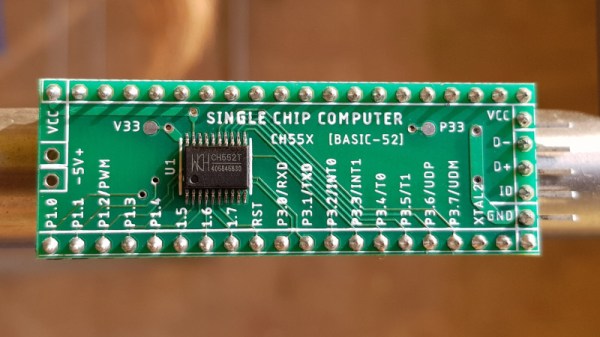
If you can’t find an original 40-pin DIP don’t worry, because [mit41301] has produced a board in a compatible 40-pin format. It’s called the single chip computer not because such a thing is a novelty in 2025, but because it has no need for the support chips which would have come with the original.

The modern 8051 clone in use is a CH558 or CH559, both chips with far more onboard than the original. The pins are brought out to one side only of the board, because on the original the other side would interface with an external RAM chip. It speaks serial, and can be used through either a USB-to-serial or Bluetooth-to-serial chip. There’s MCS-BASIC for it, so programming should be straightforward.

We can see the attraction of this board even though we reach for much more accomplished modern CPUs by choice. Several decades ago the original 8051 on Intel dev boards was our university teaching microcontoller, so there remains here a soft spot for it. We certainly see other 8051 designs, as for example this Arduino clone.

Retrotechtacular: The 1951 Telephone Selector

Telephone systems predate the use of cheap computers and electronic switches. Yesterday’s phone system used lots of stepping relays in a box known as a “selector.” If you worked for the phone company around 1951, you might have seen the Bell System training film shown below that covers 197 selectors.

The relays are not all the normal ones we think of today. There are slow release relays and vertical shafts that are held by a “dog.” The shaft moves to match the customer’s rotary dial input.

Continue reading “Retrotechtacular: The 1951 Telephone Selector”

Give Your Projects A Retro Tint With This 8051-based Arduino Uno

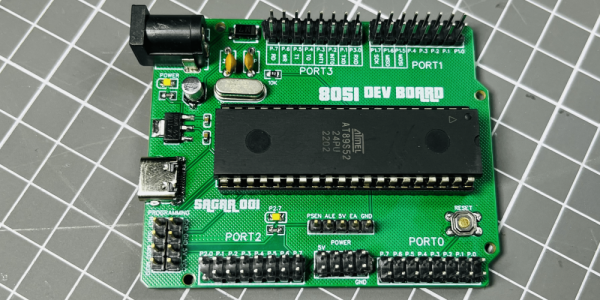
Most of us are familiar with the Arduino Uno, a starting place for electronics projects since 2010. But what if the Arduino Uno was released in 1980? You’d probably get something like [ElectroBoy]’s 8051-based Arduino Uno.

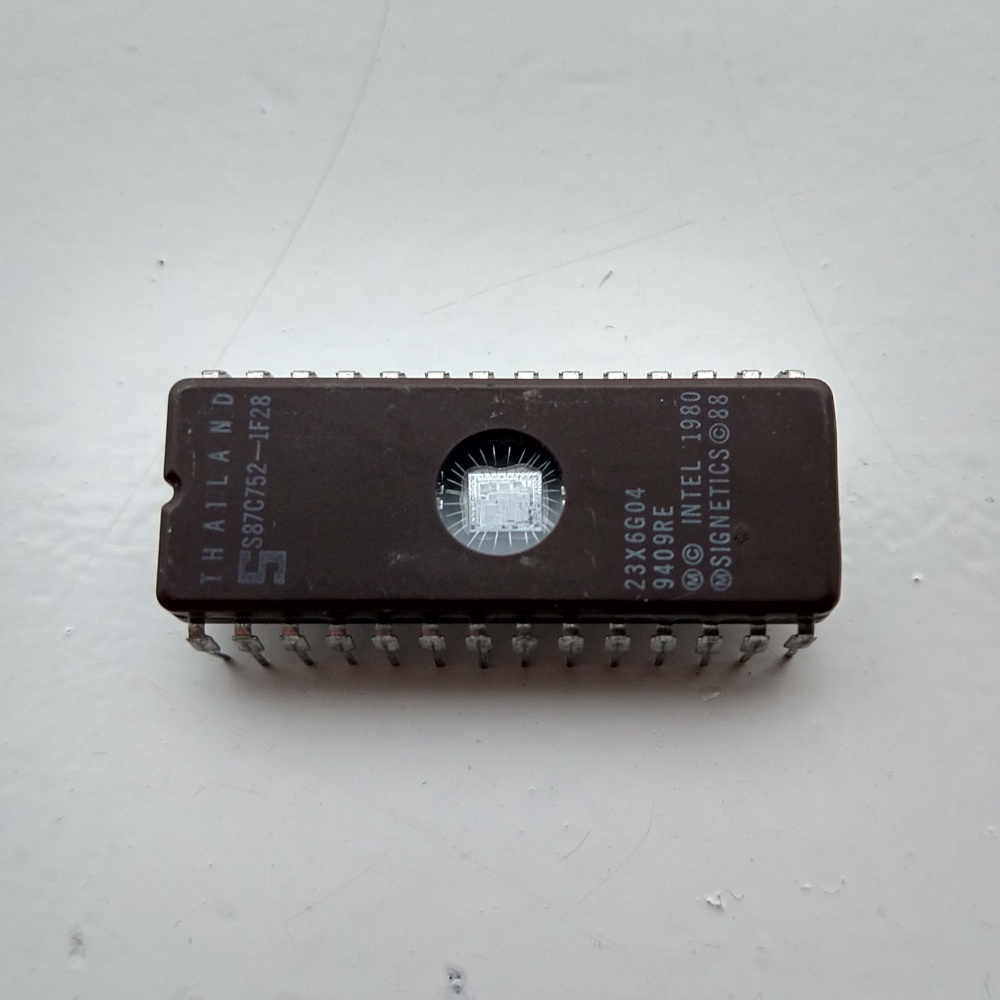
28-pin DIP integrated circuit with a window revealing the die
Close-up shot of the 87C752, an 8051 with EPROM

The Arduino Uno-compatible board has an MCS-51 (often called 8051 instead) instead of the usual ATmega328P/ATmega168. Specifically, [ElectroBoy] uses the AT89S52. Like the ATmega microcontrollers, the AT89S52 has an 8-bit CPU with a Harvard architecture and very similar GPIO capabilities. Unlike the ATmega, however, the original MCS-51 has a CISC CPU (as opposed to ATmega being RISC) and a release date about 36 years earlier.

The board itself also has some differences from the original Arduino Uno. First of all, it has a USB type-C port, which is definitely a bonus. Secondly, it’s simpler: No USB-UART (which also means no USB programming), a different pin layout (Arduino shields likely won’t fit) and more I/Os than the ATmegas have. Sure, it’s not as practical as an actual Arduino Uno, but it’s definitely cool for our retrocomputing nerds.