Qube Robots Use Well-designed Laser-cut Acrylic

These robot cubes, called BOXZ, use an interesting interlocking part design to mount and protect the parts within. But to really make them pop you need to color and apply your own papercraft skins.

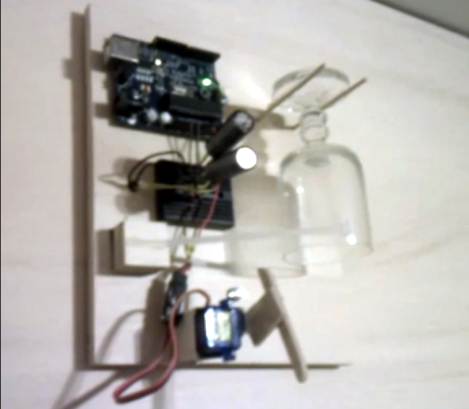
The actual hardware is quite simple. They’ve used an Arduino, along with motor driver and Bluetooth shields, to control a set of geared DC motors. There’s a battery pack which holds four AA cells and a pair of servo motors which seem to be there to act as arms. This base can then be adorned with sensors to add functionality (line following, wall following, obstacle avoidance, etc.).

Despite the simple appearance of the cube, the chassis is the most complicated part. It uses sixteen pieces of acrylic, but they may also be hand cut from cardboard by printing out templates and gluing them onto the material. The parts are designed with interlocking tabs which we often see used on laser-cut wooden box parts.

We’ve embedded the video presentation of BOXZ after the break.

Continue reading “Qube Robots Use Well-designed Laser-cut Acrylic”

Scrolling Tweets With A WiFi LED Matrix

For his most ambitious build to date, [Param] thought it would be a cool idea to have a LED matrix display spitting tweets out via a WiFi connection. The build is now done, and we’ve got to hand it to him for a very nice build.

The build is based on an Arduino with a Sparkfun WiFi shield providing the network connection. The Arduino pings a Javascript app that pulls down tweets from The Verge and displays them on an 8×8 LED matrix display.

What makes [Param]’s build so cool is its portable nature; the entire device is completely wireless, getting its power from a Sparkfun LiPower shield  and an apparently extremely capacious LiPoly battery.

With a rat’s nest of wires hanging out the back of the LED display, [Param]’s build is crying out for a proper enclosure, but even given that it remains a quality project. You can see a video of the WiFi’d Twitter display after the break.

Continue reading “Scrolling Tweets With A WiFi LED Matrix”

Helmet Of Many LEDs Built For Burning Man

This motorcycle helmet was heavily altered to accept all of the hardware that goes into driving that huge array of LEDs. [Brian Cardellini] built it to wear at burning man. He claims to have been in over his head with the project, but we certainly don’t get that feeling when we see the thing in action. It’s light on build details, but there are plenty of demo shots in the video after the break. The animation and fading action really gets started about a minute and a half into it.

One of the early frames of the video is a shot of the parts order webpage. Since it’s an HD clip we were able to glean a few bits and pieces from that. It includes a MAX7219 LED Display Driver and fifteen 25-packs of Blue LEDs. Now that chip is a great choice, and one of the later shots shows two of them on breakout board driven by an Arduino. The look is very clean since he carved out most of the helmet’s padding to make room for the electronics.

Continue reading “Helmet Of Many LEDs Built For Burning Man”

16×8 Pixel Laser Projector

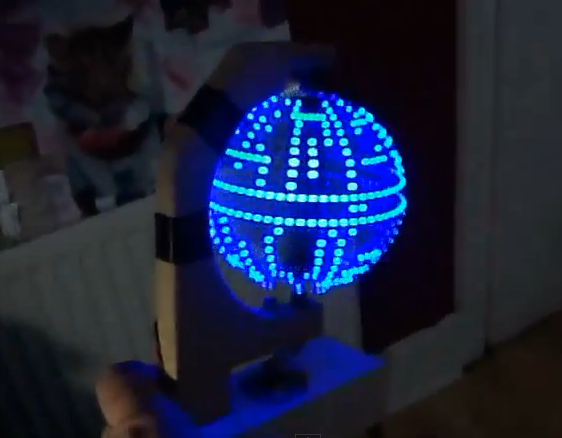
[Michiel] gave us a little shout-out by drawing the Hackaday logo with his recently completed 16×8 pixel laser projector. It uses a spinning set of mirrors mounted at slightly different angles to redirect the path of the red laser diode.

The projector is driven by an Arduino. To give it more than just a hard-coded existence [Michiel] included an Xbee module. This lets him connect to it with a computer in order to stream messages. One of the demo videos linked in his project log shows the web interface he coded which will push a message typed in the submission form out to the projector where it is scrolled like a marquee.

This type of spinning display is one of a few common methods for making laser projectors. In the image above you can see the optical sensor which is used to sync the diode with the spinning mirrors, each of which is responsible for a different row of pixels. He lists off several things that he learned when working on the project. We think the most important is the timing issues which go into something like this.

Bits And Pieces Robotic Arm

[V0R73X], who is 17  has been working on a project, to build A robotic arm. This project started out as a challenge put forward from one of his school teachers to build a robotic arm for $200.  [VoR73X] accepted, and the challenge began.

He came up with a robotic arm that can be controlled from his mobile phone and other bluetooth enabled devices. He also designed it so that he can control it from the infrared remote control of an old tv set. [VoR73X] decided to kept the design simple, to make it easy for others to build.  [VoR73X] has shared the code and a step by step process of how to build in the hopes that others would also like to take up the challenge.  Watch the video after the break for further details on his project.

via[Instructables]

Continue reading “Bits And Pieces Robotic Arm”

Genetic Research On The Cheap

When you think of DIY hardware, genetic research tools are not something that typically comes to mind. But [Stacey] and [Matt]’s OpenPCR project aims to enable anyone to do polymerase chain reaction (PCR) research on the cheap.

PCR is a process that multiplies a specific piece of DNA a few million times. It can be used for many purposes, including DNA cloning and DNA fingerprinting for forensics. PCR is also used for paternity testing.

The process involves baking the DNA at specific temperatures for the right amount of time. The DNA is first denatured, to split the helix into individual strands. Next, the temperature is lowered and primers are bound to the strands. Finally, another temperature is used to allow the polymerase to duplicate the DNA. This process is repeated to multiply the DNA.

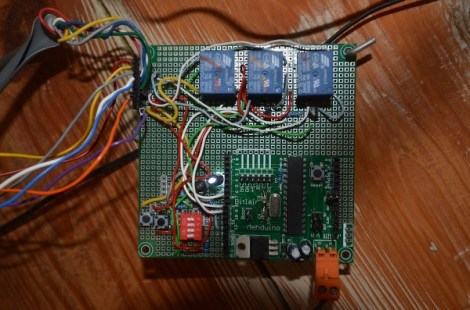
The OpenPCR uses an Arduino to control a solid state relay. This relay provides power to two large resistors that act as heaters. A MAX31855 is used to read a thermocouple over SPI and provide feedback for the system. A computer fan is used to cool the device down.

A milled aluminium sample holder houses and heats the samples during cycling. The laser cut, t-slot construction case features some helix art, and houses all of the components. It will be interesting to see what applications this $85 PCR device can perform.

Via Adafruit

3D Games For The Arduino With Raycasting

For all the Arduino-based video game builds we’ve seen, we’re really only left with a bunch of 2D platformers and other sprite-based games. [Reimecker] wasn’t satisfied with this level of computational complexity, so he ported the 3D game engine made famous by Duke Nukem 3D to the Arduino (German, Google translation).

[Reimecker]’s project is based on the very popular Build Engine written by [Ken Silverman] and used in games such as Duke Nukem 3D,  Shadow Warrior,  Blood, and TekWar. The Build Engine can be used to make a first person shooter, but more on the level of Wolfenstein 3D instead of Half-Life.

The hardware [Reimecker] used is a regular ‘ol 8-bit Arduino with an attached LCD touch screen displaying 320×240 pixels of a ray cast environment. From the videos of the build (available after the break), [Reimecker] has a fairly decent game engine capable of displaying a 2.5D environment. The frame rate might not be very high, but it’s still an amazing build considering the hardware [Reimecker] is working with.

Continue reading “3D Games For The Arduino With Raycasting”