Web Controlled Sprinkler Automation

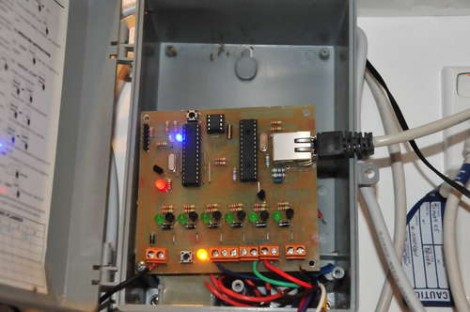
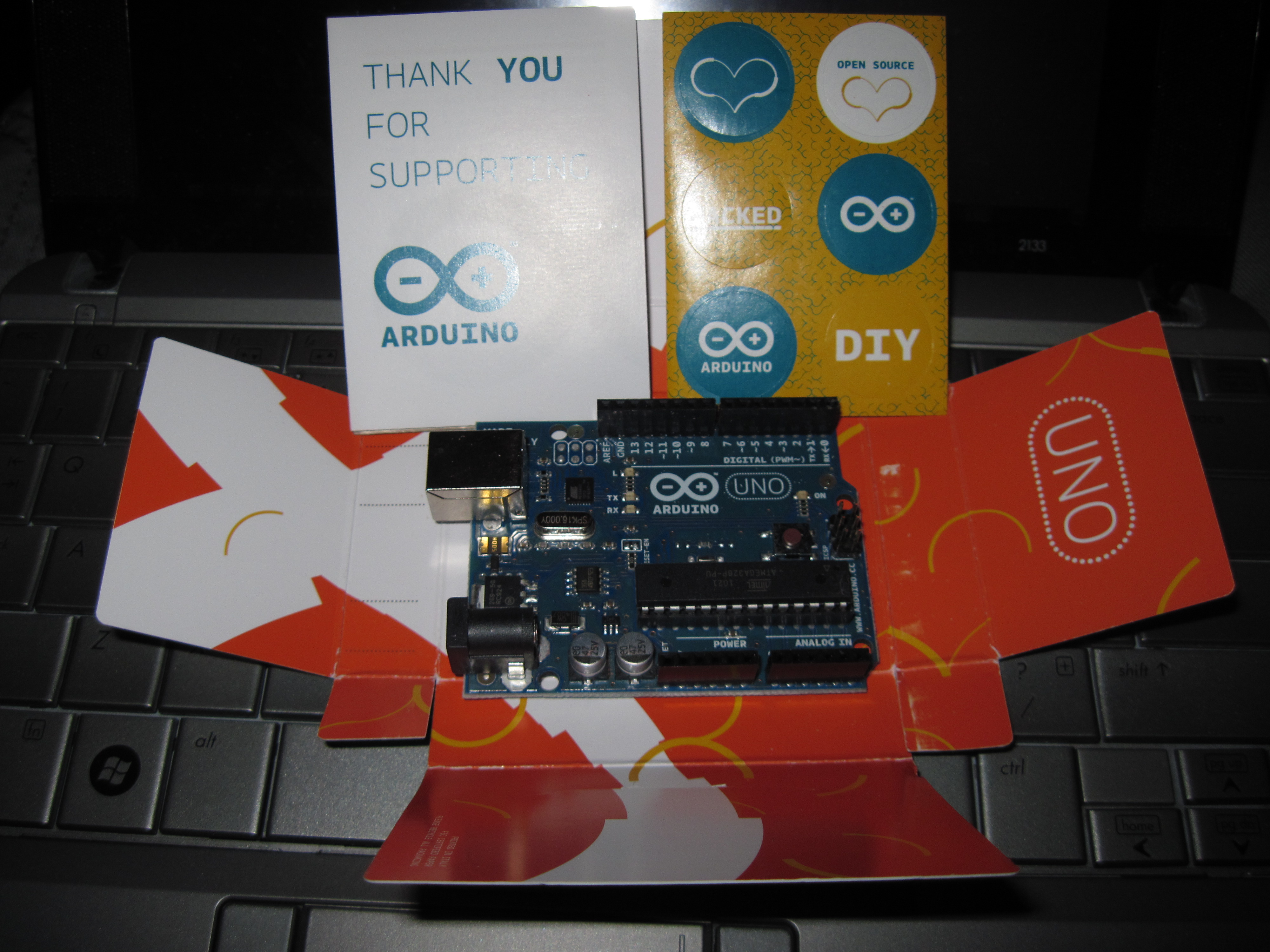
[Doug] needed to update his watering system to comply with his city’s new water saving ordinance. The old system wasn’t capable of being programmed to water only on even or odd calendar days. Rather than purchase a replacement he decided to build his own sprinkler controller. It needed to switch 12V solenoids, a job that’s not too hard to design for. Rather than re-invent the wheel, he modified a previous controller design. It is basically an Arduino and Ethernet shield on a his own etched board. In addition to the ATmega328 and an ENC28J60 (for ethernet connectivity) there is a bank of transistors to drive the watering solenoids. Now he has a web interface that controls the watering schedule and is fully in compliance with the new city code.

If you need another way to save when watering your grass you should take a look at the sidewalk-avoiding sprinkler.

5 Tones, 1 Arduino

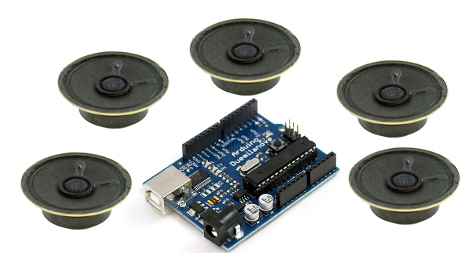
Because the Arduino is in such high demand for producing multiple musical tones at the same time; [Jeremy Blum] has successfully figured out the math and other necessaries that will take your once previously single tone producing MCU and turn it into a 5 tone producing machine. unsurprisingly its really just some creative use of PWM control but it all works out in the end anyway and helps prevent you from purchasing additional sound generating chips. This truly does open up some new doors, as [Jeremy] shows with his still in production thingamakit like project: ReacXion.

LEGO Host For All Of Your Prototyping Projects

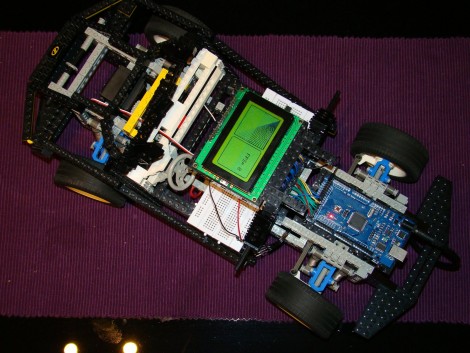
[Deadbird] decided to use a LEGO 8880 Super Car as a host for all of his electronic tinkering. Throughout his blog (translated) you’ll find the vehicle with an Arduino MEGA interfacing various prototyping bits. It starts with the motors for locomotion, closely followed by a servo for steering. From there we see the addition of a breadboard and graphic LCD screen. So far he’s worked out the use of a PS2 keyboard as a controller and, most recently he’s interfaced a Wii Nunchuck.

We’re more used to seeing NXT kits adapted for wider use, but if you’ve got a nice kit like this one it makes a great base onto which you can add your own robotic elements.

Web Controlled Watering Can

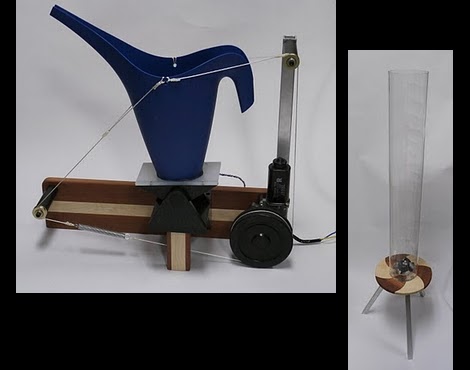
Here’s a watering can and water vortex that are controlled with a webkit browser interface. The interface displays a drawing of the watering can on your browser. If you grab one of the handles on the circle around the image and move it, the can will rotate as well.

Okay, so this isn’t going to change the world and actually presents a fairly useless watering setup. But [Ben] seems to be a master of fabrication and that’s what we appreciate in this build. The watering can is solidly mounted and moves fluidly with seemingly little effort from the motor. He uses a spring to keep the rope loop taut, sourcing a castor wheel and automotive power-window motor to provide the motion. The hinged base on which the can sits has a potentiometer in it, used to measure the current position of the watering can. Remember these techniques as they’ll come in handy in your future builds.

There’s also a little bonus at the end of the video after the break. We wondered what [Ben] might use that power drill controller hack for. Looks like it makes an appearance in his water vortex work.

Continue reading “Web Controlled Watering Can”

Easy Quadrotor Helicopter Instructions

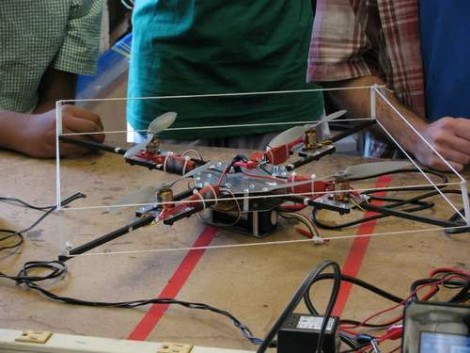
Here’s a great tutorial on building your own quadrotor helicopter. This build isn’t necessarily less expensive than others we’ve seen since quality motors, propellers, and control circuitry aren’t cheap. But the design and assembly is well documented and presents a well-planned building procedure. The carbon-fiber tubes that make up the frame have extensions to protect the motors and propellers in the event of a crash. The Arduino, IMU, and transceiver are all tucked away between two aluminum body plates as well. They only thing missing is a solid methodology for tuning the four motors, a critical procedure that is just touched up at the end of the article.

Equinox Clock

The Equinox clock is made up of simple parts but a combination of fine design and precision make it a gem of a timepiece. The guts are made up of an Arduino, a DS1307 real time clock, twelve LED drivers, and sixty RGB LEDs. These combine with a capacitive touch interface to tell the time using three lit blocks for the hours, one for the minutes, and a fading block for the seconds. See for yourself after the break.

To our delight, [Bram Knaapen] shared the specifics of the case. The black ring that makes up the body was laser cut and spray painted. He uses small blocks of acrylic that have been sandblasted to diffuse the light. This is also a great example of clean circuitry using interconnects between the different circuit boards.

We always enjoy seeing clocks no matter what level of finish is involved, but great design is something that makes us want to hang a project on the wall rather than stow it in a parts bin.

Continue reading “Equinox Clock”

Using An NES Controller On An Android Phone

[Sk3tch] rigged up a way to use an original NES controller with Android. He bought the controller and a breakout board for it at DEFCON. By combining the controller, an Arduino, and a blueSMIRF BlueTooth module the controller can be used as a keyboard on his Android device. In the video after the break he demonstrates pairing the devices and playing Super Mario Bros. 3 in an emulator.

He calls this Alpha quality but it certainly looks like it works well. In the beta version we’d love to see all of the extra electronics inside the controller case like those USB mods.

Continue reading “Using An NES Controller On An Android Phone”