Spy On Your Office

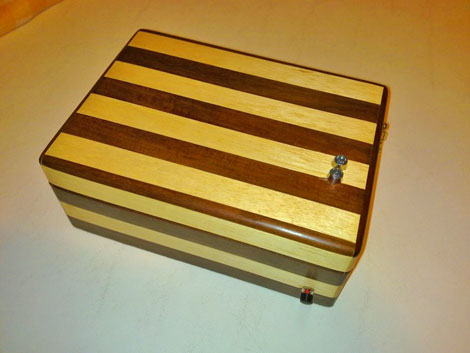
[Garagedeveloper] sent us his custom surveillance system, part 1, part 2, and part 3 after needing a way to find out why some cables at work were becoming unplugged (spoiler, the cleaners were messing up the wiring). At the base of the system is a web cam glued to a stepper motor. However, it gets much more in depth with a web front-end that allows the user to stream the feed and control the position of the stepper. We’re not particularly fond of how many different parts the project takes, while it all could be accomplished under C# with ASP.NET and parallel port library instead of including Arduino and excess code, but to each their own and the project turned out a success anyway.

Max/MSP Accelerometer Beat Control

[vimeo http://vimeo.com/8222312%5D

[Ryan] let us know about his Max/MSP Controller. Inside the device is an ADXL 335 accelerometer and 6 push buttons wired to an Arduino. The input data is sent to Max MSP, a sequencer controlling 5 audio tracks, correlating to 5 of the buttons. The 6th button controls delay. What we really liked was how the accelerometer modified the speed of the beat in the X-axis, and the delay intensity with the Y-axis. Whats next? We think gesture recognition might be something fun to try, but [Ryan] is unsure. We’ll keep you up to date.

Arduino I/O Speed Breakdown

[Jee Labs] has worked out how long it takes for an Arduino to perform various I/O operations. Predictably, analogRead() takes the longest, followed by analogWrite(). Arduino really falls behind when it comes to digital pin I/O: digitalWrite() takes a whopping fifty times longer than a direct bit write to a port register!  This is something to take into consideration when you are looking to do some beefy I/O with an Arduino. Perhaps this I/O performance will be addressed in the future with Arduino 1.0.

Qube, Not An Arduino Clone

What allows the everyday user to tinker with microcontrollers, IO, interrupts, serial communication, and even analog readings? How about individual modules that add the ability to communicate over bluetooth or add LCD support? If you were thinking Arduino, you would be wrong. It’s actually [Nilok’s] Qube, which at first seems like another Arduino clone however the Qube is based on PIC – not AVR. Another difference is the sweet black anodized case the Qube is planned to be put in.

While all this seems amazing at first, there is of course a catch – it looks like the first models are pre-order only for staunching price of $70! Sorry, but Arduino wins at half the cost.

Regardless, [Nilok] has documented the entire process and it’s amazing to read through; he even includes some guides on solder paste and bootloading USB. And who knows, maybe he’ll release open source. His site seems a little slow, we recommend the Google Cache.

Arduino Headed For One Point Oh

In a recent blog post, [Massimo] stated that there will be some stabilizing changes coming for the Arduino platform. The API, IDE, and even the website are targets for the Arduino team’s New Year’s resolutions to bring Arduino to 1.0. This platform is often seen at the core of projects we cover and many that we do not or should not cover. It has come to wide use because it has a better price point to other starter development boards, easy to use with a large user base for support, extensive hardware options with much of the coding already in libraries, and a cross-platform, open source tool-chain that can run just about anywhere. Many people that hate the Arduino, hate it because it is so easy to use. Anyone can get an LED to blink with an Arduino even though there are far more (and far less) elegant solutions. Love it or hate it, Arduino has made a significant impact and the coming changes should help keep it be around for quite some time. Let us look back, how has Arduino affected you?

Twitter Based Christmas Ornaments Update

When we introduced you to the Twitter Christmas tree ornaments, sadly we had very little information about the project. Luckily [Rob] made contact and clued us in on the inner workings. It even turns out we were wrong about the usage of Arduinos! We invite you to check out all the juicy inner workings after the break.
Continue reading “Twitter Based Christmas Ornaments Update”

TF2 Kill Counter, Binary Style

[youtube=http://www.youtube.com/watch?v=d7Pft-GPQWU]

After getting some fun new toys for Christmas, [IceColdFreezie] set up this kill counter for Team Fortress 2. At first glance, we weren’t that impressed. It’s an Arduino and a few LEDs. Then we saw that it was counting the kills in binary. We’re not sure if it gets much geekier than that. You can download the source code and try it out yourself. Just don’t make more than 31 kills.

[via littlebirdceo]