Simple Household Status System

The-Household-Informer

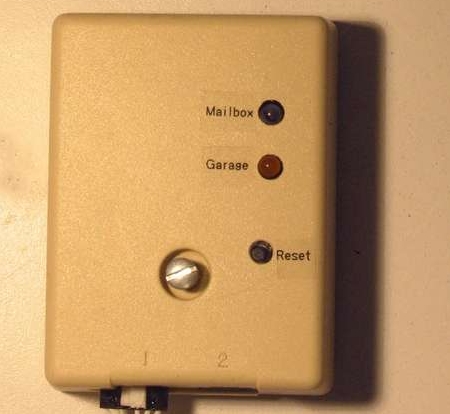
[BrianH] decided that he no longer wanted to venture outside on cold or rainy days just to check if the mail had come, so he built himself a notification system that would alert him if the postman had stopped by. Additionally, he admits to being forgetful on occasion and wanted a way to monitor whether or not he forgot to close the garage door. His Instructable details how he accomplished both of these tasks with the household monitor he built around an ATmega168. His project uses a mailbox mounted photoresistor to determine when the mailbox has been opened, and a reed switch that is triggered when the garage door has been opened. If either of these things occur, a beep is emitted from his notifier, and the appropriate status LED is lit. Simply monitoring whether the garage door has been opened is not all that helpful, so he programmed his notifier to beep persistently at 10-minute intervals if the garage has been left open for more than an hour.

His hack is pretty useful, but he does mention that there is an inordinate amount of wiring that needs to be laid, citing his driveway repaving as a great opportunity to do so.
Voice-controlled Rolling Robot

rolling_voice_controlled_robot

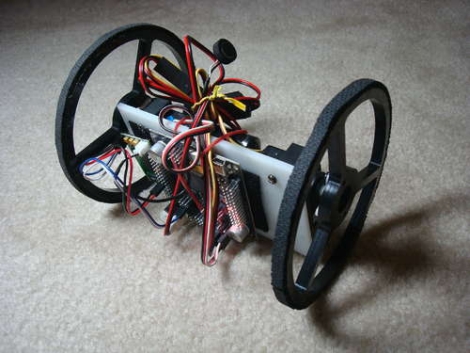
[societyofrobots] recently posted an Instructable on how to build a voice controlled robot in just a few hours time. This robot isn’t particularly cheap, weighing in at about $230, but it is a fun project if you have the means. The bot is driven around by a pair of servos, taking their directions from an Axon II MCU. A VRbot voice recognition module is used to listen for commands, enabling the user to record up to 32 custom triggers for directing the robot.

All of the source code for the robot is included, as well as instructions on how to get started programing the microcontroller. The code provides some basic functionality, but there’s likely plenty more that can be done with the powerful on-board ATmega460. While this robot would make for a great beginner/intermediate project as-is, it should be noted that [societyofrobots] manufactures and sells the Axon II, so this Instructable is half guide/half self-promotion. Have any of you had experience with the Axon II? Let us know what you think.

Keep reading to see a video of the build process as well as the robot doing its thing.

Thanks, [Bill Porter].

Continue reading “Voice-controlled Rolling Robot”

Rechargeable Battery Capacity Tester

Rechargeable-Battery-Capacity-Tester

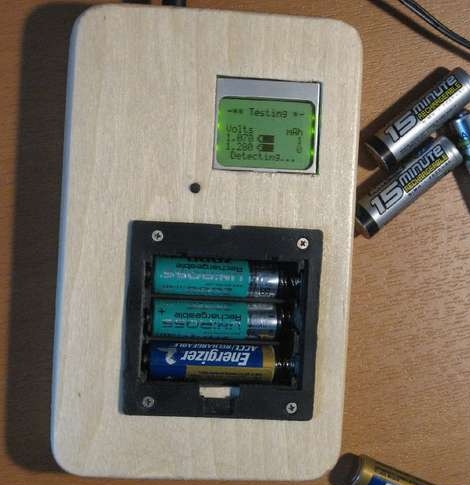
If you are like most people, you likely have a mixed pile of rechargeable batteries sitting around with no idea as to what kind of charge they can hold. You could watch a voltmeter for a few hours while you drain each and every battery, noting when it drops below its stated voltage – but then again, you have a life.  Instead of wasting away in front of his multimeter, [BrianH] decided he would build an automated battery capacity tester to do the job for him.

He created a simple circuit that drains any AA battery, NiMh or NiCd, and records its useful capacity in milliamp hours.  Since the ATMega168 microcontroller used has 6 analog/digital converters on board, he figured that he might as well design his tester to measure the capacity of three batteries simultaneously.  [BrianH] wired the meter up to an old Nokia LCD, then moved his project to a perfboarded ATMega, freeing up his Arduino for other tasks. Once he had things reassembled, he packed it all into a handsome wooden box.

His writeup is chock full of details and source code, so be sure to check it out.  We have video of the charger in action after the jump.

Continue reading “Rechargeable Battery Capacity Tester”

STK200 Pocket Change Programmer

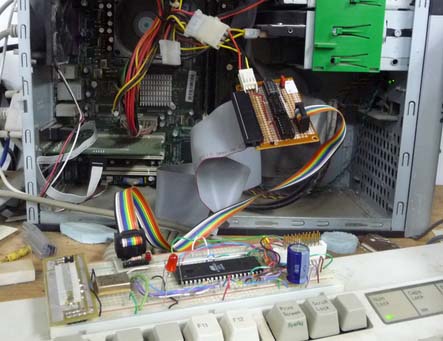
A common complaints of beginners to microcontroller programming is the availability of DIY tools that do not require a parallel port.  Using not much more than a couple of 74xx series chips and some protoboard, [Rue] was able to create an AVR programmer for less than the cost of some chips it can program – giving parallel programmers a run for thier money. [Rue] used Linux treat the ubiquitous PATA/IDE port as a parallel port. By having avrdude treat the programmer as an Atmel STK200, [Rue] was able to upload a blinky program to his AVR microcontroller through ISP. If anybody can think of an even lower cost unconventional solution give us a shout.

Roll The D’Icey

Most of the dice related hacks we run into have to do with pseudo random number generation, but today we saw something different. This sleek looking jumbo die is actually a prize holding box opened by a secret sequence of rotations. Using an accelerometer and an ATmega 328 with a sub-micro servo to control the locking mechanism. Worried about the batteries going flat and losing your treasure indefinitely? Good news! The batteries are accessable without giving away the secret inside.

It also turns out that this is an update to an earlier project from the same laboratory, so be sure to check that out as well to see where this build came from. Code is available for anyone looking to make their own, as well as a useful parts list.

[via Hacked Gadgets]

Connecting A Nokia 3310 LCD Using An AVR

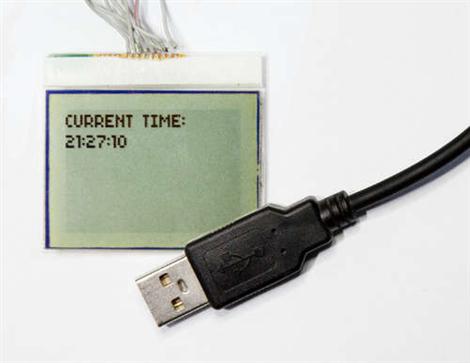
In this instructible, [wkter] takes us through the process of running a Nokia 3310 LCD display using an ATmega8.  This instructible isn’t a beginners project as he assumes you already have a strong understanding of how to work with these components and their programming languages. He is very thorough with information though, providing datasheets, pinout diagrams, and source code. Once you get this down, you could go a little further and make  Conway’s game of life.

Magically Repair AVR Chips

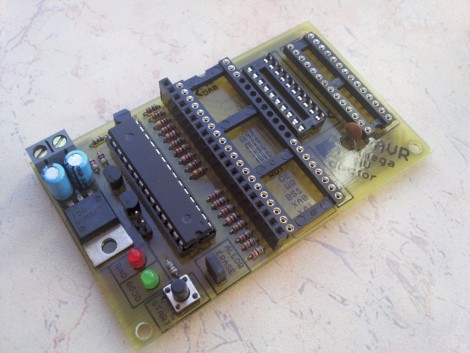
If you’ve ever spent time working with AVR microcontrollers you’ve probably set the fuse bits incorrectly at least once. The ATmega fusebit doctor will automatically repair the fuse bits and get you back in business until your next mishap. The ATmega8 that powers the device has the chip signatures for the ATmega family stored inside so it will automatically detect which chip you’re trying to ‘unbrick’. From there it looks up the correct fuse bits and resurrects the sick microcontroller. This is useful in recovering a chip that has serial programming disabled, used the reset pin as I/O, or just enabled an external clock without the necessary hardware to deliver on that feature.

This magic is taken care of by using High Voltage Parallel Programming. We’ve seen HVPP used in the Arduino rescue shield and it is a valuable feature of the AVR Dragon, our favorite AVR programmer, as well as others. Still, you can hardly beat the ease of plugging a dead chip into this board and pressing one button. Oh, did you brick a member of the ATtiny family? There’s a rescue board for those too.

[Thanks Stewe]