LAMEBOY Is Handheld Gaming On The ESP8266

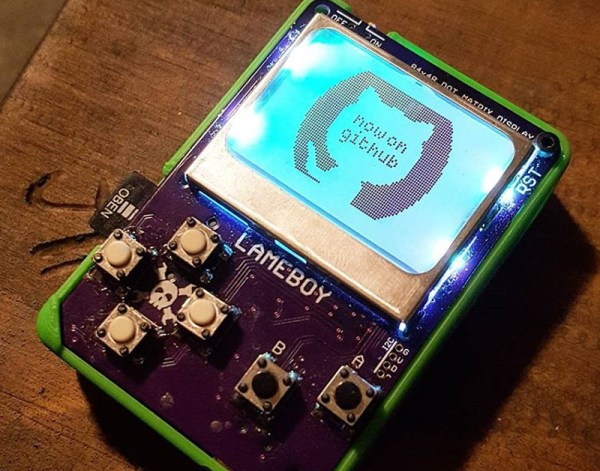
We’ve had our eye on [davedarko’s] LAMEBOY project for a while now, a handheld setup in roughly the same form factor as the classic Nintendo Game Boy. It’s remarkable how approachable portable electronic design has become, and that’s really what makes this interesting. The design is beautiful, and the closer you look, the more respect you have for what [dave] is doing.

Right now his proof of concept has a 3D printed enclosure whose face is the printed circuit board. We love how the lower left corner of the PCB slips under a pocket in the case, which makes it possible to use just one screw to secure the two together in the upper right.

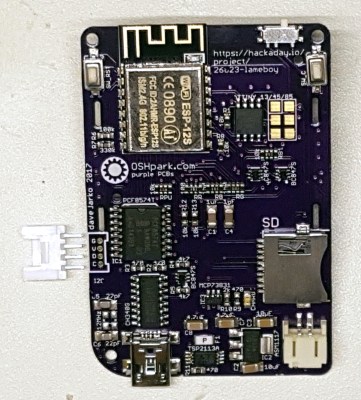
The LAMEBOY is built around an ESP8266 module. Anyone who has used one knows this chip contains a fair amount of horsepower, but very little I/O. [Dave] has a lot going on with an LCD screen, six user buttons, a USB to I/O chip, and an SD card slot. He took two approaches to solve this dilemma. First he grabbed a PCF8574 port expander, and second he’s offloaded the color control of the screen backlights to an ATtiny85 (running a BlinkM clone).

Below you can see some early game tests on the perfboard prototype. We haven’t seen game play on the most recent prototype (there is a screen color test video in his latest project log) but it sounds as though [dave] plans to make use of the Gamebuino framework. This should mean that there will be no shortage of cool ROMs to load.

Continue reading “LAMEBOY Is Handheld Gaming On The ESP8266”

Customizable PCB Business Card

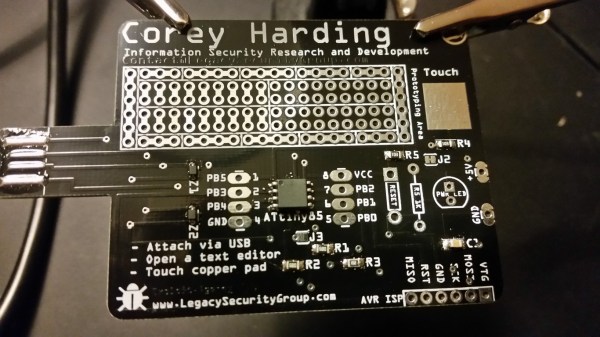
[Corey Harding] designed his business card as a USB-connectable demonstration of his skill. If potential manager inserts the card in a USB drive, open a text editor, then touches the copper pad on the PCB, [Corey]’s contact info pops up in the text box.

In addition to working as a business card, the PCB also works as a Tiny 85 development board, with a prototyping area for adding sensors and other components, and with additional capabilities broken out: you can add an LED, and there’s also room for a 1K resistor, a reset button, or break out the USB’s 5V for other uses. There’s an AVR ISP breakout for reflashing the chip.

Coolly, [Corey] intended for the card to be an Open Source resource for other people to make their own cards, and he’s providing the Fritzing files for the PCB. Fritzing is a great program for beginning and experienced hardware hackers to lay out quick and dirty circuits, make wiring diagrams, and even export PCB designs for fabrication. You can download [Corey]’s files from his GitHub repository.

For another business card project check out this full color business card we published last month.

Mini Tetris Game Packs A Tiny85

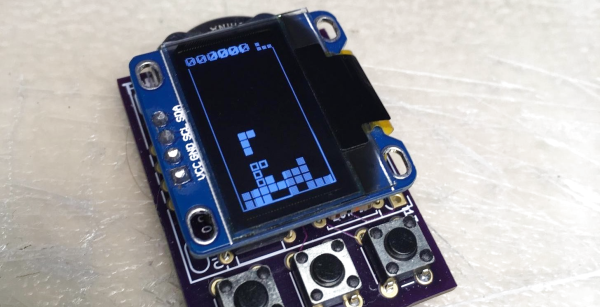
[dombeef] originally built pocketTETRIS as a Father’s Day gift for his Tetris-loving pops. However, having finished the project he’s decided to share it with the universe, and it’s looking rather sweet.

He made the game the smallest he could make, with size limitations imposed by a 0.96” OLED display, the coin-cell battery pack, and his desire for a durable 3D-printed case. It uses a ATtiny85 for the brains, mounted on a custom PCB that [dombeef] designed in KiCad. The Arduino code was modified from Andy Jackson’s ATtinyArcade code, giving it three-button capability instead of two. [dombeef] has details on the project page on Hackaday.io as well as 3D-design and PCB-design files on the project’s code repository on GitHub.

We’ve published a fair number of Tetris posts in the past, including skyscraper Tetris, playing Tetris on a soldering iron, and Tetris in 446 bytes. What’s the smallest Tetris you’ve seen?

Ambitious ATtiny85 Board Tests A Beginner’s Skills

[Chris O’Riley] has been playing around with Arduinos for around a year, and decided he wanted a breadboardable ATtiny85 in order to prototype using the actual controller that would be used in the final project. He wants to use it to interface with a Bosch BMP280 pressure sensor, but for now it stands alone.

It’s a simple board with the Tiny85, 3.3 V and 5 V regulators, a power LED, as well as the usual resistors and caps [Ed: not resistor sand caps]. The double-sided PCB [Chris] milled himself — he’s an illustrator and photographer by day, so it’s no surprise the board turned out gorgeous. He designed the board in Illustrator after taking a stab at Eagle, then ran it through his CNC to mill the circuits using a .017 inch end mill as well as drilling the vias. He add solder paste using the tip of a knife, but after messing around with an iron, he ended up investing in a hot air rework station.

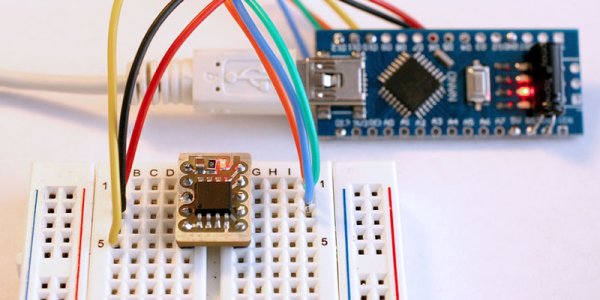
We love our Tiny85s here on Hackaday. Check out the ATtiny85 gaming console, the NTSC-generating ATTiny85, and making DIY I2C devices with the chip.

Antique Pinball Machine Lives As Clock

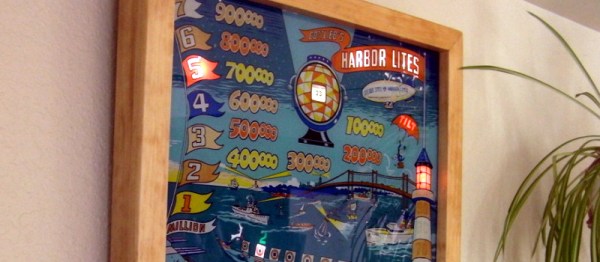
A big problem with restoring old arcade or pinball machines is finding original parts to get them running again. That’s part of the fun, though; when something finally works after weeks or months of effort. On the other hand, sometimes the only hope for old parts that will never be in a pinball machine again is for [Randy] to come across them. One of those parts he had lying around was a backglass for an old machine, and decided to turn it into a unique word clock.

The original pinball machine was built in 1956, and despite its age the backglass had almost no signs of wear or damage. There are 43 lights on this particular machine which is more than enough for 12 hours, minutes (by the 10s), seconds, and a few extras. An ATtiny85 serves as the controller and drives a fleet of Neopixels hidden in the display. There are also three buttons which control the brightness and allow the time to be set.

Be sure to check out the video below of this one-of-a-kind clock in action. A lot more went into this build as well including framing the glass, giving it a coat of paint and polish, and programming the clock into the microcontroller. Old backglasses from pinball machines seem to be relatively popular to repurpose into more conventional clocks, too, even clocks of an atomic nature.

Continue reading “Antique Pinball Machine Lives As Clock”

Copper Foil Makes Music–With A Little Help

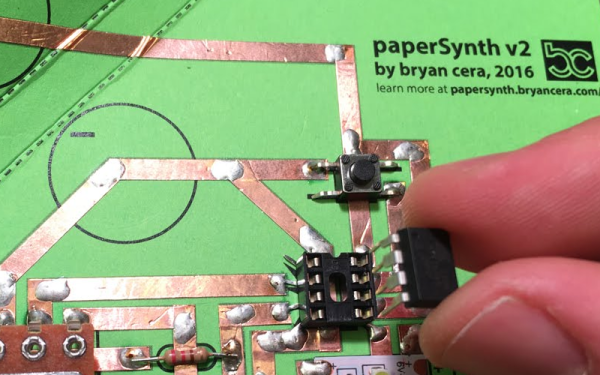
Craft stores are often the source of odd inspiration. In the stained glass section, we’ve seen the copper foil, and even used it to prototype some RF circuits on the tops of shoeboxes. However, we could never get a good method for connecting ICs to the relatively thick foil. [Bryan Cera] did it though. His paperSynth uses some paper and cardboard for a substrate, copper foil, and an ATtiny CPU to make music. You can see the device in operation in the video, below.

The copper foil is sticky and it isn’t conductive on the back, so anywhere the foil is supposed to touch, you need a blob of solder. We wouldn’t trust the insulation by itself to cross wires, but with a bit of insulating material between–a piece of paper or electrical tape, for example–you could probably cross with impunity. For an RF circuit, you might even make low-value capacitors like that.

Continue reading “Copper Foil Makes Music–With A Little Help”

Hackaday Prize Entry: Breathe Your Troubles Away

Navy SEALs and other highly trained special forces operators all know a simple, basic fact – you’ve got to breathe to live. That seems self-evident, but breathing control is immensely important to being able to perform at a high level in stressful situations. But even if you never anticipate being under fire, you can learn the SEAL way of breathing with this visual aid.

Lest you think that Box Breathing, also known as the four-square breathing technique, is some sort of New Age nonsense, recent research has uncovered the neurological basis for the feeling of calm that can come over someone taking slow, deep, even breaths. But in the heat of the moment, remembering to square your breaths can be a little difficult. [Lim Han Yang] decided that a portable visual cue could help, so he put an ATTiny85, an LED, and a coin cell battery on a tiny circular PCB and spun up a simple translucent dome out of PLA. The blue LED has a soothing appearance behind the diffuser as it goes through a 16-second cycle, ramping up in brightness for four seconds, holding steady for four, then dimming and finally staying dark. The idea is to breathe in sync with the light to get relief from stress.

No build files are posted yet, but we hope to see them soon – we can think of a few people this would benefit greatly. In the meantime, if you’re still looking for that New Age breathing experience, you can always breathe with the psychedelic flowers.