Motorcycle Lighting Upgrade Ensures Other Drivers Know You’re There

led-brake-lights

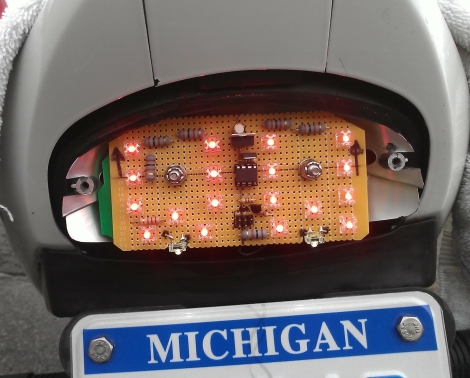
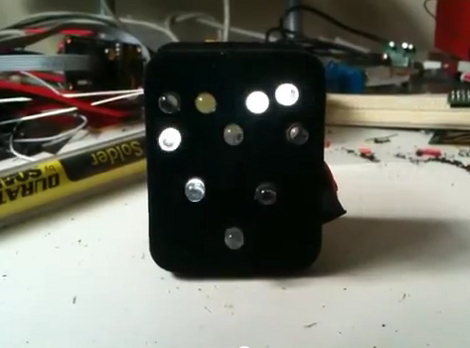
[Pete Mills] recently bought himself a motorcycle, and as people are known to do, they start trying to scare him with gruesome stories of cycling accidents once they hear about his purchase. While he tries to shrug them off as people simply not minding their own business, something must have resonated with him, because he started tinkering with the bike’s taillight in order to ensure he was always seen by other drivers.

He swapped out his motorcycle’s incandescent taillight for a smart LED-based lamp that he constructed using perfboard. Not only does his new brake light feature ultra bright LEDs, but the onboard ATtiny85 rapidly flashes the lights each time he hits the brakes, making his presence impossible to miss. Before everyone starts with the claims of, “Flashing red lights are illegal!”, let’s all take a deep breath and read on.

We’ve seen these sorts of lights on the back of motorcycles for years, though being a careful guy, [Pete] wrote to the state of Michigan in order to ensure that his modifications won’t get him pulled over. He has yet to hear back, but in the meantime, he merely needs to start the bike with the brakes applied to trigger the ATtiny85 to run the lights in “normal mode.”

Continue reading to see a short demo video of his brake light mod in action.

Continue reading “Motorcycle Lighting Upgrade Ensures Other Drivers Know You’re There”

USB Dongle Generates And Enters Your Passwords So You Don’t Have To

usb-password-dongle

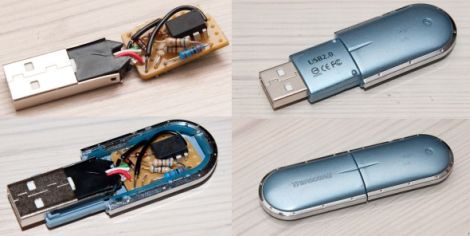
Like many businesses out there, [Joonas Pihlajamaa’s] employer requires him to change his password every few months. Instead of coming up with a complex, yet easy to remember password again and again, he built a small USB device to do the work for him.

He dismantled an old USB memory stick, fitting it with an ATtiny85 with its required components on a small piece of perfboard. Using the knowledge he gleaned from his previous USB HID tinkering, he programmed the ATtiny to act as a USB keyboard which enters his password for him whenever he plugs it in.

The USB dongle not only types his password in for him, it can generate a new password with a few simple keystrokes whenever he desires. Obviously it merely takes someone getting their hands on his USB stick to compromise security, but it does beat a Post-It under the keyboard any day.

Continue reading to see a short video of his USB password dongle in action, and be sure to swing by his site for more details on how it was all put together.

Continue reading “USB Dongle Generates And Enters Your Passwords So You Don’t Have To”

Rapid Fire Update Brings Many New Features

[Shawn McCombs] has been spending some time refining his Xbox 360 rapid fire hack. This time around he’s got a lot more features, many of which we haven’t really seen before.

When we looked at the original project he had added an ATtiny85 which read a potentiometer to set the rapid fire speed for one of the buttons. This time around he’s opened up settings for individual weapons in the game. For instance, if you have a hand-gun and a rifle, you can set different rapid fire rates for each to account for the reload speed for those guns. He patched into the ring of LEDs on the controller in order to indicate which preset is currently chosen. There are three tactile switches on the underside of the controller too. One of them is a reset button which gets you back to your primary weapon and the default rapid fire rate. Settings for each weapon are saved to the EEPROM so you won’t lose them when the controller goes to sleep. Check out [Shawn’s] description of the project in the video after the break.

Continue reading “Rapid Fire Update Brings Many New Features”

JTAG Dongle Pushes Code To FPGA After Bootup

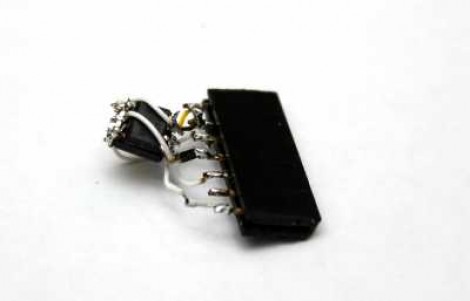
This gnarly beast has near-magical qualities. [Sprite_TM] patched it together as a dongle which attaches to a JTAG header (we’re fairly certain this is not a standard footprint for that interface though). He uses it to push code to an FPGA after that device boots. Why? Well, there’s several reason, but the most generic answer is that some boards will not boot unless there is a chain of trust that validates the code which will be running.

In this case, [Sprite_TM] is using a knock-off board he acquired from a Chinese supplier. It’s a hardware network terminal (thin client), and as you can see in the video after the break, it works just fine. But that’s pretty boring and he wanted to use it for his own purposes. When he plugs in the dongle and powers up the board the network terminal is nowhere to be found, replaced with the code to play Pac-Man as if were a full arcade cabinet.

The dongle is simply a female DIL header, an ATtiny85, and a flash memory chip. The AVR has a software UART that speaks XSVF, the protocol used to push data to the FPGA. The data to be written is stored in the memory chip, and with that header in place reprogramming the AVR is just a matter of connecting an ISP programmer. Brilliant!

Continue reading “JTAG Dongle Pushes Code To FPGA After Bootup”

A Simple, Self-contained 7-segment Display

self-contained-7-seg

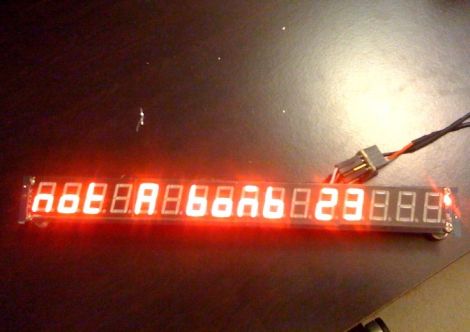
It’s no secret that seven-segment displays are an easy and useful way to relay data, so [Kelvyn Panici] decided to put together a minimalst, self-contained display for use around the house.

The display itself is a 16-digit model he picked up from DealExtreme for under $10. He wanted to find a microcontroller small enough to fit behind the display’s footprint, so he chose an ATtiny85 to control it. After mounting the mcu on a small piece of perfboard, he burned the Arduino bootloader and uploaded a small sketch to drive the display.

Things worked out quite well as you can see by the video below where he shows off a pre-perfboard prototype. [Kelvyn] currently does not have any immediate projects in the works that will utilize the display, though there are a plethora of possibilities. We think it would work great anywhere if it were fitted with a battery and some sort of wireless radio in order to make it completely self-contained.

Continue reading “A Simple, Self-contained 7-segment Display”

Adjustable Rapid Fire For Xbox 360 Controller

[Shawn] wrote in to share his post outlining the addition of rapid fire to an Xbox 360 controller. He’s going all out with this mod by including a pretty beefy microcontroller. But you get a lot of functionality for that. You can just make out the trimpot below and to the right of the green A button. This tweaks the speed at which your right trigger repeats. Next to the trimmer is an amber LED which indicates whether the hack is enabled or not. The switch to the left of the D-pad simply patches the add-on circuit into the right trigger hardware.

Some might raise an eyebrow when we call the ATtiny85 used here beefy. But considering the job at hand, we’re sure a lot of the lower end of the ATtiny family will work just as well. [Shawn] soldered everything up on a piece of protoboard and removed one of the rumble motors to make room inside the controller. The video after the break is pretty shaky and out of focus, but you can clearly hear him explain how the hack works.

If you’re looking for a rapid fire mod that doesn’t require programming a chip, perhaps you could just repurpose the PWM from the LED. Continue reading “Adjustable Rapid Fire For Xbox 360 Controller”

Building An EEPROM Programmer

Behold this ATtiny85 based EEPROM programmer. It seems like a roundabout way of doing things, but [Quinn Dunki] wanted to build to her specifications using tools she had on hand. What she came up with is an ATtinyISP USB programmer, pushing data to an ATtiny85, which then programs an EEPROM chip with said data.

The hardware is the next module for her Veronica 6502 computer build. When we last saw that project [Quinn] was planning to add persistent storage for the operating firmware. This will be in the form of an EEPROM programmed with this device. Using ISP and an ATtiny as a go-between means that she should have no problems reflashing the OS without removing the chip. But it all depends on how she designs the interface.

For example, she blew a whole bunch of time troubleshooting the device because garbage data was being written to the chip. In the end, having her manual bus programmer hooked up during the flashing operation was the culprit. Lesson learned, it’s onward and upward with the build.

We’ve been featuring [Quinn’s] projects a lot lately. That’s in part because they’re really interesting, but also because she does such a great job of documenting her experience.