Audio Old And New Meet In Perfect Harmony

There’s an uneasy meeting in the world of audio between digital and analogue. Traditional analogue audio reached a level of very high quality, but as old-style media-based audio sources have fallen out of favor there’s a need to replace them with ones that reflect a new digital audio world. To do this there are several options involving all-in-one Hi-Fi separates at a hefty price, a cheaper range of dongles and boxes for each digital input, or to do what [Keri Szafir] has done and build that all-in-one box for yourself.

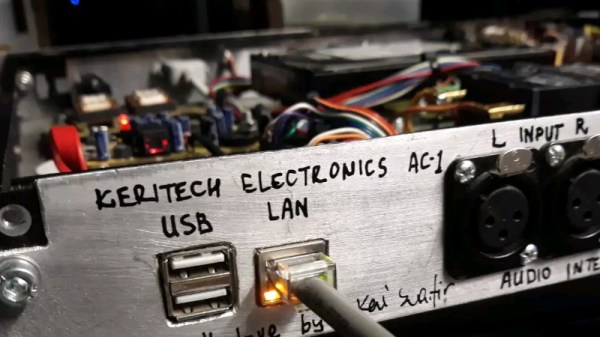
The result is a 1U 19″ rack unit that contains an Orange Pi for connectivity and streaming, a hard drive to give it audio NAS capability, plus power switching circuitry to bring all the older equipment under automation. Good quality audio is dealt with by using a Behringer USB audio card, on which in a demonstration of how even some digital audio is now becoming outdated, she ignores the TOSlink connector.

The rear panel has all the connectors for power, USB, network, and audio laid out, while the front has an array of status lights and switches. We particularly like the hand-written lettering, which complements this as a homebrew unit. It certainly makes the Bluetooth dongle dangling at the back of our amplifier seem strangely inadequate.

If audio is your thing, we had a look at some fundamentals of digital audio as part of our Know Audio series.

Wear Your Fave Cassette Tapes As A Necklace With This 3D Printed Adapter

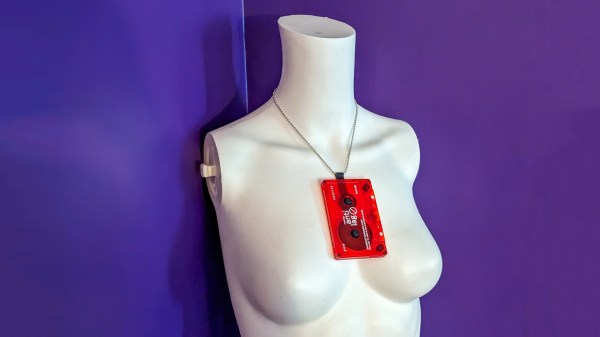
While packing merch for a recent gig, I realised I had the opportunity to do something a little fun. I’d released an album on tape, and spent a little extra to ensure the cassette itself was a thing of beauty. It deserved to be seen, rather than hidden away in a case on a shelf. I wanted to turn this piece of musical media into a necklace.

Of course, cassette tapes aren’t meant to be used in this way. Simply throwing a chain through the cassette would lead to tape reeling out everywhere. Thus, I fired up some CAD software and engineered a solution to do the job! Here’s how I built an adapter to turn any cassette tape into a cool necklace.

Find the design on Thingiverse, and more details below!

Continue reading “Wear Your Fave Cassette Tapes As A Necklace With This 3D Printed Adapter”

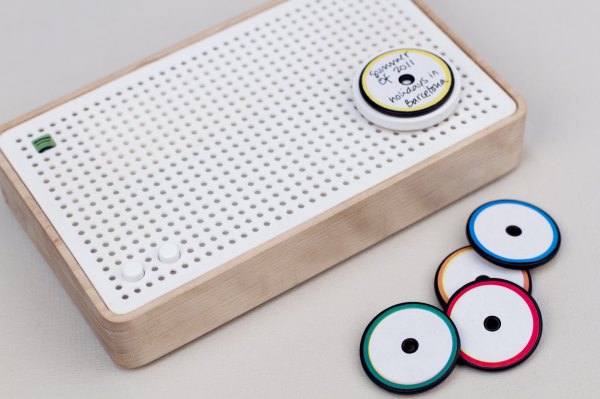
A radio with a white front grate and wood edges sits on a grey surface. Next to the radio are small white disks with colorful edges reminicient of microdisc-sized records. A yellow-ringed disk sits on the radio. The handwritten title says, "Summer of 2011; Holidays in Barcelona"

Spotify Player Brings Back Physical Media

Digital music has made keeping all your tunes with you a lot more convenient, but have we lost something with dematerialization? [Jordi Parra] felt that there was something lacking with the digital music experience and designed a Spotify player with a tactile interface.

Specific playlists are selected via small RFID tags that look like a cross between a MiniDisc and a vinyl record. As this is a prototype, an Arduino reads the RFID tag, but needs a computer to actually play the Spotify playlist. Future iterations could include an integrated speaker and run libspotify to create a self-contained device.

While there is still work to do for a fully seamless experience, we love the details in the industrial design of this project. Clean simple lines and a combination of wood and more modern materials make this feel like a timeless piece of tech. Definitely check out the full photo gallery including shots of the really impressive packaging.

Want more digital music with a tactile interface? Check out this MP3 Player Shelf or a Simple Internet Radio Transplant.

How To Restore A Musical Amiga

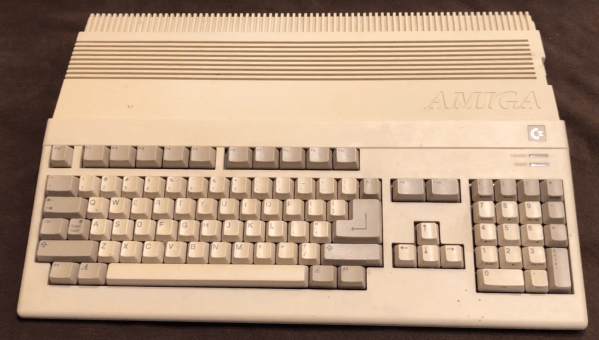
Despite the huge strides in computing power and functionality that have been achieved in the past few decades, there are still some things that older computers can do which are basically impossible on modern machines. This doesn’t just include the ability to use older hardware that’s now obsolete, either, although that is certainly a perk. In this two-part restoration of an Amiga 500, [Jeremy] shows us some of these features like the ability to directly modify the audio capabilities of this retro machine.

The restoration starts by fixing some damage and cleaning up the rest of the machine so it could be powered up for the first time in 30 years. Since it was in fairly good shape he then started on the fun part, which was working with this computer’s audio capabilities. It includes a number of amplifiers and filters in hardware that can be switched on or off, so he rebuilt these with new op-amps and added some new controls so that while he is using his MIDI software he can easily change how it sounds. He also restored the floppy disk drives and cleaned up the yellowing on the plastic parts to improve the overall appearance, as well as some other general improvements.

These old Amigas have a lot going for them, but since [Jeremy] is a musician he mostly focused on bringing back some of the musical functionality of his childhood computer, although he did build up a lot of extra features in this machine as well. These types of audio circuits are not something found in modern computers, though, so to get a similar sound without using original hardware you’ll need to build something like this NES audio processing unit programmed in Verilog.

Continue reading “How To Restore A Musical Amiga”

Kids’ Jukebox Based On Arduino With RFID

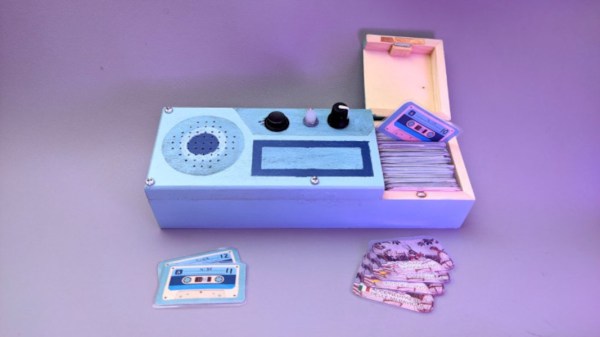
Consumer electronics aimed at young children tend to be quite janky and cheap-looking, and they often have to be to survive the extreme stress-testing normal use in this situation. You could buy a higher quality item intended for normal use, but this carries the risk of burning a hole in the pockets of the parents. To thread the needle on this dilemma for a child’s audiobook player, [Turi] built the Grimmboy for a relative of his.

Taking its name from the Brothers Grimm, the player is able of playing a number of children’s stories and fables in multiple languages, with each physically represented by a small cassette tape likeness with an RFID tag hidden in each one. A tape can be selected and placed in the player, and the Arduino at the center of it will recognize the tag and play the corresponding MP3 file stored locally on an SD card. There are simple controls and all the circuitry to support its lithium battery as well. All of the source code that [Turi] used to build this is available on the project’s GitHub page.

This was also featured at the Arudino blog as well, and we actually featured a similar project a while ago with a slightly different spin. Both are based on ideas from Tonuino, an open source project aimed at turning Arduinos into MP3 players. If you’re looking to build something with a few more features, though, take a look at this custom build based on the RP2040 microcontroller instead.

A Simple High-Fidelity DIY Mic Pre Amp

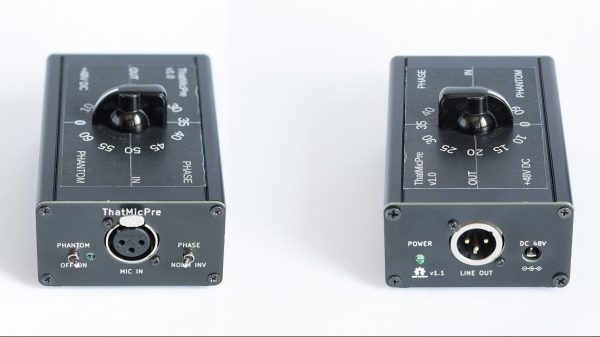
If you’re doing any serious work with microphones, you’ll typically find yourself in want of a dedicated preamp. [ojg] needed just such a thing for acoustic measurement duties, and set about working up a cheap DIY design by the name of ThatMicPre.

The design is based around the THAT1510 preamp IC, known for its good frequency response and low harmonic distortion and noise. The design is also compatible with THAT1512, SSM2019, and INA217 chips as well. [ojg] gave the design switch-controlled gain levels, providing greater accuracy than a potentiometer adjustment, and the ability to supply phantom power for mics that require it. The PCB is designed to rely on through-hole parts and common connectors for easy assembly.

The design is open source, and has already been built by others on the DIYAudio forums. Built into a simple case, it looks like a handsome and well-built piece of audio equipment. We’ve featured quite a few unique preamps over the years, and if you’ve been building your own, we’d love to see those too!

I’ve Got Two Turntables And A Laser Engraver

Digital media provides us with a lot of advantages. For something like recording and playing back music, digital copies don’t degrade, they can have arbitrarily high quality, and they can be played in a number of different ways including through digital streaming services. That being said, a number of people don’t feel like the digital experience is as faithful to the original sound as it could be and opt for analog methods instead. Creating analog copies of music is a much tougher matter though, as [Marco] demonstrates by using a laser engraver to produce vinyl records.

[Marco] started this month-long project by assembling and calibrating the laser engraver. It has fine enough resolution to encode analog data onto a piece of vinyl, but he had to create the software. The first step was to generate the audio sample, then process it through a filter to remove some of the unwanted frequencies. From there, the waveform gets made into a spiral, accounting for the changing speed of the needle on the record as it moves to the center. Then the data is finally ready to be sent to the laser engraver.

[Marco] did practice a few times using wood with excellent success before moving on to vinyl, and after some calibration of the laser engraver he has a nearly flawless 45 rpm record ready to hit the turntable. It’s an excellent watch if not for anything than seeing a working wood record. We’ve actually seen a similar project before (without the wood prototyping), and one to play records from an image, but it’s been quite a while.

Thanks to [ZioTibia81] for the tip!

Continue reading “I’ve Got Two Turntables And A Laser Engraver”