Trash To Treasure Bluetooth Radio And Tube Amp Build

trash-to-treasure-internet-radio

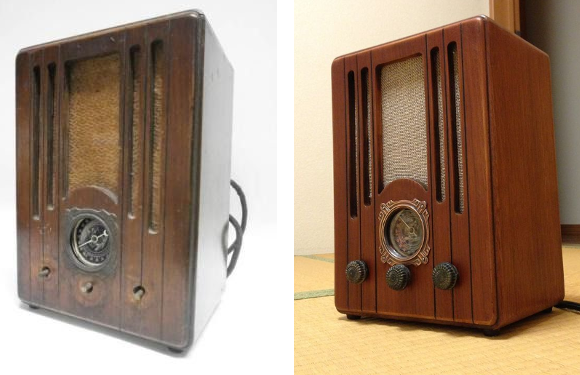
The before image doesn’t look all that bad but we were still impressed with what went into the restoration of this radio. Perhaps restoration isn’t the right word since it didn’t manage to hold on to any of the original internals. This is more resurrection of a retro radio case for use as a Bluetooth radio.

At first look we didn’t notice that the original knobs were missing. The speaker fabric is ripped and the glass on the tuning dial is broken as well. [Yaaaam] happened to have another antique radio with interesting knobs — but he didn’t just transplant them. He made a mold of one knob and cast three replacements for the radio. After refinishing the wood he replaced the fabric and things were really starting to look up.

All of the electronic components were removed and a new tube amp was built on the original metal chassis. It uses a Bluetooth module for input which facilitates using your smart phone as the playback device without involving any wires or other nonsense. Two problems popped up after the project was completed. The first replacement power supply overheated. The second replacement had a different problem, needing some additional shielding to prevent noise from creating unwanted… noise.

This looks so much better than modern injection molded plastic shelf systems. But there are some fun wireless hacks out there for those too.
Sending Data Over Bluetooth Low Energy With A Cheap NRF24L01+ Module

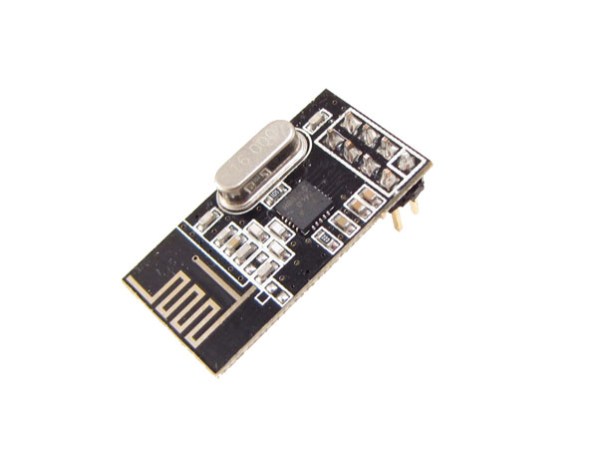
nRF24L01+ modules like the one shown above are a great way to send data wirelessly between your projects. They can be found on many websites for less than $1.50 a piece and many libraries exist for them. After having thoroughly looked at the Bluetooth Low Energy (BLE) specifications, [Dimitry] managed to find a way to broadcast BLE data with an nRF24L01+.

Luckily enough, BLE and nRF24L01+ data packets have the same preambles. However, the latter can’t send more than 32 bytes in a packet and can’t hop between frequencies as fast as the BLE specification wants. [Dimitry] found the solution when he discovered that he could send unsolicited advertisements on three specific channels. In the end, considering the 32 bytes the nRF24L01+ can send, you’ll need to use 3 bytes for the CRC, 2 for the packet header, 6 for the MAC address and 5 for devices attributes. This leaves us with 16 bytes of pure data or 14 bytes to split between data and name if you want your project to have one.

Motobrain: A Bluetooth Controlled PDU

motobrain

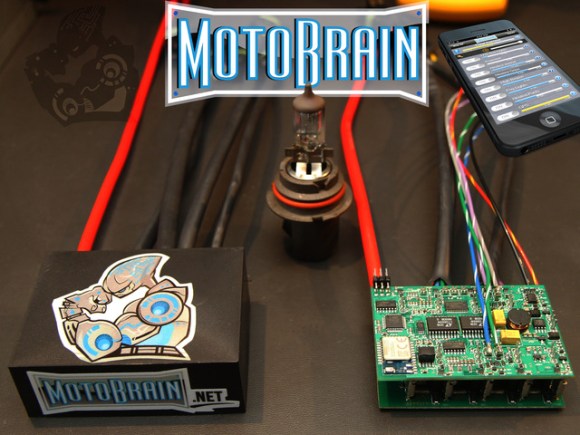
If you’ve ever considered modding your vehicle’s electrical system, [Josh Oster-Morris’s] Motobrain PDU (power distribution unit) might make life easier by providing precision control and protection for auxiliary 12V outputs in your car, bike, boat, etc. Once the Motobrain is paired to a phone over Bluetooth, a companion app displays real-time telemetry and lets you program up to 8 output channels.

Each of these 8 outputs can be directly controlled in the app, but the real power lies in the 4 programmable inputs. Here you can tie systems together and dictate exactly how one should respond to the other, e.g. detecting high-beams and disabling the auxiliary light bar you added. There’s even a “delayed on” option. Programming also has PWM capabilities, so flipping a switch could raise the brightness of some lights over 4 levels of intensity. If those lights are LEDs, the Motobrain can also provide constant current to specification. Each circuit can supposedly handle 15A continuous current and has a programmable circuit breaker, which would make fuses optional.

You can watch an overview video after the break to get a better idea of how it all works, but stop by [Josh’s] project blog to see all the features explained across multiple videos and blog posts as they are developed and tested.

Continue reading “Motobrain: A Bluetooth Controlled PDU”

ArduGuitar, An Arduino Controllable Guitar

The ArduGuitar

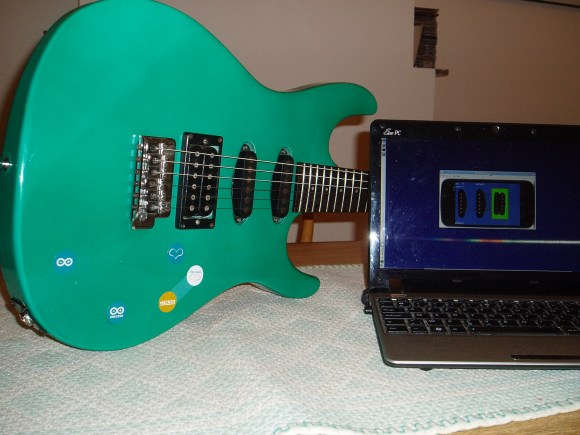
Electric guitars have several switches and potentiometers for controlling volume, tone, and which pickups are enabled. Rather than fiddling with these by hand, [Bob] built the ArduGuitar. It uses an Arduino to control the parameters over Bluetooth. This allows for musicians to configure presets, then recall them as needed, providing the exact same sound every time. It’s similar to the Guitarduino, but adds wireless control.

The internals of the ArduGuitar consist of the Arduino Micro, a BlueSMiRF from Sparkfun, and resistive opto-isolators. The resistive opto-isolators allow the Arduino to adjust resistance through an electrically isolated barrier. This prevents the Arduino from interfering with the guitar’s sound.

Some of the first Vactrols were used to create a tremolo effect in guitar amplifiers. These pulsed a incandescent lamp onto a photoresistor. Fortunately, there are now integrated solutions. PerkinElmer makes these, and they have a nice application note [PDF] on audio applications.

The final part of the design is an Android app, which provides remote control over Bluetooth. The source for everything is available on Github, and the detailed build log is available here.

Modifying The HC-05 Bluetooth Module Defaults Using AT Commands

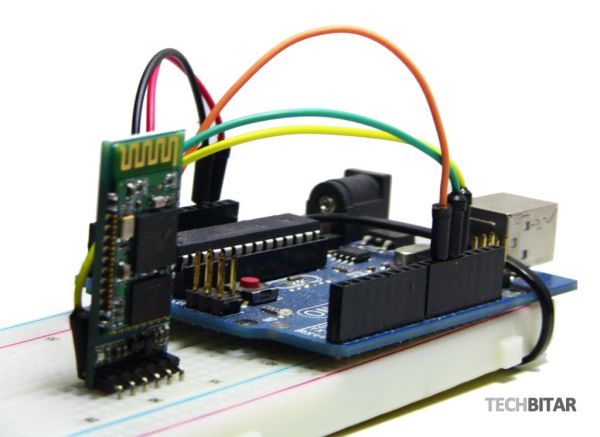
The HC-05, a Bluetooth to serial bridge, can be found for around $5 on the internet and therefore may be the cheapest way to add Bluetooth connectivity to your project.

However, its default settings may need to be changed depending on your application. [Hazim] explains a way to enter the HC-05 AT command mode to benefit from the rich set of features that the device can provide. The process is fairly simple as it only consists of maintaining the key pin of the HC-05 high while powering on. The device then boots in AT command mode with a default 38400bits/s speed and listens for all of the AT command set (PDF). As an example [Hazim] provides a sketch allowing you to write the AT commands directly in your favorite terminal.

With the basics out of your way you may want to further research the hardware, especially if you will be using modules from different sources. They don’t always come with the same firmware.

IMU Boards As Next-gen Motion Capture Suit?

This guy takes a drink and so does the virtual wooden mannequin. Well, its arm takes a drink because that’s all the researchers implemented during this summer project. But the demo really makes us think that suits full of IMU boards are the next generation of motion capture. Not because this is the first time we’ve seen it (the idea has been floating around for a couple of years) but because the sensor chips have gained incredible precision while dropping to bargain basement prices. We can pretty much thank the smartphone industry for that, right?

Check out the test subject’s wrist. That’s an elastic bandage which holds the board in place. There’s another one on this upper arm that is obscured by his shirt sleeve. The two of these are enough to provide accurate position feedback in order to make the virtual model move. In this case the sensor data is streamed to a computer over Bluetooth where a Processing script maps it to the virtual model. But we’ve seen similar 9-axis sensors in projects like this BeagleBone sensor cape. It makes us think it would be easy to have an embedded system like that on the back of a suit which collects data from sensor boards all over the test subject’s body.

Oh who are we kidding? [James Cameron’s] probably already been using this for years.

Continue reading “IMU Boards As Next-gen Motion Capture Suit?”

Hacking Sensoria, The Smart Sock

sensorSock

Sensor-meets-sock product “Sensoria” won’t hit the shelves for a while, but [Andrew] managed to snag a Sensoria Gaming SDK and has hacked the smart sock to control an inexpensive toy helicopter. Seldom do we see projects this rugged yet clearly effective. The sock sends data via its companion device—a Bluetooth anklet—to LabVIEW. LabVIEW subsequently talks to an attached Arduino to manipulate a servo that [Andrew] just…duct taped to the helicopter’s controller. The result: a a quick and dirty hack that proves surprisingly intuitive, providing accelerator-style foot control to drive the throttle. Check out a video of [Andrew] punishing his helicopter after the break.

This is the first hack we’ve seen for the Sensoria, which is still in the crowdsourcing phase over at Indigogo. They have already reached their funding goal, but a few SDKs remain unclaimed. You can watch an official video of the sock’s sensors lighting up a heat map in real time below.

And, if you missed it, have a look at the AsTeRICS project’s helicopter controlled by neck muscles.

Continue reading “Hacking Sensoria, The Smart Sock”