Model Train Delivers Fresh Coffee

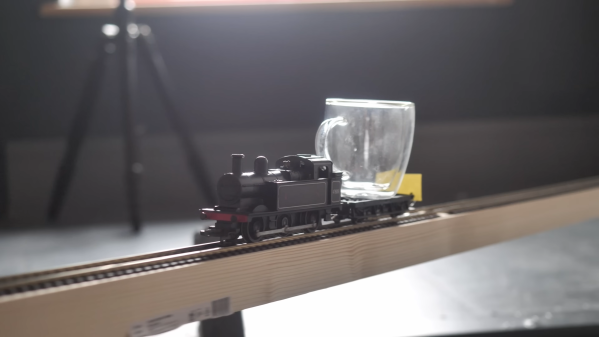
Model trains are good fun, though few of them serve any purpose beyond amusement or authentic railway simulation. [ProjectAir] decided to put his model train to practical use by having it deliver fresh espresso, and faced plenty of difficult challenges along the way.

It sounds simple, but the practicalities of the task proved difficult. After all, even a slight wobble is enough to tip a coffee cup off a small train. Automating everything from the railway itself to the kitchen coffee machine was no mean feat either. Plus, the aim was to deliver coffee from a downstairs kitchen up to an upstairs office. This meant finding a way to get the train to climb a steep staircase and to carry the coffee over a 20-meter journey without losing the caffeinated beverage in the process. That required the construction of a fancy train elevator to do the job — an impressive accomplishment on its own.

The final system is a joy to watch. Having a train roll into the upstairs workshop with a fresh brew certainly beats having to go all the way downstairs for a cup. Just don’t think about the fact that moving the coffee machine upstairs might have been a quicker solution.

Continue reading “Model Train Delivers Fresh Coffee”

Using GitHub Actions To Brew Coffee

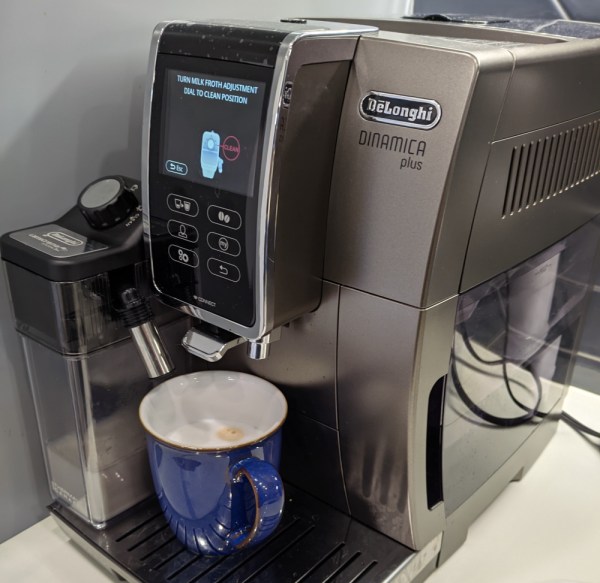
It’s getting harder and harder to think of a modern premium-level appliance that doesn’t come with some level of Internet connectivity. These days it seems all but the cheapest refrigerators, air purifiers, and microwaves include wireless capabilities — unfortunately they’re often poorly implemented or behind a proprietary system. [Matt] recently purchased a high-end coffee maker with Bluetooth functionality which turned out to be nearly useless, and set to work reverse-engineering his coffee maker and adapting it to work by sending commands from GitHub.

Since the wireless connectivity and app for this coffee maker was so buggy and unreliable, [Matt] first needed to get deep into the weeds on Bluetooth Low Energy (BTLE). After sniffing traffic and identifying the coffee maker, he set about building an interface for it in Rust. Once he is able to send commands to it, the next step was to integrate it with GitHub, so that filing issues on the GitHub interface sends the commands from a nearby computer over Bluetooth to the coffee maker, with much more reliability than the coffee maker came with originally.

Using [Matt]’s methods, anyone stuck with one of these coffee makers, a Delonghi Dinamica Plus, should be able to reactivate the use of its wireless functionality. While we’d hope that anyone selling a premium product like this would take a tiny amount of time and make sure that the extra features actually work, this low bar seems to be oddly common for companies to surmount. But it’s not required to pick up an expensive machine like this just to remotely brew a cup of coffee. You can do that pretty easily with a non-luxury coffee maker and some basic wireless hardware.

Using Statistics Instead Of Sensors

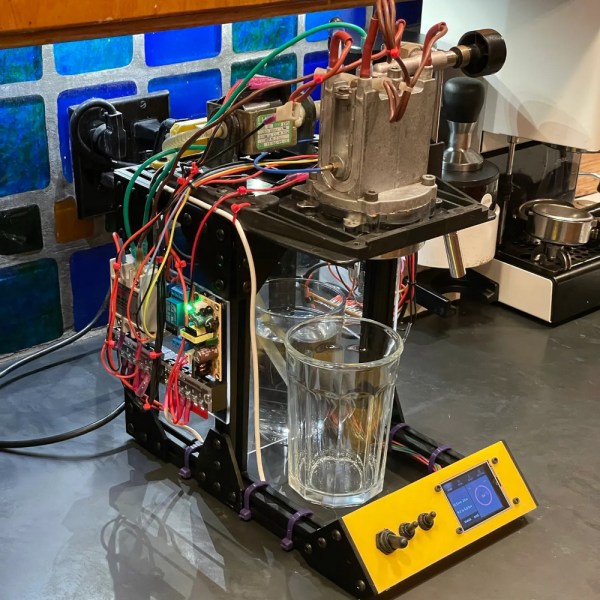
Statistics often gets a bad rap in mathematics circles for being less than concrete at best, and being downright misleading at worst. While these sentiments might ring true for things like political polling, it hides the fact that statistical methods can be put to good use in engineering systems with fantastic results. [Mark Smith], for example, has been working on an espresso machine which can make the perfect shot of coffee, and turned to one of the tools in the statistics toolbox in order to solve a problem rather than adding another sensor to his complex coffee-brewing machine.

To make espresso, steam is generated which is then forced through finely ground coffee. [Mark] found that his espresso machine was often pouring too much or too little coffee, and in order to improve his machine’s accuracy in this area he turned to the linear regression parameter R2, also known as the coefficient of determination. By using a machine learning algorithm tuned to this value, which assesses predictable variation in a data set, a computer can more easily tell when the coffee begins pouring out of the portafilter and into the espresso cup based on the pressure and water flow in the machine itself rather than using some other input such as the weight of the cup.

We have seen in the past how seriously [Mark] takes his coffee-making, and this is another step in a series of improvements he has made to his equipment. In this iteration, he has additionally produced a simulation in JupyterLab to better assist him in modeling the system and making even more accurate predictions. It’s quite a bit more effort than adding sensors, but since his espresso machine already included quite a bit of computing power it’s not too big a leap for him to make.

Extreme Espresso, Part 2: An Inductive Water Level Sensor

[Mark Smith] must really, really like his coffee, at least judging by how much effort he’s put into tricking out his espresso machine.

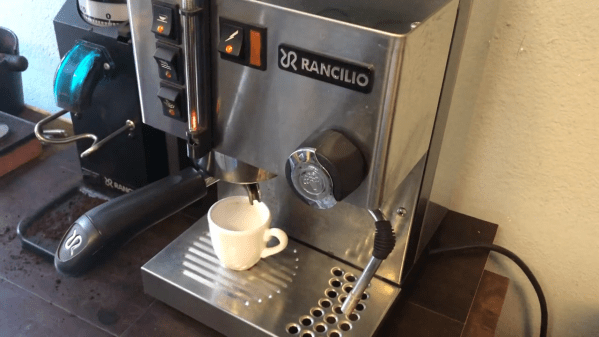
This inductive water tank sensor is part of a series of innovations [Mark] has added to his high-end Rancilio Silvia machine — we assume there are those that would quibble with that characterization, but 800 bucks is a lot to spend for a coffee maker in our books. We recently featured a host of mods he made to the machine as part of the “Espresso Connect” project, which includes a cool Nixie tube bar graph to indicate the water level in the machine. That display is driven by this sensor, the details of which [Mark] has now shared. The sensor straddles the wall of the 1.7-liter water tank, so no penetrations are needed. Inside the tanks is a track that guides a copper and PETG float that’s sealed with food-safe epoxy resin.

Directly adjacent to the float track on the outside of the tank is a long PCB with a couple of long, sinuous traces. These connect to an LX3302A inductive sensor IC, which reads the position of the copper slug inside the float. That simplifies the process greatly; [Mark] goes into great detail about the design and calibration of the sensor board, as well as hooking it into the Raspberry Pi Zero that lies at the heart of “Espresso Connect’. Altogether, the mods make for a precisely measured dose of espresso, as seen in the video below.

We’d say this was maybe a bit far to go for the perfect cup of coffee, but we sure respect the effort. And we think this inductive sensor method has a lot of non-caffeinated applications that probably bear exploration.

Continue reading “Extreme Espresso, Part 2: An Inductive Water Level Sensor”

The insides of a coffee machine replaced with new smart electronics

Add Smarts To Your Old Capsule Coffee Maker

Everyone has their preferred method of making (and consuming) coffee. While modern coffee makers are starting to come standard with IoT and ‘smart’ capabilities, owners of older models should fear not, as [Andreas Skoglund] shows how just about any old machine can be upgraded with the latest automation wizardry.

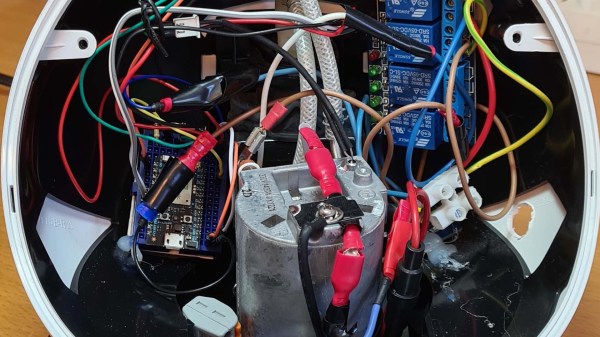
The most involved part of this conversion is removing the electronic guts of the Dolce Gusto donor machine, leaving just the original heater, pump and the control levers. With safety in mind, the user must make the machine ‘hot’ by configuring the levers and replacing the coffee capsule manually, otherwise no automated coffee magic can take place.

A low-tech relay powers on the coffee maker, with the entire logic supported by an off-the-shelf microcontroller. If you’re using a Particle.io controller, the provided instructions offer some helpful tips on automatically brewing your first beverage. From there it’s trivial to start using Home Assistant to set up various rules and schedules for your coffee drinking pleasure. You can even select whether you want a small or large cup.

There’s a few improvements that our coffee-starved hero suggests implementing, such as upgrading the power supply, as well as investing in refillable capsules to spite a certain global conglomerate corporation (plus it’s cheaper and much better for the environment). We’re not short on coffee-inspired hacks, so why not also check out this AI Powered Coffee Maker.

Continue reading “Add Smarts To Your Old Capsule Coffee Maker”

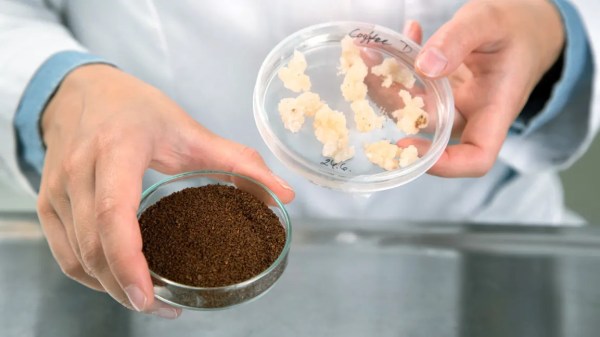
Regular coffee grounds and lab-grown coffee.

Is Lab-Grown Coffee Worth A Hill Of Beans?

Historically, coffee has needed two things to grow successfully — a decent altitude and a warm climate. Now, a group of scientists from the VTT Technical Research Centre of Finland have managed to grow coffee in a lab. They started by culturing coffee plant cells, and then planted them in bioreactors full of nutrient-rich growing medium. But they didn’t grow plants. Instead of green beans inside coffee cherries, the result is a whitish powdered biomass that resembles pure caffeine. Then the scientists roasted the powder as you would beans, and report that it smells and tastes just like regular coffee.

There are plenty of problems percolating with the coffee industry that make this an attractive alternative — mostly worker exploitation, unsustainable farming methods, and land rights issues. And the Bean Belt, which stretches from Ethiopia to South America to Southeast Asia is getting too hot. On top of all that, coffee production is driving deforestation in Vietnam and elsewhere, although coffee could help the forests regenerate more quickly.

Coffee purists shouldn’t be dismayed, because variety is still possible using varying cell cultures to dial in the caffeine level and the flavors. We’ll drink to that.

Another thing in the industry that’s a real grind is coffee cupping, but spectroscopy could soon help determine bean quality.

Filtering Coffee Through 3D Printed Glass

Typically, when we think of 3D printing, we think of gooey melted plastics or perhaps UV-cured resins. However, there’s a great deal of research going on around printing special impregnated filaments with alternative materials inside. [Ahron Wayne] has been working on these very materials, and decided to make himself a brew with a prototype print.

Tasty, but [Ahron] notes you shouldn’t drink in the lab.
The subject of [Ahron]’s experimentation is a glass-impregnated filament under development by The Virtual Foundry. The filament is full of tiny glass particles, and the idea is that it can be printed like any regular plastic filament. From there, it’s heated in what’s known as a debinding process, which removes the plastic in the print. Then, it’s heated again in a sintering process to bond the remaining glass particles together.

It’s a complex process, and one that leads to some shrinkage in dimensions as well as porosity in the final part. However, where some might see failure, [Ahron] saw opportunity. The porous printed part was used to filter coffee, with the aid of a little vacuum from what sounds like a water venturi.

[Ahron] notes it’s not a particularly efficient way to make coffee but it did work. We’ve seen exciting work with steel-impregnated filaments, too. Video after the break.

Continue reading “Filtering Coffee Through 3D Printed Glass”