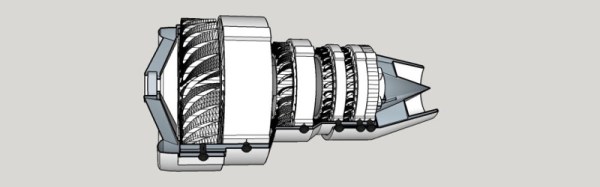
In specific applications, jet engines are often the most efficient internal combustion engines available. Not just for airplanes, but for anything that needs to run on a wide variety of fuels, operate at a consistent high RPM, or run for an extended amount of time. Of course, most people don’t have an extra $4,000 lying around to buy a small hobby engine, but now there’s a 3D-printed axial compressor available from [noob_sauce].
As an aero propulsion engineer, [noob_sauce] is anything but a novice in the world of jet engines. This design is on its fourth iteration with a working model set to be tested by the end of the month. Additionally, [noob_sauce] created his own software that was necessary for the design of such a small, efficient jet engine which has all been made available on Git. So far the only part that has been completed has been the compressor stage of the engine, but it’s still a very impressive build that we don’t see too often due to the complexity and cost of axial compressor jet engines.
Of course, there are some less-complex jet engines that are available to anyone with access to a hardware store and a welder which don’t require hardly any precision at all. While they’re fun and noisy and relatively easy to build, though, they don’t have near the efficiency of a jet engine like this one. The build is impressive on its own, and also great that [noob_sauce] plans to release all the plans so that anyone can build one of these as well.

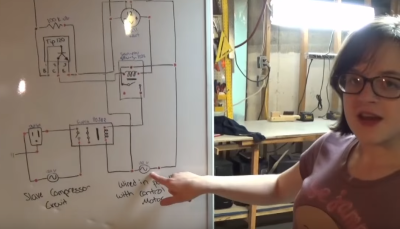 The Arduino’s GPIO pins can’t handle 9 amp AC loads, so [Hannah] wired them to TIP120 transistors. The TIP120s drive low power relays, which in turn drive high current air conditioning relays. The system works quite well, as can be seen in the video below the break.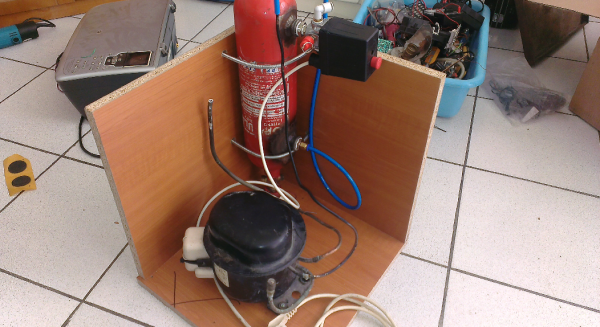
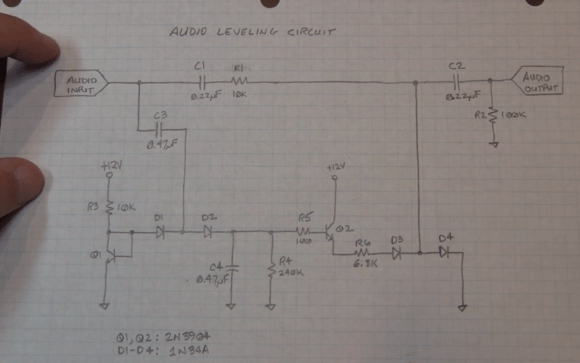
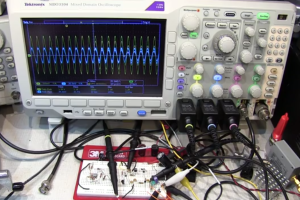 ircuit isn’t new, he states right in the video that various audio limiting, compressing, and automatic gain control circuits have been passed around the internet for years. What he’s brought to the table is his usual flair for explaining the circuits’ operation, with plenty of examples using the oscilloscope. (For those that don’t know, when [Alan] isn’t building circuits for fun, he’s an RF applications engineer at Tektronix).