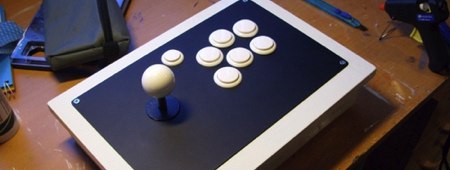
[astralpancakes] wireless arcade stick project looks like a great place to start if you want a simple project. Well constructed arcade sticks can cost $100+, but with all the MAME cabinet builders, the parts have become easy to acquire. The stick has a rigid wooden case with a metal faceplate. All of the component connections are soldered to the pads of a Logitech wireless controller. [astralpancakes] built this specifically to play Street Fighter III: 3rd Strike.
controller270 Articles
Playstation 2 Controller Analysis
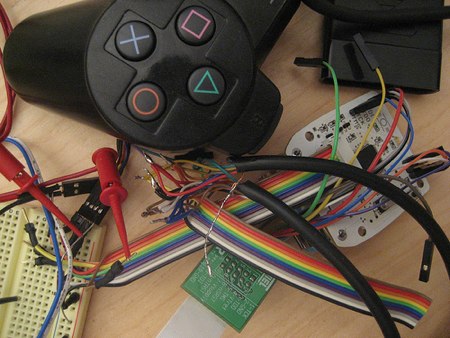
The people at Near Future Laboratory are trying to spoof the behavior of a Playstation 2 controller using just a microcontroller. They wrote some initial code using the controller info found here, but decided the best way to figure out what was going on, was to probe the interface. They’re using a Logicport, which features 34 channels plus two clock channels. They only need six channels because the PS2 implements an SPI protocol plus an ACK line. The post is just a preliminary investigation, but will give you a little insight into how the Logicport works and why you might find it useful.
PSP L2/R2 Button Mod
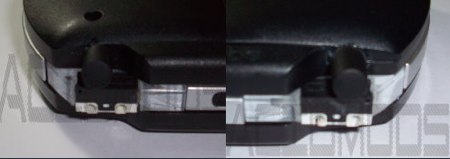
This is quickly becoming an unintentional “game controller Saturday”. We haven’t been covering the PSP much lately, so this is a treat. AcidMods forum member [Electro] put together a quick guide for adding two missing shoulder buttons to the PSP. The L2 and R2 buttons are used while playing Playstation 1 games and are usually mapped to directions on the joystick. This mod jumps the joystick’s contacts an relocates the buttons to the shoulders. The switches used in the post seem kind of bulky, but you’re free to use anything that fits.
[via Engadget]
X2Wii, NES/SNES/N64 To Wii Adapter
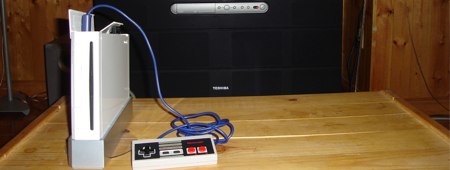
If you poke around [Raphaël]’s site, the creator of today’s featured hack, you’ll find a lot of interesting projects. X2Wii is an ongoing project to adapt controllers from earlier console generations so they work with the Wii’s GameCube ports. He adapted his Multiuse tiny1 which uses an ATmega8. The code is all assembly so the microcontroller can keep up with the protocol. Definitely check out [Raphaël]’s other project pages.
LED Lightbar Controller
[youtube=http://www.youtube.com/watch?v=6ihIaNN9UBY&hl=en]
[Adam Grieg] recently posted this video of his LED lightbar controller at work making a strip of LEDs flash to the beat of his music. The controller does it by picking up the music via an electret microphone, then amplifying it with an LM386 Amp. The ATtiny13 microcontroller keeps track of the noise level and makes the LED array flash whenever it senses a peak.
In addition to the parts listed, [Grieg] used a small SparkFun box as the enclosure for the controller. If you’re considering trying your hand at this project, check out [Grieg]’s schematics and code. It’s relatively cheap to make, so it wouldn’t be that hard to rig up several of these set to flash at different frequencies.
[via SparkFun]
Guitar Hero Actuator
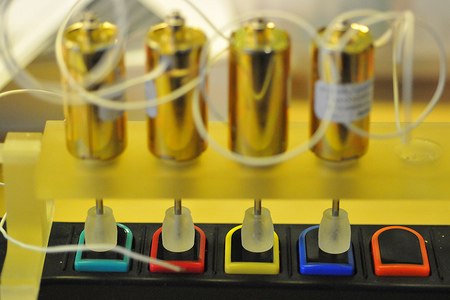
Another day, another EE that refuses to play Guitar Hero properly. [Julian Bleecker] went into the design of this Guitar Hero actuator not really knowing how to size solenoids properly. Luckily, trial and error can get you a long way. The first solenoids he purchased couldn’t apply enough force. The second was overkill. It was certainly strong enough but too heavy and too large to mount to the neck. The final set ended up being both the right size and working well even at 12V, half the design voltage. The elegant mounting system is what really makes this project shine. [Julian] provides the schematic for the ATmega168 driver board, which is an Arduino stripped of the extraneous bits.
Related: Slashbot and AutoGuitarHero
[via Make]
One Handed Controller Available For Pre-order
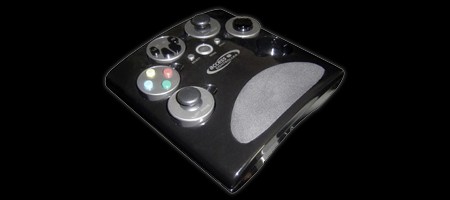
You are probably familiar with the work of [Ben Heckendorn]. His latest commercial project, the one handed Access Controller, is now available for pre-order. A well known modder, he has created several unique video game console adaptations including a scratch built one handed Xbox 360 controller.
A unique feature of this controller is that it allows you to change the location of the buttons/joysticks. This modular design can be swapped and customized depending on your needs. Ben is including a guide for creating your own modules, should you be so inclined. The device uses 2.4Ghz wireless to communicate and is available for $129.99.
Since we know you are more interested in hacks than gadgets, be sure to checkout Heckendorn’s nice collection of how-tos on Engadget.
[via Engadget]