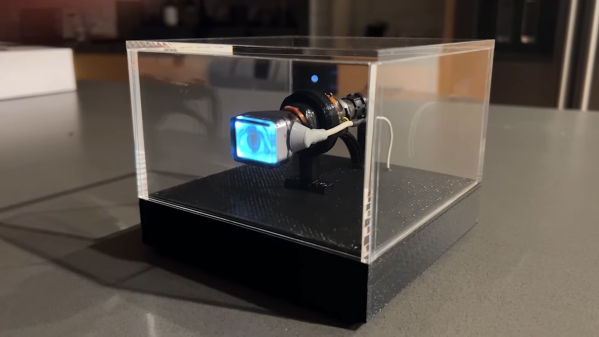
The days of cathode ray tubes, or CRTs, are firmly behind us, and that’s generally a good thing. Display tubes were heavy, bulky and fragile, and needed complicated high-voltage electronics in order to work. But not all of them were actually large: miniature display tubes were also produced, for things like camcorder viewfinders, and [Tavis] from Sideburn Studios decided to turn one of those into a slightly creepy art project.
The heart of this build is a one-inch CRT that was salvaged from an RCA video camera. [Tavis] mounted the tiny tube inside an acrylic box on a 3D printed base. Inside that base sits a Raspberry Pi along with a high-voltage driver and a power management board. The Pi continuously plays a video that shows a human eye blinking and looking in various directions. Just an eye, floating in space, looking at the world around it.
The magic is briefly lost when the Pi starts up, because it then shows a microscopic version of the Pi’s standard bootup sequence, but once the thing is running it adds a weird vibe to a room. It actually looks like something you’d find in an avant-garde art exhibition — in the video (embedded below) it’s accompanied by eerie music that gives it an even more unsettling feel. Electronic eyes are always a bit scary, especially when they’re actually looking at you.
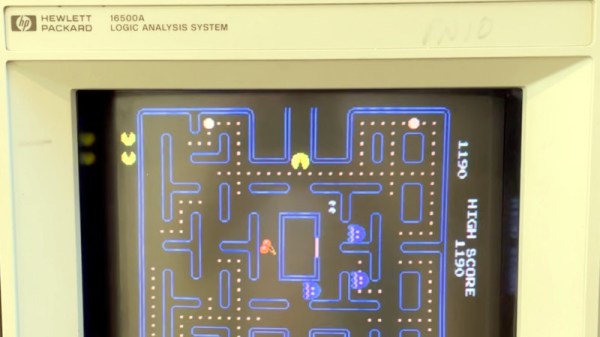
The designers of older equipment that contained a CRT monitor rarely made the effort to design their own driver and deflection circuitry. Instead they were more likely to buy an off the shelf assembly from a monitor manufacturer, and simply supply it with their video. [TomV] has an old HP 16500A logic analyzer, and in it he found a Sony monitor chassis. With a quest for a microfiche service manual and a bit of reverse engineering, he was able to hook it up to a VGA port and use it as an extension monitor for his laptop.
The monitor chassis is a Sony CHM-9001-00, which sports their 10″ Trinitron tube. These were among the very best CRT tubes of the day, making it the type of module 1990s hacker would have been very pleased to get their hands on. Here in 2022 a look at the monitor’s 40-pin connector reveals a standard RGB interface which the service manual confirms is within the voltage range to be driven from a VGA output. A Thinkpad X220 is pressed into service, with a 576 by 360 pixel at 60 Hz video mode defined, and there we have it, a modern desktop on an obsolete piece of test equipment.
The intended destination for this monitor is a small arcade cabinet, so it needed to be independent of the HP chassis. The required 120 VDC supply comes from an inverter designed for solar battery charging, which balked at the inrush current from the monitor when fed with 12 V. Increasing the supply voltage on the low voltage side solved that, leading to a very serviceable monitor. We have no use for one, but we’d be lying if we said we didn’t want one.
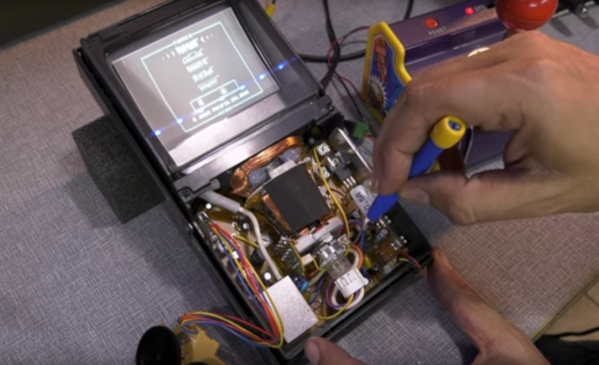
Restoring vintage electronics is a difficult hobby to tackle. Even the most practical builds often have to use some form of modern technology to work properly, or many different versions of the machine need to be disassembled to get a single working version. Either way, in the end someone will be deeply hurt by the destruction of anything antique, except perhaps with [Marco]’s recent tiny arcade with a unique CRT display.
The CRT is a now-obsolete technology, but Arcade and MAME purists often seek them out because of the rounded screen and vintage feel these devices have when compared to modern LCD or LED displays. For a build this small, though, [Marco] couldn’t just use parts from an old TV set as there wouldn’t be clearance in the back of the cabinet. An outdated video conferencing system turned out to have just the part he needed, though. It has a CRT mounted perpendicularly to a curved screen in order to reduce the depth needed dramatically.
The final build uses a tiny Namco system meant to plug into the RCA jack on a standard TV, but put in a custom case that makes it look like an antique video game cabinet. It’s an interesting build that doesn’t destroy any valuable antique electronics, while still maintaining a classic arcade feel. If you’re building a larger arcade cabinet which will still satisfy the purists out there, make sure you’re using a CRT with the right kind of control system.
In any era, the story of electronics has very much been about figuring out how to make something happen with what’s available at the time. And as is often the case, the most interesting developments come from occasions when needs exceed what’s available. That’s when real innovation takes place, even if circumstances conspire to keep the innovation from ever taking hold in the marketplace.
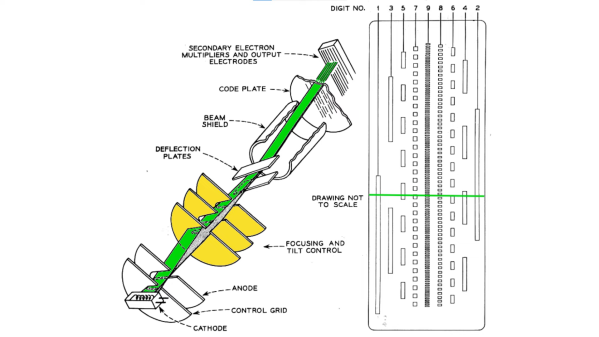
This gem of a video from the Antique Wireless Association has a perfect example of this: the long-lost analog-to-digital converter vacuum tube. Like almost every mid-20th-century innovation in electronics, this one traces its roots back to the Bell Laboratories, which was keenly interested in improving bandwidth on its massive network of copper lines and microwave links. As early as 1947, one Dr. Frank Gray, a physicist at Bell Labs, had been working on a vacuum tube that could directly convert an analog signal into a digital representation. His solution was a cathode ray tube similar to the CRT in an oscilloscope. A beam of electrons would shine down the length of the tube onto a shadow mask containing holes arranged in a “reflected binary code,” which would later be known as a Gray code. The analog signal to be digitized was applied to a pair of vertical deflector plates, which moved the beam into a position along the plate corresponding to the voltage. A pair of horizontal deflector plates would then scan the beam across the shadow mask; where electrons fell on a hole, they would pass through to an output plate to be registered as a bit to be set.
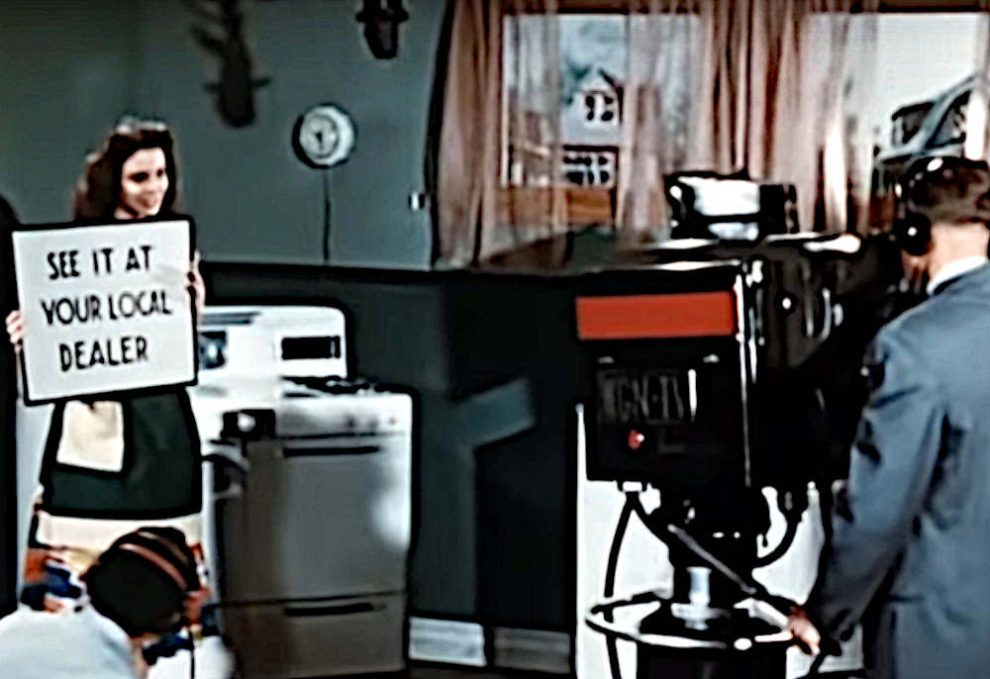
Watching television today is a very different experience from that which our parents would have had at our age, where we have high-definition digital on-demand streaming services they had a small number of analogue channels serving linear scheduled broadcasting. A particular film coming on TV could be a major event that it was not uncommon for most of the population to have shared, and such simple things as a coffee advert could become part of our common cultural experience. Behind it all was a minor miracle of synchronised analogue technology taking the signal from studio to living room, and this is the subject of a 1952 Coronet film, Television: How It Works! Sit back and enjoy a trip into a much simpler world in the video below the break.
Production values for adverts had yet to reach their zenith in the 1950s.
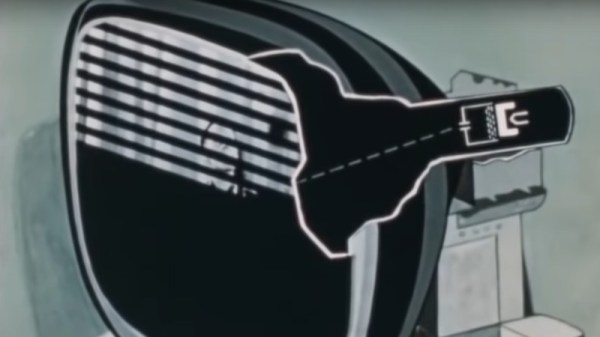
After an introduction showing the cultural impact of TV in early-50s America there’s a basic intro to a cathode-ray tube, followed by something that may be less familiar to many readers, the Image Orthicon camera tube that formed the basis of most TV signals of that era.
It’s written for the general public, so the scanning raster of a TV image is introduced through the back-and-forth of reading a book, and then translated into how the raster is painted on the screen with the deflection coils and the electron gun. It’s not overly simplified though, for it talks about how the picture is interlaced and shows how a synchronisation pulse is introduced to keep all parts of the system working together.
A particularly fascinating glimpse comes in a brief mention of the solid copper co-axial cable and overland microwave links used to transmit TV signals across country, these concrete towers can still be seen today but they no longer have the colossal horn antennas we can see in the film.
A rather obvious omission in this film is the lack of any mention of colour TV, as while it would be late 1953 before the NTSC standard was formally adopted and early 1954 before the first few colour sets would go on sale. Colour TV would have been very much the Next Big Thing in 1952, but with no transmissions to watch and a bitter standards war still raging between the field-sequential CBS system and RCA’s compatible dot-sequential system that would eventually evolve into the NTSC standard it’s not surprising that colour TV was beyond the consumer audience of the time.
Thus we’re being introduced to the 525-line standard which many think of as NTSC video, but without the NTSC compatible colour system that most of us will be familiar with. The 525-line analogue standard might have disappeared from our living rooms some time ago, but as the last few stations only came off-air last year we’d say it had a pretty good run.
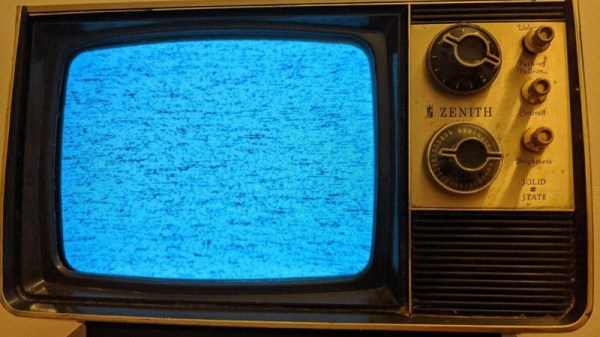
With the huge popularity of retrocomputing and of cyberdecks, we have seen a variety of projects that use a modern computer such as a Raspberry Pi bathed in the glorious glow of a CRT being used as a monitor. The right aesthetic is easily achieved this way, but there’s more to using a CRT display than simply thinking about its resolution. Particularly a black-and-white CRT or a vintage TV has some limitations due to its operation, that call for attention to the design of what is displayed upon it. [Jordan “Ploogle” Carroll] has taken a look at this subject, using a 1975 Zenith portable TV as an example.
The first difference between a flat panel and a CRT is that except in a few cases it has a curved surface and corners, and the edges of the scanned area protrude outside the edges of the screen. Thus the usable display area is less than the total display area, meaning that the action has to be concentrated away from the edges. Then there is the effect of a monochrome display on colour choice, in other words the luminance contrast between adjacent colours must be considered alongside the colour contrast. And finally there’s the restricted bandwidth of a CRT display, particularly when it fed via an RF antenna socket, which affects how much detail it can reasonably convey. The examples used are games, and it’s noticeable how Nintendo’s design language works well with this display. We can’t imagine Nintendo games being tested on black-and-white TV sets in 2022, so perhaps this is indicative of attention paid to design for accessibility.
While they require a bit of respect due to the presence of dangerous voltages, there’s a lot of fun to be had bringing a CRT into 2022. Get one while you still can, and maybe you could have a go at a retro cyberdeck.
84 years ago, a teenager built a TV set in a basement in Hammond, Indiana. The teen was a radio amateur, [John Anderson W9YEI], and since it was the late 1930s the set was a unique build — one of very few in existence built to catch one of the first experimental TV transmitters on air at the time, W9XZV in Chicago. We know about it because of its mention in a 1973 talk radio show, and because that gave a tantalizing description it’s caught the interest of [Bill Meara, N2CQR]. He’s tracking down whatever details he can find through a series of blog posts, and though he’s found a lot of fascinating stuff about early TV sets he’s making a plea for more. Any TV set in the late ’30s was worthy of note, so is there anyone else out there who has a story about this one?
The set itself was described as an aluminium chassis with a tiny 1″ CRT, something which for a 1930s experimenter would have been an expensive and exotic part. He’s found details of a contemporary set published in a magazine, and looking at its circuit diagram we were immediately struck by how relatively simple the circuit of an electrostatically-deflected TV is. Its tuned radio frequency (TRF) radio front end is definitely archaic, but something that probably made some sense in 1939 when there was only a single channel to be received. We hope that [Bill] manages to turn up more information.