How To Get Started With The ESP32

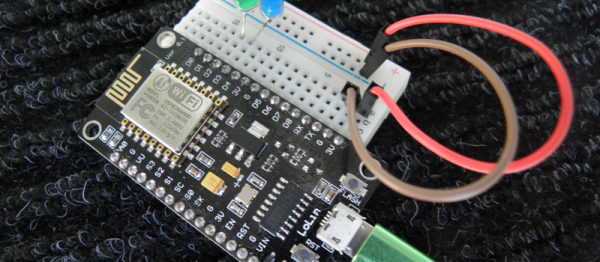
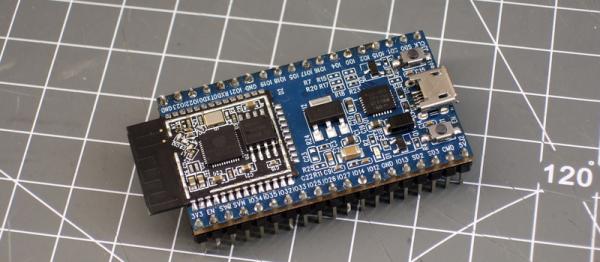
ESP32 is the hottest new wireless chip out there, offering both WiFi and Bluetooth Low Energy radios rolled up with a dual-core 32-bit processor and packed with peripherals of every kind. We got some review sample dev boards, Adafruit and Seeed Studio had them in stock for a while, and AI-Thinker — the company that makes the most popular ESP8266 modules — is starting up full-scale production on October 1st. This means that some of you have the new hotness in your hands right now, and the rest of you aren’t going to have to wait more than a few more weeks.

As we said in our first-look review of the new chip, many things are in a state of flux on the software side, but the basic process of writing, compiling, and flashing code to the chip is going to remain stable. It’s time to start up some tutorials!

Continue reading “How To Get Started With The ESP32”

Hackaday Prize Entry: Under Cabinet LED Lighting Controller

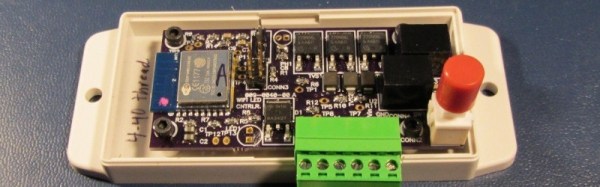
[Matt Meerian]’s workbench seems to be in perpetual shadow, so he has become adept at mounting LED strips under all his shelves and cabinets. These solve any problems involving finding things in the gloom, but present a new problem in that he risks a lot of LED strips being left on, and going round turning them all off is tedious.

His solution is to make a wireless controller for all his home LED strips, under the command of a web app from his Android tablet. An ESP8266 and a set of MOSFETs provide the inner workings, and the whole is presented on a very compact and well-designed purple OSH Park PCB reflow soldered on a $20 Wal-Mart hotplate and set in a plastic enclosure. The web interface is still in development, but has a fairly simple CSS front end for the ESP8266 code. All software, the schematic, and BoM can be downloaded from the Hackaday.io page linked above.

This project isn’t going to end world hunger or stop wars, but it’s beautifully done and well documented, and it makes [Matt]’s life a lot easier. And that makes it a good entry for the Hackaday Prize.

Hackaday Prize Entry: Theia IoT Light-switch

There are it seems no wireless-enabled light switches available in the standard form factor of a UK light switch. At least, that was the experience of [loldavid6], when he decided he needed one. Also, none of the switches he could find were open-source, or easy to integrate with. So he set out to design his own, and the Theia IoT light switch is the result.

In adapting a standard light switch, he was anxious that his device would not depend on the position of the switch for its operation. Therefore he had to ensure that the switch became merely an input to whichever board he designed, rather than controlling the mains power. He settled upon the ESP8266 wireless-enabled microcontroller as the brains of the unit, with a relay doing the mains switching. He first considered using an LNK304 off-line switching PSU chip to derive his low voltages, but later moved to an off-the-shelf switch-mode board.

So far two prototype designs have been completed, one for each power supply option. Boards have been ordered, and he’s now in the interminable waiting period for international postage. All the KiCad and other files are available for download o the project’s hackaday.io page, so you can have a look for yourselves if you are so inclined.

You might ask why another IoT light switch might be needed. But even though they are now available and inexpensive, there is still a gap for a board that is open, and more importantly does not rely on someone else’s cloud backend. Plus, of course, this board can be used for more than lighting.

Light bulb image: Осадчая Екатерина (Own work) [CC BY-SA 4.0], via Wikimedia Commons.

Finding ESP8266 Inside Big-Box Store IoT Plugs

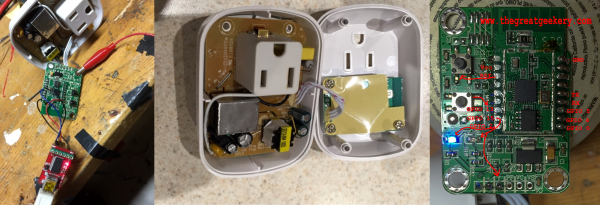
When we buy new shiny toys, we usually open them up to at least have a look. [Scott Gibson] does the same, apparently. He found an ESP8266 module inside the EcoPlug brand WiFi-controlled wall switches.

The original device was intended to be controlled by a (crappy) app. He sniffed the UDP packets enough to send the on-off signals to an unmodified device, but where’s the fun in that? [Scott] gave it an upgrade by replacing the ESP8266’s firmware with his own and now he’s got a much more capable remote switch, one that speaks MQTT like the rest of his home automation system.

Continue reading “Finding ESP8266 Inside Big-Box Store IoT Plugs”

An ESP8266 In Every Light Switch And Outlet

[Hristo Borisov] shows us his clever home automation project, a nicely packaged WiFi switchable wall socket. The ESP8266 has continuously proven itself to be a home automation panacea. Since the ESP8266 is practically a given at this point, the bragging rights have switched over to the skill with which the solution is implemented. By that metric, [Hristo]’s solution is pretty dang nice.

esp8266-smart-lightswitchIt’s all based around a simple board. An encapsulated power supply converts the 220V offered by the Bulgarian power authorities into two rails of 3.3V and 5V respectively. The 3.3V is used for an ESP8266 whose primary concern is the control of a triac and an RGB LED. The 5V is optional if the user decides to add a shield that needs it. That’s right, your light switches will now have their own shields that decide the complexity of the device.

The core module seen to the right contains the actual board. All it needs is AC on one side and something to switch or control on the other The enclosure is not shown (only the lid with the shield connectors is seen) but can be printed in a form factor that includes a cord to plug into an outlet, or with a metal flange to attach to an electrical box in the wall. The modules that mate with the core are also nicely packaged in a 3D printed shield. For example, to convert a lamp to wireless control, you use a shield with a power socket on it. To convert a light switch, use the control module that has a box flange and then any number of custom switch and display shields can be hot swapped on it.

It’s all controllable from command line, webpage, and even an iOS app; all of it is available on his GitHub. We’d love to hear your take on safety, modularity, and overall system design. We think [Hristo] has built a better light switch!

Smartphone TV Remote Courtesy Of Homekit And ESP8266

Good grief, this smartphone-to-TV remote really drives home how simple hardware projects have become in the last decade. We’re talking about a voltage regulator, IR LED, and ESP8266 to add TV control on your home network. The hardware part of the hack is a homemade two sided board that mates an ESP with a micro-USB port, a voltage regulator to step down fom 5 to 3.3 v, and an IR LED for transmitting TV codes.

Let’s sit back and recount our good fortunes that make this possible. USB is a standard and now is found on the back of most televisions — power source solved. Cheap WiFi-enabled microcontroller — check. Ubiquitous smartphones and established protocols to communicate with other devices on the network — absolutely. It’s an incredible time to be a hacker.

Television infrared remote codes are fairly well documented and easy to sniff using tools like Arduino — in fact the ESP IR firmware for this is built on [Ken Shirriff’s] Arduino IR library. The rest of the sketch makes it a barebones device on the LAN, waiting for a connection that sends “tvon” or “tvoff”. In this case it’s a Raspberry Pi acting as the Homekit server, but any number of protocols could be used for the same (MQTT anyone?).

Continue reading “Smartphone TV Remote Courtesy Of Homekit And ESP8266”

Hackaday Prize Entry: Neopixel Pocket Watch

A timepiece is rather a rite of passage in the world of hardware hacking, and we never cease to be enthralled by the creativity of our community in coming up with new ones.

Today’s example comes from [Joshua Snyder], who has made a pocket watch. Not just any pocket watch, he’s taken the shell of a clockwork watch and inserted a ring of Neopixels, which he drives  from an ESP8266 module. Power comes from a small LiPo battery, and he’s cleverly engineered a small push-button switch so that it can be actuated by the knob from the original watch. Different colour LEDs traverse the ring to simulate the hands of a traditional timepiece, and the whole nestles behind the perforated cover of the watch shell for something of a steampunk feel.

He admits the battery life is not very good at the moment, probably because for now the WiFi is always enabled so he can reach its web interface for debugging. Sadly he appears to have not yet posted the software, but he does tell us it uses NTP to update its time, and that it supports over-the-air updating for new versions. He suggests a future version might dispense with the ESP and use an ATtiny or similar with a real-time clock giving better battery life.

We’ve covered a lot of LED timepieces over the years, including quite a few watches. Only a small selection are this PIC LED ring in a pocket watch case, another LED ring this time powered by an ATMega645, and this very stylish OLED wristwatch.