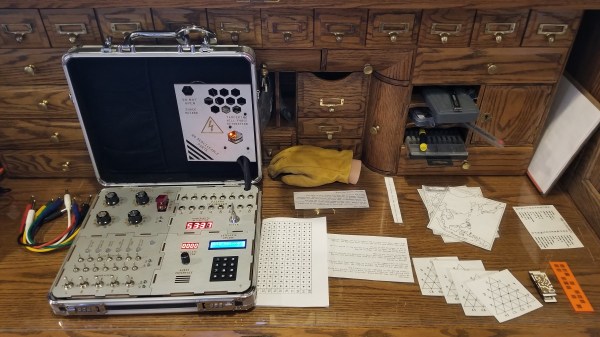
Escape rooms are awesome for people who like to solve puzzles, see how things work, or enjoy a mystery. Everyone reading this falls into at least one of those categories. We enjoy puzzles and mysteries, but we have a fondness for seeing how things work. To this end, we direct your attention to [doktorinjh]’s “Bomb Disarming Puzzle in a Suitcase” Game, which is a mysterious puzzle box he built himself. I guess the mystery is mostly in the gameplay, which you can watch below because he shows us his build photos and describes the hardware inside.
At its heart is an Arduino Mega, a wise choice since our back-of-the-napkin estimation puts his I/O count over forty-five and the Mega can handle them all with a few pins to spare. Working inside the confines of a briefcase came with its own challenges, but we adore the way he used the hexagon theme in the top panel to allow for knob clearance. It was so subtle that we almost missed it.
The escape room theme is delightful, and we appreciate the mix of games, aesthetics, and techno-trickery in many forms.
Continue reading “In Case You Cannot Make It To An Escape Room”