LED-ifying A Guitar

Say you have a guitar, an expensive guitar – one of only three like it. And say this guitar sounds great, but it’s missing something. It needs something, but something that won’t ruin the finish. Over at Sparkfun, [Englandsaurus] was asked to come up with a really cool looking mod to a three-of-a-kind guitar – covering the body with LED strips to create light patterns on the guitar.

In order not to damage or modify the guitar [Englandsaurus] sandwiched the body between two plexiglass sheets, connected together by 3D printed clips. The clips have a dual purpose – they hold the plexiglass pieces to the guitar and also act as conduits for a pair of fiber optic tubes that run around the edge of the body. In order that the color goes all the way around the guitar’s edge without a break in the light, the fiber optic cables are offset. At each clip light is fed into them. One cable runs between two clips, skipping one in between, and the second cable runs between the skipped clips. This allows light to flow around the guitar’s body.

At nearly 500W at full-white, these LEDs draw a lot of power, however, at full brightness they’re overpoweringly bright, so [Englandsaurus] used some WonderFlex, a moldable, diffuse plastic sheet, to cover them. Even with this, the LEDs aren’t run at full brightness. The fiber optic cables, though, need full brightness due to their covering.

Around 1600 LEDs went in to this mod and the guitar itself hasn’t been modified.  Everything is removable, and the guitar would go back to its original self if the strips were taken off. Take a look at Strumbot, another project where the original guitar wasn’t modified, or a really cool scrap metal guitar.


Continue reading “LED-ifying A Guitar”

The Boldport Cordwood And Cuttlefish, Together As A Guitar Tuner

As regular readers will know, here at Hackaday we are great enthusiasts for the PCB as an art form. On a special level of their own in that arena are the Boldport kits from [Saar Drimer], superlative objets d’art that are beautifully presented and a joy to build.

The trouble some people find with some of their Boldport kits though is that they are just too good. What can you do with them, when getting too busy with hacking them would despoil their beauty? [Paul Gallagher] has the answer in one case, he’s used not one kit but two of them as for a guitar tuner project.

At its heart is a Boldport Cuttlefish ATmega328 development board, and for its display it uses a Cordwood Puzzle as an LED array. All the details are available on a GitHub page, and it’s a modified version of an Arduino guitar tuner he found on Instructables. In particular he’s using a different pre-amp for an electret microphone, and a low-pass filter with a 723Hz cut-off to reduce harmonic content that was confusing the Arduino’s algorithm.

The result is a simple-to-use device with an LED for each string of his guitar, which you can see in the very short YouTube clip below. It joins many other tuners we’ve featured over the years, of which just one is this ATmega168-powered project with MIDI-out.

Continue reading “The Boldport Cordwood And Cuttlefish, Together As A Guitar Tuner”

DIY Scrap Guitar Really Shreds

[Keith Decent] recently got himself involved in a plywood challenge, and decided to make a single-pickup electric guitar. Since he is a prolific hoarder of scrap wood, the result is a lovely stack of laminates from many sources, including reclaimed cabinet doors. Really though, the wood is just the beginning—nearly every piece of this texture-rich axe started life as something else.

He’s made a cigar box guitar before, but never a bona fide solid-body electric. As you might guess, he learned quite a bit in the process. [Keith] opted for a neck-through design instead of bolting one on and using a truss rod. The face pieces are cut from his old bench top, which has a unique topology thanks to several years of paint, glue, and other character-building ingredients.

We love the geometric inlay [Keith] made for the pick guard, and the fact that he used an offcut from the process as a floating bridge. He also made his own pickup from bolts, an old folding rule, and reclaimed magnet wire from discarded wall wart transformers. Once he routed out the body and installed the electronics, [Keith] cut up an old painting he’d done on plywood to use as the back panel. Our only complaint about this beautiful guitar is that he didn’t design the back piece to be dinosaur side out. Shred past the break to give her a listen.

[Keith] wound his pickup with a little help from a drill, but a DIY pickup winder might have caused him less grief.

Continue reading “DIY Scrap Guitar Really Shreds”

Stomping On Microcontrollers: Arduino Mega Guitar Effects Pedal

Effects pedals: for some an object of overwhelming addiction, but for many, an opportunity to hack. Anyone who plays guitar (or buys presents for someone who does) knows of the infinite choice of pedals available. There are so many pedals because nailing the tone you hear in your head is an addictive quest, an itch that must be scratched. Rising to meet this challenge are a generation of programmable pedals that can tweak effects in clever ways.

With this in mind, [ElectroSmash] are back at it with another open source offering: the pedalSHIELD MEGA. Aimed at musicians and hackers who want to learn more about audio, DSP and programming, this is an open-hardware/open-software shield for the Arduino MEGA which transforms it into an effects pedal.

The hardware consists of an analog input stage which amplifies and filters the incoming signal before passing it to the Arduino, as well as an output stage which does the DAC-ing from the Arduino’s PWM outputs, and some more filtering/amplifying. Two 8-bit PWM outputs are used simultaneously to make pseudo 16-bit resolution — a technique you can read more about in their handy forum guide.

The list of effects currently implemented covers all the basics you’d expect, and provides a good starting point for writing custom effects. Perhaps a library for some of the commonly used config/operations would be useful? Naturally, there are some computational constraints when using an Arduino for DSP, though it’s up to you whether this is a frustrating fact, or an opportunity to write some nicely optimised code.

[ElectroSmash] don’t just do pedals either: here’s their open source guitar amp.

Continue reading “Stomping On Microcontrollers: Arduino Mega Guitar Effects Pedal”

DIY Mini-Amp Goes To Eleven

On the day mini-amps were invented, electric guitar players the world over rejoiced.  No longer would they be house-bound when jamming out on their favourite guitar. It is a doubly wondrous day indeed when an electric guitar-inclined maker realizes they can make their own.

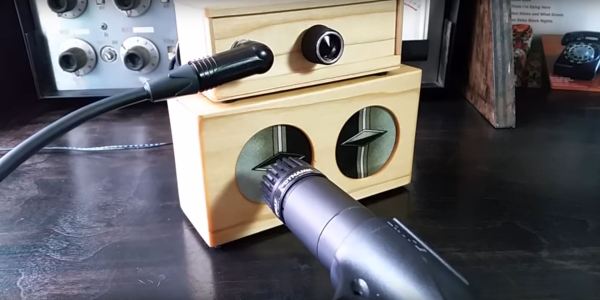
[Frank Olson Music] took apart an old pair of headphones and salvaged the speakers — perhaps intending to replicate a vintage sound — and set them aside. Relying on the incisive application of an X-Acto knife, [Olson] made swift work cutting some basswood planks into pieces of the amp before gluing them together — sizing it to be only just bigger than the speakers. A tie was also shown no mercy and used as a dapper grille screen. Both the head and speaker cabinets were sanded and stained for a matching finish.

Continue reading “DIY Mini-Amp Goes To Eleven”

Wah-Wah-Won’t, To Wah-Wah-Will

This is the tale of [Chris], who discovered he was no [Jimi Hendrix] in his youth, and shelved his trusty wah-wah pedal as a result. Many years later as a bassist with more modest aims he brought it out of retirement and built a blend pedal kit to allow him to bring in a bit of wah to the mix when he wanted it, but as more of a Voodoo Grown-Up than the full Voodoo Chile.

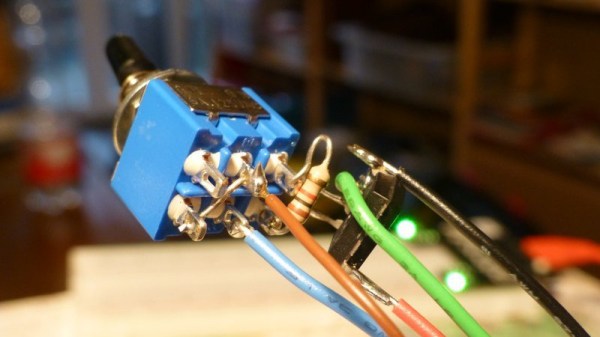
The kit worked and he should have been happy with it, but for one thing. As he increased the mix on the loop box instead of getting more wah he simply got less volume. A bit of detective work reached the conclusion that the old pedal was inverting everything, and that he needed to put in a circuit to correct that when needed. A single op-amp and a switch, with the op-amp circuit dead-bug-style on the back of the switch, completed the modification.

Wah pedals seem to be a recurring feature here. We’ve brought you one made of Lego among many others, as well as one repurposed as a synth controller.

Strumbot: The Guitar That Strums Itself

[Clare] isn’t the most musically inclined person, but she can strum a guitar. Thanks to a little help from an Arduino, she doesn’t even have to do that.

She built the strumbot, which handles the strumming hand duties of playing the guitar. While [Claire] does believe in her strumbot, she didn’t want to drill holes in her guitar, so hot glue and double-sided foam tape were the order of the day.

The business end of the strumbot is a micro servo. The servo moves two chopsticks and draws the pick across the strings. The tiny servo surprisingly does a great job getting the strings ringing. The only downside is the noise from the plastic gears when it’s really rocking out.

Strumbot’s user interface is a 3D-printed case with three buttons and three LEDs. Each button activates a different strum pattern in the Arduino’s programming. The LEDs indicate the currently active pattern. Everything is powered by a USB power pack, making this a self-contained hack.

[Clare] was able to code up some complex strum patterns, but the strumbot is still a bit limited in that it only holds three patterns. It’s good enough for her rendition of “Call Me Maybe”, which you can see in the video after the break. Sure, this is a simple project, not nearly as complex as some of the robotic guitar mods we’ve seen in the past. Still, it’s just the ticket for a fun evening or weekend project – especially if you’re introducing the Arduino to young coders. Music, hacking, and modding – what more could you ask for?

Continue reading “Strumbot: The Guitar That Strums Itself”