Hackaday Links Column Banner

Hackaday Links: March 20, 2022

Well, that de-escalated quickly! It was less than a week ago that the city of Shenzhen, China was put on lockdown due to a resurgence of COVID-19 in the world’s electronics manufacturing epicenter. This obviously caused no small amount of alarm up and down the electronics supply chain, promising to once again upset manufacturers seeking everything from PCBs to components to complete electronic assemblies. But just a few days later, the Chinese government announced that the Shenzhen lockdown was over. At least partially, that is — factories and public transportation have been reopened in five of the city’s districts, with iPhone maker Foxconn, one of the bigger players in Shenzhen, given the green light to partially reopen. What does this mean for hobbyists’ ability to get cheap PCBs made quickly? That’s hard to say, at least at this point. Please feel free to share your experiences with any supply chain disruptions in the comments below.

Better news from a million miles away, as NASA announced that the James Webb Space Telescope finished the first part of its complex mirror alignment procedure. The process, which uses the complex actuators built into each of the 18 hexagonal mirror segments, slightly moves each mirror to align them all into one virtual optical surface. The result is not only the stunning “selfie” images we’ve been seeing, but also a beautiful picture of the star Webb has been focusing on as a target. The video below explains the process in some detail, along with sharing that the next step is to move the mirrors in and out, or “piston” them, so that the 18 separate wavefronts all align to send light to the instruments in perfect phase. Talk about precision!

Is a bog-standard Raspberry Pi just not tough enough for your application? Do you need to run DOOM on a  platform that can take a few g of vibration and still keep working? Sick of your Pi-based weather station breaking own when it gets a little wet or too hot? Then you’ll want to take a look at the DuraCOR Pi, a ruggedized chassis containing a Pi CM4 that’s built for extreme environments. The machine is in a tiny IP67-rated case and built to MIL-STD specs with regard to vibration, temperature, humidity, and EMI conditions. This doesn’t really seem like something aimed at the hobbyist market — it’s marketed by Curtiss-Wright Defense Solutions, a defense contractor that traces its roots all the way back to a couple of bicycle mechanics from Ohio that learned how to fly. So this Pi is probably more like something you’d spec if you were building a UAV or something like that. Still, it’s cool to know such things are out there.

BrainLubeOnline has a fun collection of X-rays. With the exception of a mouse — the other kind — everything is either electronic or mechanical, which makes for really interesting pictures. Seeing the teeth on a gear or the threads on a screw, and seeing right through the object, shows the mechanical world in a whole new light — literally.

And finally, would you buy a car that prevents you from opening the hood? Most of us probably wouldn’t, but then again, most of us probably wouldn’t buy a Mercedes EQS 580 electric sedan. Sarah from Sarah -n- Tuned on YouTube somehow got a hold of one of these babies, which she aptly describes as a “German spaceship,” and took it for a test drive, including a “full beans” acceleration test. Just after that neck-snapping ride, at about the 7:20 mark in the video below, she asks the car’s built-in assistant to open the hood, a request the car refused by saying, “The hood may only be opened by a specialist workshop.”  Sarah managed to get it open anyway, and it’s not a frunk — it’s home to one of the two motors that power the car, along with all kinds of other goodies.
Put A Little Piece Of The James Webb On Your Wall

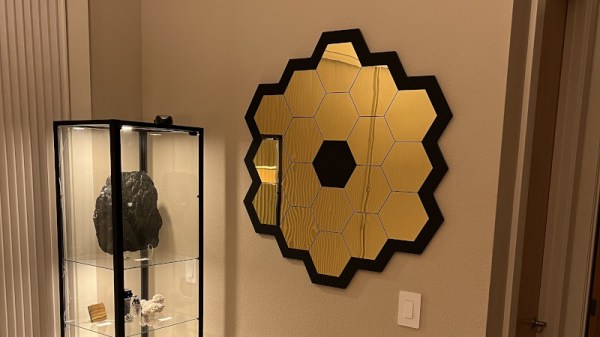
The James Webb Space Telescope (JWST) has become something of a celebrity here on Earth, and rightfully so. After decades of development, the $10 billion deep space observatory promises to peel back the mysteries of the universe in a way that simply hasn’t been possible until now. Plus, let’s be honest, the thing just looks ridiculously cool.

So is it really such a surprise that folks would want a piece of this marvel hanging up in their wall? No, it’s not the real thing, but this rendition of the JWST’s primary mirror created by [James Kiefer] and [Ryan Kramer] certainly gets the point across.

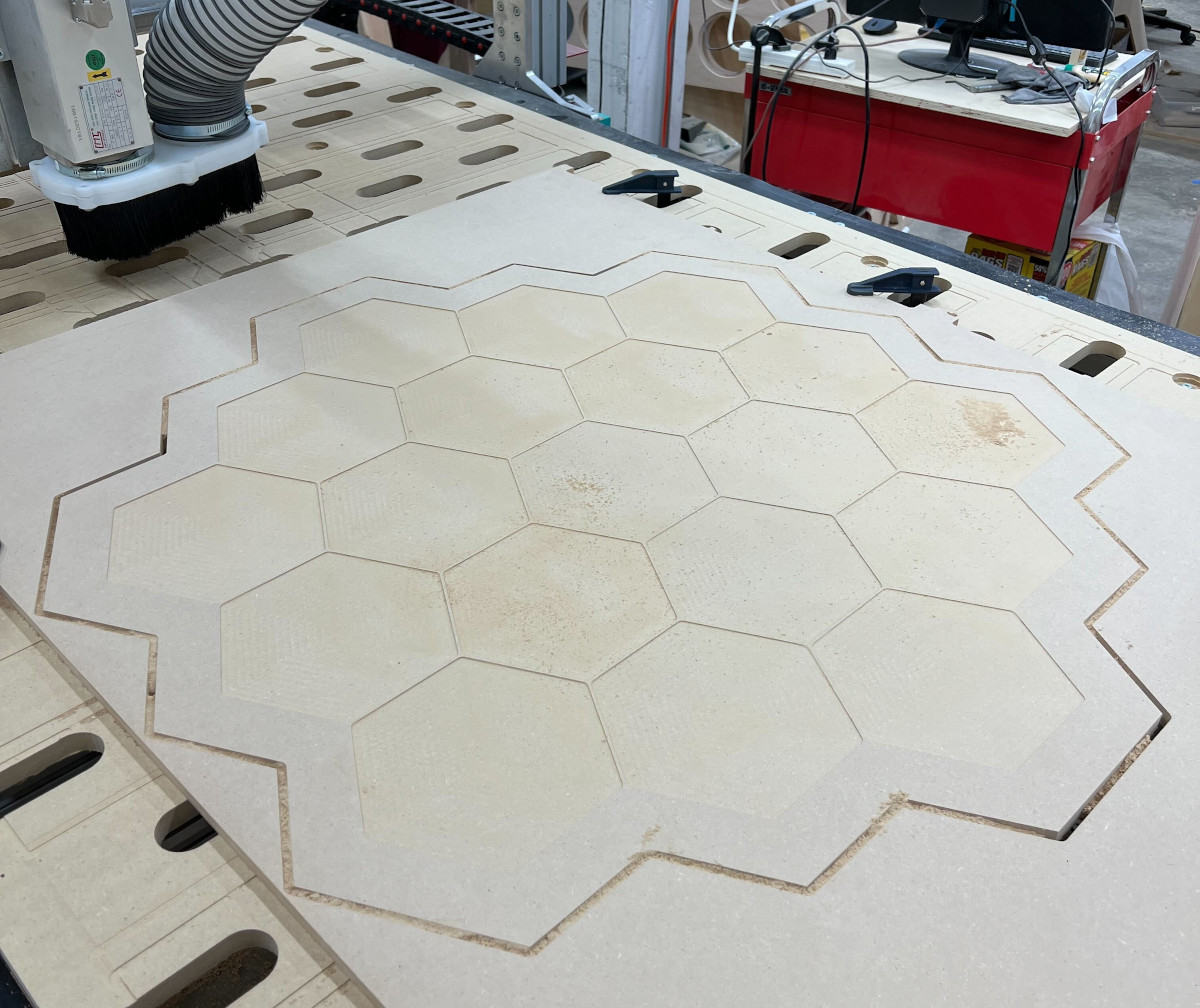
A CNC router was used to cut the outside shape from a piece of 1/2 inch MDF, as well as put 1 mm deep pockets in the face to accept the hexagonal golden acrylic mirrors. We originally thought the mirrors were also custom made, but somewhat surprisingly, gold-tinted hex mirrors are apparently popular enough in the home decor scene that they’re readily available online for cheap. A quick check with everyone’s favorite a large online bookseller turned global superpower shows them selling for as little as $0.50 a piece.

With a coat of black paint on the MDF, the finished piece really does look the part. We imagine it’s fairly heavy though, and wonder how it would have worked out if the back panel was cut from a piece of thick foam board instead.

Of course this isn’t a terribly difficult design to recreate if you had to, but we still appreciate that the duo has decided to release both the Fusion 360 project file and the exported STL to the public. It seems only right that this symbol for science and discovery should be made available to as many people as possible.

After a dramatic launch on Christmas Day and a perilous flight through deep space, the JWST has performed impeccably. Even though we’re still a several months away from finally seeing what this high-tech telescope is capable of, it’s already managed to ignite the imaginations of people all over the globe.

Hackaday Links Column Banner

Hackaday Links: February 13, 2022

If you need evidence that our outwardly peaceful little neck of the solar system is actually a dangerous place, look no further than the 40 newly launched Starlink satellites that were just clobbered out of orbit. It seems that the SpaceX launch on February 3 was ill-timed, as it coincided with the arrival of energetic plasma from a solar storm that occurred a few days before. The coronal mass ejection followed an M-class flare on the Sun, which was aimed just right to hit just as the 49-satellite addition to the Starlink constellation was being released. This resulted in an expansion of the upper atmosphere sufficient to increase drag on the newborn satellites — up to 50% more drag than previous launches had encountered. Operators put the satellites into safe mode, but it appears that 40 of them have already met a fiery demise, or soon will. Space is a tough place to make a living.

Continue reading “Hackaday Links: February 13, 2022”

JWST mirror actuator model

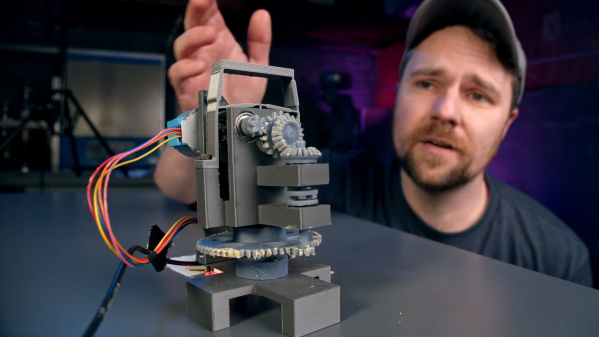
Working Model Reveals Amazing Engineering Of Webb’s Mirror Actuators

We end up covering a lot of space topics here on Hackaday, not because we’re huge space nerds — spoiler alert: we are — but because when you’ve got an effectively unlimited budget and a remit to make something that cannot fail, awe-inspiring engineering is often the result. The mirror actuators on the James Webb Space Telescope are a perfect example of this extreme engineering, and to understand how they work a little better, [Zachary Tong] built a working model of these amazing machines.

The main mirror of the JWST is made of 18 separate hexagonal sections, the position of each which must be finely tuned to make a perfect reflector. Each mirror has seven actuators that move it through seven degrees of freedom — the usual six that a Stewart platform mechanism provides, plus the ability to deform the mirror’s curvature slightly. [Zach]’s model actuator is reverse-engineered from public information (PDF) made available by the mirror contractor, Ball Aerospace. While the OEM part is made from the usual space-rated alloys and materials, the model is 3D printed and powered by a cheap stepper motor.

That simplicity belies the ingenious mechanism revealed by the model. The actuators allow for both coarse and fine adjustments over a wide range of travel. A clever tumbler mechanism means that only one motor is needed for both fine and coarse adjustments, and a flexure mechanism is used to make the fine adjustments even finer — a step size of only 8 nanometers!

Hats off to [Zach] for digging into this for us, and for making all his files available in case you want to print your own. You may not be building a space observatory anytime soon, but there’s plenty about these mechanisms that can inform your designs.

Continue reading “Working Model Reveals Amazing Engineering Of Webb’s Mirror Actuators”

Hackaday Links Column Banner

Hackaday Links: January 30, 2022

After all the fuss and bother along the way, it seems a bit anticlimactic now that the James Webb Space Telescope has arrived at its forever home orbiting around L2. The observatory finished its trip on schedule, arriving on January 24 in its fully deployed state, after a one-month journey and a couple of hundred single-point failure deployments. The next phase of the mission is commissioning, and is a somewhat more sedate and far less perilous process of tweaking and trimming the optical systems, and getting the telescope and its sensors down to operating temperature. The commissioning phase will take five or six months, so don’t count on any new desktop photos until summer at the earliest. Until then, enjoy the video below which answers some of the questions we had about what Webb can actually see — here’s hoping there’s not much interesting to see approximately in the plane of the ecliptic.

Continue reading “Hackaday Links: January 30, 2022”

Hackaday Links Column Banner

Hackaday Links: January 16, 2022

As winter well and truly grips the northern hemisphere, it’s time once again to dunk on Tesla for leaving some owners out in the cold — literally. It seems that some Model 3 and Model Y owners are finding their ride’s heat pump isn’t exactly up to the task of, you know, pumping heat. That this seems to be happening mostly in the northeastern US and southern Canada, where a polar vortex is once again dominating the weather and driving temperatures down into the -30 °C (-22 °F) range, perhaps speaks more to the laws of thermodynamics than it does to the engineering of the Tesla climate control system. After all, if there’s not much heat outside the car, it’s hard to pump it inside. But then again, these are expensive machines, some of which have had extensive repairs to address this exact same issue when it cropped up last year. It seems to us that owners have a legitimate gripe with Tesla about this, and they may be getting some help from the Feds, who are taking an interest in the situation from a safety standpoint. After all, no heat likely means fogged up windows, and that’s hardly conducive to a safe trip. But hey, that’s what self-driving is for, right?

Much has been made of the dearth of engineering cameras on the James Webb Space Telescope, and the fact that we’ve been relying on animations to illustrate the dozens of deployments needed to unfurl the observatory and make it ready for its mission. Putting aside the fact that adding extra cameras to the spacecraft makes little sense since the interesting stuff was all happening on the side where the sun doesn’t shine, we did get treated to what was billed as “humanity’s last look at Webb” thanks to an engineering camera on the Ariane 5 rocket. But not so fast — an astrophotographer named Ethan Gone managed to spot the JWST as it transited to L2 the day after launch. Granted, the blip of light isn’t as spectacular as the Ariane shots, and it took a heck of a lot of astrophotography gear to do it, but it’s still thrilling to watch Webb moving gracefully through Orion.

Continue reading “Hackaday Links: January 16, 2022”

Hackaday Links Column Banner

Hackaday Links: January 9, 2022

It looks like we have a new space observatory! According to NASA, all the major deployments on the James Webb Space Telescope have been completed successfully. This includes the tricky sunshield deployment and tensioning, which went off this week without much in the way of trouble. The final major deployment, the unfolding of the starboard wing of the primary mirror of the telescope, was completed on Saturday while the spacecraft was still almost 400,000 km from its forever home orbiting Lagrange point L2. Mission controllers had allotted two weeks for the 300-odd deployments needed to turn the packaged machine into a working observatory. The remaining two weeks or so of flight include less dramatic tasks, such as trimming the shape of the primary mirror with servos that subtly alter the position and curvature of each of the 18 segments, plus a bunch of calibration tasks. But it looks like most of the really scary stuff is behind us now.

From the “Interesting Innards” department, if you’re a fan of either gaming or industrial CT scans, check out Scan of the Month’s look inside Nintendo handheld game consoles. They’ve put a bunch of games through computed tomography scans, and the results are really interesting, false-colored though they may be. Seeing the progression of technology from the original 1989 Game Boy to the Switch is fascinating. The side notes on the history and tech inside each one are pretty cool too.

A couple of weeks ago we mentioned Andrew Sink’s online low-poly generator, which takes any 3D model and allows you to control the number of polygons used to render it. He dropped us a line to let us know the tool proved popular enough that he had to move it off GitHub and onto a dedicated site. Check it out at its new home.

When something like this pops up in your feed, it seems like the best approach is to share it. It’s called DentalSlim, and claims to be the first intra-oral device designed for weight loss. It’s a hardware lock for your teeth, and it looks perfectly horrifying. The device is designed to be applied by a sadist dentist and effectively locks the lower jaw to the upper with magnets, allowing the wearer to open his or her mouth only enough to take a liquid diet. There’s also a provision for the wearer to unlock the device in an emergency, which is wise — can you imagine catching a stomach bug with your jaw locked shut? — but that seems to defeat the “hardware-enforced willpower” that the device is based on.

Have you got a bunch of filament spools lying around from all that 3D printing? Rather than put them to use rolling up strings of lights from the Christmas tree, here’s another idea: turn them into nice covered bird feeders. All you need to do is apply a rim around one side to hold the seed before hanging them out for the birds. We suppose walling off the space between the sides completely and drilling some holes could also turn them into birdhouses, too.

And finally, if your filament spool bird feeder isn’t attracting the attention of the neighborhood cats, perhaps it’s because they’ve found a nice, cozy spot to soak up some heat. At least that’s what some Starlink users are seeing as their feline friends cuddle up on Dishy McFlatface for a long winter’s nap. You see, the phased array antenna inside the enclosure gets pretty toasty, and cats are pretty much any-port-in-a-storm critters, so it’s only natural. We can’t imagine their choice of basking locale does much for data throughput, and it’s probably quite a laugh when the dish pivots to track a satellite. But it’s hard to feel sorry for something that sleeps 23-½ hours a day.