500 Lasers Are Not Necessarily Better Than One, But They Look Great

If playing with but a single laser pointer is fun, then playing with 500 laser pointers must be 500 times the fun, right? So by extension, training 500 laser pointers on a single point must be the pinnacle of pointless mirth. And indeed it is.

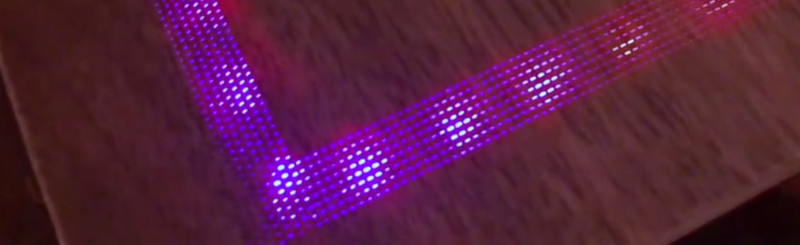
When we first spotted this project, we thought for sure it was yet another case of lockdown-induced  boredom producing an over-the-top build. Mind you, we have no problem with that, but in this case, [nanoslavic] relates that this is actually a project from a few years back. It’s really as simple as it looks: 500 laser pointer modules arranged on a plate with a grid of holes in a 25 by 20 array. As he placed the laser modules on the board with a glob of hot glue, he carefully aimed each one to hit a single point about a meter and a half away.  There are also a handful of blue LEDs nestled into the array, because what project is complete without blue LEDs?

The modules are wired in concentric circuits and controlled by a simple bank of toggle switches. Alas, 500 converging 150-mW 5 mW lasers do not a 75-W 2.5 W laser make; when fully powered, the effect at the focal point is reported to be only a bit warm. But it looks incredible, especially through smoke. Throwing mirrors and lenses into the beam results in some interesting patterns, too.

You’ll still need to take safety seriously if you build something like this, of course, but this one is really just for show. If you’re really serious about doing some damage with lasers, check out the long list of inadvisable laser builds that [Styropyro] has accumulated — from a high-powered “lightsaber” to a 200-Watt laser bazooka.

(Terminate your beams carefully, folks. We don’t want anyone going blind.)

Continue reading “500 Lasers Are Not Necessarily Better Than One, But They Look Great”

High Speed The Way We Want It

The one thing we have learned over the current pandemic is that we need the internet, and the faster the better. Though cost is surely a hurdle, the amount of bandwidth available has its bottlenecks rooted from the underlying technology. Enter new technology from an Australian Research team who have claimed to have field tested internet speeds as fast at 44.2 terabits per second.

The breakthrough in bandwidth is attributed to a new optical chip that employs optical frequency combs or micro-comb, and has been published by [Corcoran et al] of Monash University. The team exploits the ability of certain crystals to create resonant optical fields called solitons and these form highly efficient optical transmission system. For the uninitiated, optical frequency combs are an optical spectrum of equidistant lines whose values if fixed, can be used to measure unknown frequencies. The original discovery earned Roy J. Glauber, John L. Hall and Theodor W. Hänsch the Nobel Prize in Physics in 2005, and though it is a relatively new field it has seen a lot of activity in the research community.

The experimental setup has a resonator with a free spectral range spacing of 48.9GHz, and from the generated optical fields or lines, 80 were selected. Using a side-band modulator the bands were doubled and eventually with 64 QAM modulation facilitated a symbol rate of 23 Gigabaud. Now at this point, the paper says that this experiment is still an under-utilization of the available resources. The extra connectivity speed may be helpful in gaming and streaming but we will be needing faster drives to get our emails attachments downloaded faster. If you are inspired and want to play with lasers and optical communications, check out the DIY Laser Optical Link.

Thanks [Anil Pattni] for the tip.

Tiny Laser Cutter Puts Micro Steppers To Work

The influx of cheap laser cutters from China has been a boon to the maker movement, if at the cost of a lot of tinkering to just get the thing to work. So some people just prefer to roll their own, figuring that starting from scratch means you get exactly what you want. And apparently what [Mike Rankin] wanted was a really, really small laser cutter.

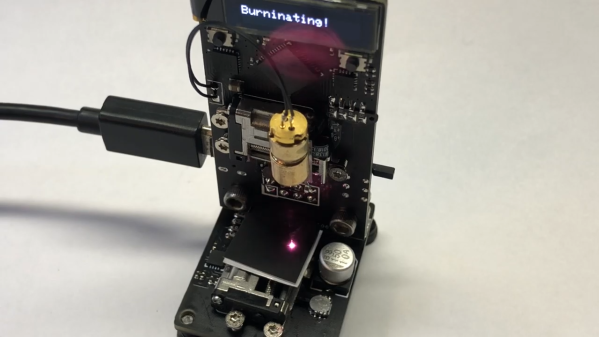
The ESP32 Burninator, as [Mike] lovingly calls his creation, is small enough to be in danger of being misplaced accidentally. The stage relies on tiny stepper-actuated linear drives, available on the cheap from AliExpress. The entire mechanical structure is two PCBs — a vertical piece that holds the ESP32, an OLED display, the X-axis motor, and the driver for the laser, which comes from an old DVD burner; a smaller bottom board holds the Y-axis and the stage. “Stage” is actually a rather grand term for the postage-stamp-sized working area of this cutter, but the video below shows that it does indeed cut black paper.

The cuts are a bit wonky, but this is surely to be expected given the running gear, and we like it regardless. It sort of reminds us of that resin 3D-printer small enough to fit in a Christmas ornament that [Sean Hodgins] did a while back. We’d suggest not trying to hang this on a tree, though.

Continue reading “Tiny Laser Cutter Puts Micro Steppers To Work”

Why Does Solder Smoke Always Find Your Face?

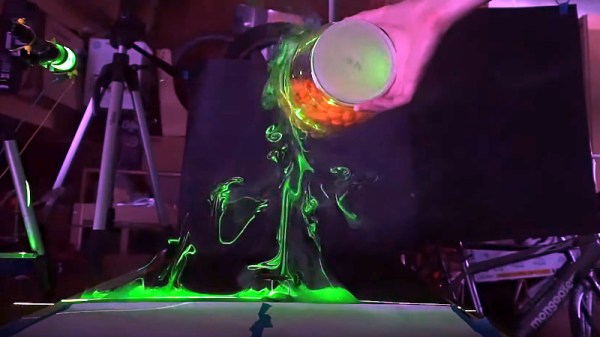
For some of us the smell of rosin soldering flux vaporizing from the tip of an iron as a project takes shape is as evocative as the scent of a rose on a summer’s day. We’ve certainly breathed enough of it over the years, as it invariably goes from the piece of work directly into the face of the person doing the soldering. This is something that has evidently troubled [AlphaPhoenix], who has gone to extravagant lengths to research the problem using planar laser illumination and a home-made (and possibly hazardous) smoke generator.

He starts with a variety of hypotheses with everything from a human-heat-driven air vortex to the Coandă effect, but draws a blank with each one as he models them using cardboard cut-outs and boxes as well as himself. Finally he has the light bulb moment and discovers that the key to the mystery lies in his arms coming across the bench to hold both iron and solder. They close off an area of lower-pressure dead space which draws the air current containing the smoke towards it, and straight into his face.  It’s something that can be combated with a small fan or perhaps a fume extractor, as despite some video trickery we have yet to master soldering iron telekinesis.

Continue reading “Why Does Solder Smoke Always Find Your Face?”

Open Source Raman Spectrometer Is Cheaper, But Not Cheap

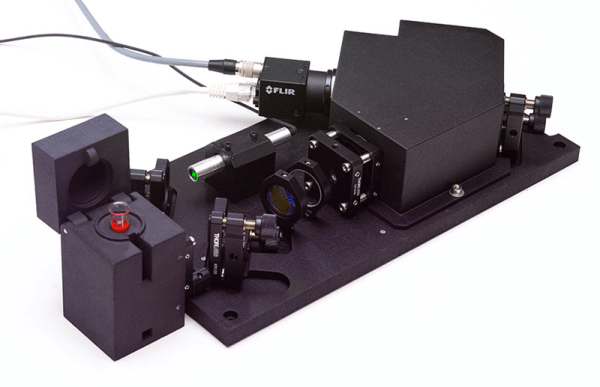
Raman spectrography uses the Raman scattering of photons from a laser or other coherent light beam to measure the vibrational state of molecules. In chemistry, this is useful for identifying molecules and studying chemical bonds. Don’t have a Raman spectroscope? Cheer up! Open Raman will give you the means to build one.

The “starter edition” replaces the initial breadboard version which used Lego construction, although the plans for that are still on the site, as well. [Luc] is planning a performance edition, soon, that will have better performance and, presumably, a greater cost.

Continue reading “Open Source Raman Spectrometer Is Cheaper, But Not Cheap”

Open Laser Blaster Shells Out More Bang For The Buck

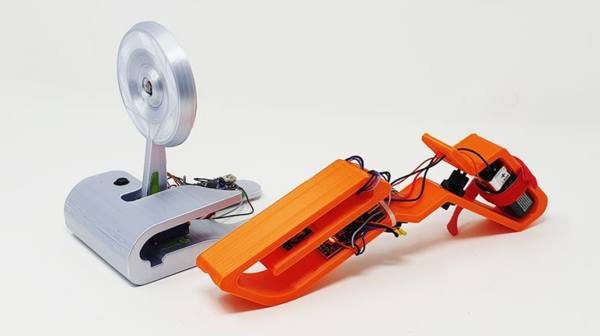
[a-RN-au-D] was looking for something fun to do with his son and dreamed up a laser blaster game that ought to put him in the running for father of the year. It was originally just going to be made of cardboard, but you know how these things go. We’re happy the design went this far, because that blaster looks fantastic.

Both the blaster and the target run on Arduino Nanos. There’s a 5mW laser module in the blaster, and a speaker for playing the pew pew-related sounds of your choice. Fire away on the blaster button, and the laser hits a light-dependent resistor mounted in the middle of the target. When the target registers a hit, it swings backward on a 9g servo and then returns quickly to vertical for the next shot.

There are some less obvious features that really make this game a hit. The blaster can run in 10-shooter mode (or 6, or whatever you change it to in the code) with a built-in reload delay, or it can be set to fully automatic. If you’re short on space or just get sick of moving the target to different flat surfaces, it can be mounted on the wall instead — the target moves forward when hit and then resets back to flat. Check out the demo video we loaded up after the break.

No printer? No problem — here’s a Node-RED shooting gallery that uses simple wooden targets.

Continue reading “Open Laser Blaster Shells Out More Bang For The Buck”

Human-Powered Laser Gun Makes Battery-Free Target Practice

[Dirk] shared a fascinating project of his that consists of several different parts coming together in a satisfying whole. It’s all about wanting to do target practice, indoors, using a simple red laser dot instead of any sort of projectile. While it’s possible to practice by flashing a red laser pointer and watching where it lands on a paper target, it’s much more rewarding (and objective) to record the hits in some way. This is what led [Dirk] to create human-powered, battery-free laser guns with software to track and display hits. In the image above, red laser hits on the target are detected and displayed on the screen by the shooter.

Right under the thumb is the pivot point for the lever, and that’s also where a geared stepper motor (used as a generator) is housed. Operating the action cranks the motor.

There are several parts to this project and, sadly, the details are a bit incomplete and somewhat scattered around, so we’ll go through the elements one at a time. The first is the guns themselves, and the star of the show is his 3D printed cowboy rifle design. The rifle paints the target with a momentary red laser dot when the trigger is pressed, but that’s not all. [Dirk] appears to have embedded a stepper motor into the lever action, so that working the lever cranks the motor as a generator and stores the small amount of power in a capacitor. Upon pulling the trigger, the capacitor is dumped into the laser (and into a piezo buzzer for a bit of an audio cue, apparently) with just enough juice to create a momentary flash. We wish [Dirk] had provided more details about this part of his build. There are a few more images here, but if you’d like to replicate [Dirk]’s work it looks like you’ll be on your own to some extent.

As for the target end of things, blipping a red dot onto a paper target and using one’s own eyeballs can do the job in a bare minimum sort of way, but [Dirk] went one further. He used Python and OpenCV with a camera to watch for the red dot, capture it, then push an image of the target (with a mark where the impact was detected) to a Chromecast-enabled screen near the shooter. This offers much better feedback and allows for easier scoring. The GitHub repository for the shot detector and target caster is here, and while it could be used on its own to detect any old laser pointer, it really sings when combined with the 3D printed cowboy rifle that doesn’t need batteries.

Not using projectiles in target practice does have some benefits: it’s silent, it’s easy to do safely, there is no need for a backstop, there are no consumables or cleaning, and there is no need to change or patch targets once they get too many holes. Watch it all in action in the video embedded below.

Continue reading “Human-Powered Laser Gun Makes Battery-Free Target Practice”