Testing IR Camera Blocking

[youtube=http://www.youtube.com/watch?v=0u5hAfnq2-4&hl=en&fs=1&rel=0][randy] from F.A.T. tested the theory that infrared LEDs can actually hide you from the prying eyes of surveillance cameras. We’ve previously covered camouflage, IR, and other suggestions for eluding the cameras, but haven’t taken to sewing stuff onto our clothes yet. [randy] lined his hoodie with high-intensity infrared LEDs, hoping to create a halo effect that would hide his head, and tested his results. Unfortunately, his efforts were unsuccessful. He tested many many different combinations and we’re confident in his conclusion that it would be very hard to make this work.

SMD Soldering Practice Kit


Here’s an interesting kit put together just to help you work on your SMD soldering skills. It’s got 49 SMD LEDs on the front with a programming header and switch jumper. The back has an ATtiny26L and a coin cell. At only 3V, power management is essential; all of the example programs are only addressing one LED at a time (imperceptible to the human eye). If you turn on too many LEDs at the same time, the voltage drop could cause the AVR to reset. Included example programs are a scrolling marque, bouncing balls, and Conway’s game of life. SparkFun has tutorials for regular SMD soldering and using a reflow skillet. The video below shows the kit builder attaching just one LED using the heat and slide method.

Continue reading “SMD Soldering Practice Kit”

LED Floor Captures Digital Footprints

[youtube=http://www.youtube.com/watch?v=NpRE6CM3oOY&hl=en&fs=1&rel=0&color1=0x3a3a3a&color2=0x999999]
Sensacell created a unique interactive flooring system for the 2008 World Expo in Zaragoza, Spain. Comprised of 1000 LED panels, the 250 foot installation is covered in architectural glass and lights up in response to pressure. We like what different people are doing in this clip; from walking in a line to dragging a mop over the floor, the results are undeniably captivating and ultimately irresistible.

[via Gizmodo]

PoiPlay – LED Poi


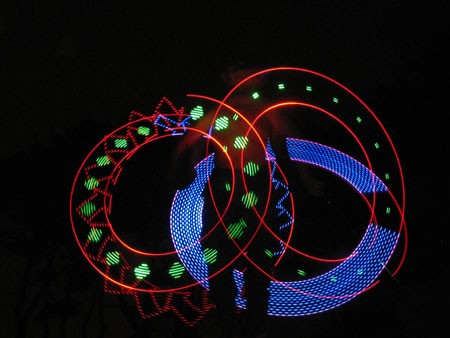
PoiPlay is an elegant mix of new technology and traditional medium. Poi, Maori for ball, is a traditional form of juggling originating in New Zealand. In poi, a ball at the end of a rope or chain is swung in circular motion to develop visual patterns. Often augmented by flame, and more recently LEDs and glow sticks.

The PoiPlay device has 28 RGB LEDs in a 1 foot long enclosure at the end of a rope. They have a 1mbit per second bidirectional wireless interface, three Atmel processors, a lithium ion battery, and a charger. The base station controls not only the PoiPlay but the music as well. All the control software that resides on the PC was written in Perl and communicates via USB port under Cygwin.

They have built the devices to be individually addressable with the capability of being grouped by subnet. This feature isn’t supported by the software yet, but they say it should be done by the next show in 2009.

The site, while pretty offers very little information. Some construction shots would be fantastic. Go check it out though, the pictures are mesmerizing.

[thanks Jm]

Synchronizing Fireflies NG


[Alex] from Tinkerlog has revisited an old project with Synchronizing Fireflies NG. Fascinated by how fireflies blink at same rate and synchronize with each other, he built a digital version. Each board has an RGB LED and a phototransistor or photoresistor. A ping-pong ball is used as a diffuser. The blink rate is controlled by an ATtiny13v. The board power can be daisy chained, but each firefly mote operates independently of the others. The microcontroller has a fixed flash rate and monitors for other flashes. It attempts to sync by flashing earlier. The color of the LED expresses how satisfied the firefly is with its current sync. You can see a video of eight fireflies attempting to self organize embedded below.

Continue reading “Synchronizing Fireflies NG”

RGB LED Cylinder

[Dave Clausen] from NYC Resistor sent in his open source RGB LED cylinder. We have seen many cubes in the past (even one that display low-res 3D video) so a cylinder is certainly a new concept and the RGB LEDs are a nice upgrade. The LEDs are wired in a 5-way multiplexed grid using four TLC5940NTs (16 channel LED drivers with internal PWM hardware) so each light is individually addressable. The best thing about this project, of course, is that he has source and EAGLE schematics availbale for download and both are licensed under Creative Commons.

[via NYC Resistor]

Nodeblinky, Rechargeable And Full Of Blink

[youtube=http://www.youtube.com/watch?v=Si—o0fEto&hl=en&fs=1]
Over 2500 unique patterns and up to 25 hours of winky blinky fun, that’s what you get with Nodeblinky. This contraption was designed by the Image Node crew as a learning platform and a way to raise money for their upcoming Burning Man display.

The kit measures 4″ square and has 28 LEDs spread across its surface. An AVR ATmega168, rechargeable 9 volt battery, and two LED drivers power it. One section of their site states that it has over 2500 unique patterns, while another area says 5000 combinations of patterns. Either way, its pretty trippy as you can see in the video above. There are 4 brightness levels as well as 4 running modes to keep you amused. The kit can be purchased for $40 or the assembled unit for $80. They do freely give out all the details though, so if you really felt like building one yourself, you probably could.