Composing Music With The Force Trainer

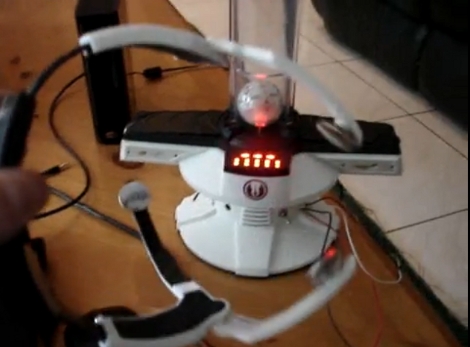
In the ongoing quest to make the Force Trainer useful [Hunter Scott] developed a music composition platform for your mind (channel Jack Black’s voice for the last half of that sentence). Using the Force Trainer’s serial port [Hunter] feeds the data stream into a computer via an FTDI cable and uses Processing to make the music. It’s good, and the demos on his site are worth the click, but we still can’t get enough of the shocking video from back in March. But we digress, let [Hunter] walk you through his setup in the video after the break. Continue reading “Composing Music With The Force Trainer”
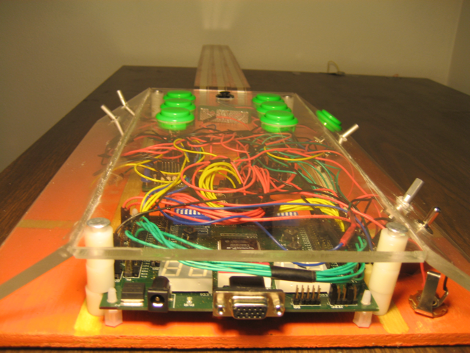

Part Arcade, Part Guitar

Finally a guitar that all of the arcade gaming geeks can jam with. [Mike Davenport] sent us his 8bit arcade based guitar for his senior project. Details are a little sparse if you intend to build you own at the moment, but he does mention the basics: such as it uses an FPGA for logic and function, the strings and joystick modify pitch, it has selectable waves and other parameters, and even includes save banks! Check out a video of him playing street fighter rocking out after the break. Continue reading “Part Arcade, Part Guitar”

Solenoid Orchestra Led A By Laser Conductor

[youtube=http://www.youtube.com/watch?v=B-rpp28AuXo]

This video brought a smile to our faces. [Griffin Milsap] is creating live music using an orchestra of solenoid instruments. Each solenoid is set up to strike an object such as a bowl or mug. The trigger mechanism is a light sensor inside of a ping-pong ball. The collection of instruments is conducted by a motor-mounted green laser. When the beam of light passes by one of the ping-pong balls the photo transistor inside actuates the solenoid and a note is played. The pitches are quite a bit more random than the Robo-vibe, but it’s delightful to hear the results that [Griffin] has achieved.

Sponge Music

[youtube=http://www.youtube.com/watch?v=k4cYpf9zwkg]

[Aaron] calls this project “Stochasticity”. It uses two sponges as a musical interface.  The performer wears a wrist strap and then draws on the table with water from the sponge to play different notes. You really need to watch the video to fully understand what’s going on here.

We’re guessing that this is Arduino based since some of his other projects are as well. You can try out another quick project of his, an Arduino electromagnetic field detector. Check out video of that after the break.

Continue reading “Sponge Music”

Hackaday Links: Sunday January 24

Everyone Remembers Free day right? [The Ideanator’s] Bus Pirate came in such a nice red box – he decided to make it his permanent case.

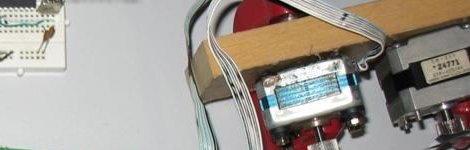
[Chico] is in the middle of making a CNC, but decided to make some music with the steppers in the mean time.

What looks like an old wooden box is actually [Ludvig’s] super sweet retro arcade cabinet. Complete with a giant emergency stop red button.

Who says Legos are dead? [Carl] used them to create a simple and cheap diffraction grating projector. Including video!

[Torchris] used an Ethernet shield exactly as it was designed, sending data over Ethernet. Still a nice hack for those needing help working with Ethernet shields and Arduino.

Finally [Robert] let us know about a friends Arduino Binary Clock. But we think his elegant use of tape and a sand blaster to engrave glass is cooler.

L2Ork – Virginia Tech Linux Laptop Orchestra

Create Digital Music Wrote a semi guide for Linux music creation and interaction after interviewing the L2Ork group. L2Ork is a Virginia Tech based Orchestra that use only laptops loaded with a custom Linux kernel, Wii remotes, and home built speaker salad bowls to produce some surprisingly amazing music. We’ve seen music creation from Wii Remotes before, but it didn’t sound anything like what L2Ork has created. The best part of the project, there are several videos and guides produced by L2Ork so you don’t have to attend Virginia Tech to produce your own music.