Arduino Space Program

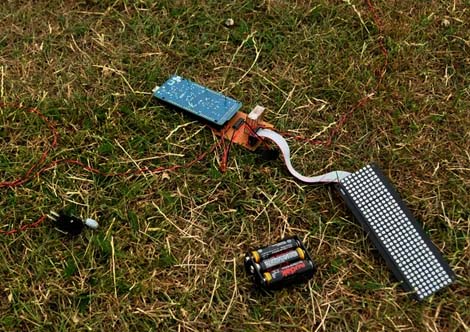
With the recently proposed cuts to NASA, our friends across the pond (in Northampton UK) decided to take action with a space program of their own… at least at a miniature scale. NortHACKton, a hackerspace in Northampton decided to host a rocketry day consisting of rockets powered by chemical reactions, pressurized water bottles, and even one that employed an Arduino controlled launch system, akin to a few we have seen in the past. It essentially consists of a countdown and automated ignition system. Schematics and source code are available for those adventurous enough to embark on missions of their own.

Hackaday Links: December 7 2009

[youtube=http://www.youtube.com/watch?v=_5lksMvmqQc]

Ah the beauty of watching molten solder pull SMD components into place. Yeah, we’ve seen it before, but for some reason it never gets old.

The glory days of wardriving are certainly behind us but if you’re still hunting in certain areas for access points you can leave the laptop at home. A homebrew program called Road Dog can turn your PSP into a WiFi search device. You must be able to run custom code to use this app.

[youtube=http://www.youtube.com/watch?v=OE2pB1pyZN0]

Ferrofluid is our friend. But having grown up watching the Terminator and Hellraiser movies we can’t help being a little creeped out by the effects seen in this movie.

[youtube=http://www.youtube.com/watch?v=-1OTSbIzcwI]

Follow along with the NASA astronauts in this 20 minute HD tour of the international space station. It’s a cramped place to live but we can’t help thinking that it looks incredibly clean. After all, where would the dirt come from?

How are your woodworking skills?  Can you take a wooden block and turn it on a lathe until you have a lampshade 1/32″ thick? We’d love to see how these are made, but imagine the artist’s reaction when hours of labor are ruined by a minuscule amount of misplaced pressure on a carving tool. Patience, we’ll learn it some day!

[youtube=http://www.youtube.com/watch?v=F6pUMlPBMQA]

This video from the past that is about the future of  travel does leave us wondering why our cars don’t have built-in radar for poor visibility? We’ve already realized the rear-view-mirror-tv-picture, but we’re going to need your help before the flying police/fire/ambulance-mobile is a common sight. Oh, the fun of seeing a high-tech push-button selector 3:30 into the video. Perhaps the touch-screen was a bit beyond the vision of the time.

[youtube=http://www.youtube.com/watch?v=VW5PByaR2EQ]

Sometimes you have so many servants you need to find creative things for them to do. Only the most discriminating of the super-rich employ a person whose sole responsibility is to erase and redraw the hands of a clock each minute. This video is obviously a result of the global recession as the live time-keeper has been let go; a looping recording took his job!

[youtube=http://www.youtube.com/watch?v=i7woG0pqFjs]

Last time we checked in with [Marco Tempest] he was syncing video over multiple iPhones. Now he’s at it again with an augmented reality setup. A camera picks up some IR LEDs in a canvas and translates that into information for a video projector. We’d call this a trick, but it’s certainly not magic.

Lunar Auto Repair Depends On The Sticky Stuff

lunar-rover-fender-uses-duct-tape

When you’ve got problems with your lunar rover you can’t just “trust the Midas touch”. Every unexpected repair that happens outside of the Earth’s atmosphere is a hack and it seems the common ingredient in each one is Duct tape. If you’ve seen the movie Apollo 13 you know it was used in making a square carbon dioxide filter fit into a round filter socket. [XD] let us know about another hack where NASA used Duct tape to replace a fender on the lunar rover during the Apollo 17 mission.

The rover kicks up a lot of moon dust as it cruises around on its wire tires. When a rear fender started to come loose it was secured with duct tape. We delighted in watching a moon-man tear off chunks of tape for the fix, shown in the video after the break. When the fender finally flew off of the vehicle, the engineers on the ground came up with a way to replace it using laminated maps and more duct tape.

We’ve been critical of the use of duct tape in the past. But when you’re in a bind, accept no substitutes.

Continue reading “Lunar Auto Repair Depends On The Sticky Stuff”

“Interplanetary Internet” Passes First Test

NASA just completed the first deep-space test of what could one day become the interplanetary internet. Images of Mars and its moon Phobos were sent back and forth between computers on Earth and NASA’s Epoxi spacecraft. Instead of TCP/IP a new protocol, named “Disruption/Delay Tolerant Networking” (DTN) was used. Information is only sent once with DTN, and stored at each node until another node is available to receive the information.  To prevent hackers from interfering with the network, information that is transmitted over DTN is encrypted. The team at NASA is hoping to get the protocol accepted by the international community and setup a permanent node at the International Space Station next year.

[via Warren Ellis]

Apollo Guidance Computer Clone


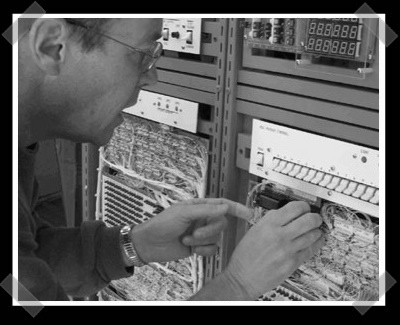
[Cliff Miller] pointed out this incredible project from 2004. [John Pultorak]’s journey began in late 2000 when he decided to build a 60’s or 70’s era minicomputer. While gathering technical documentation, he found some interesting information on the Apollo Guidance Computer and felt that was the way to go. The AGC was the first integrated circuit computer ever built. Designed by MIT in 1964 it was constructed from ~5000 ICs, almost all 3-input NOR gates. [John]’s version uses late 1960’s 74LS TTL logic which gains him a 10 to 1 reduction in the number of ICs. A good thing when you have to do ~15K wirewrap connections. He also used flipflops and register chips instead of building everything from NOR gates. [John] essentially built the AGC three times: First, he coded a simulator in C++. Then, he imported the logic design into CircuitMaker to verify that it would actually work. Finally, he built the 3 by 5foot machine. He’s provided an amazing amount of documentation for anyone that wants to explore this device and the overview alone is well worth a look.

Magnetic Movie


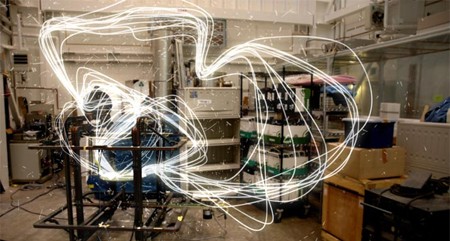
Magnetic field lines may be invisible to the naked eye, but they behave in ways that would amaze us if only we could see them. [Ruth Jarman] and [Joe Gerhardt] from Semiconductor wanted to make them visible for everyone, so they produced Magnetic Movie, a film that combines animations, theoretical models, and actual VLF recordings of the entire Earth’s magetic forces to create a film that shows magnetic fields moving and jumping through the air in living color.

The film is part art project and part scientific experiment, but we can enjoy it on both levels, as watching the path and motion of magnetic field lines is both beautiful and informative. Get a glimpse for yourself after the break.

Continue reading “Magnetic Movie”

Make Your Own Aerogel

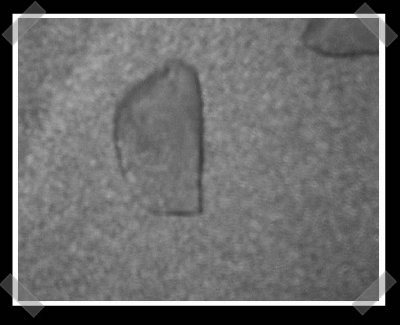
Our own [Eliot] dug this one up from the grave. While the recipe has been online for a while, do you know many 10 year olds who made their own Aerogel, that wonderful insulator that’s essentially gelled air? [William] made some(cache) for his science project in 2002. He started with Silbond H5, a combination of ethyl alcohol and ethyl polysilicate. You can get the MSDS after a painless email registration on the Silbond website. After the gel is formed you have to soak it in an alcohol bath to make sure all water has been removed from the structure. Then the gel is placed in a drying chamber. Liquid CO2 is forced into the chamber to displace all the alcohol in the chamber and the structure. Once the the alcohol is gone the supercritical drying phase begins. The temperature is raised to 90degF and the pressure is regulated to 1050psi. At this point the liquid CO2 in the gel structure takes on gas properties (looses surface tension) and leaves the silica structure. All that remains in the chamber is your new Aerogel which is 99% empty space and 1000 times less dense than glass.

Of course, if you’re lazy, you can buy some here.