How Do PAL And NTSC Really Work?

Many projects on these pages do clever things with video. Whether it’s digital or analogue, it’s certain our community can push a humble microcontroller to the limit of its capability. But sometimes the terminology is a little casually applied, and in particular with video there’s an obvious example. We say “PAL”, or “NTSC” to refer to any composite video signal, and perhaps it’s time to delve beyond that into the colour systems those letters convey.

Know Your Sub-carriers From Your Sync Pulses
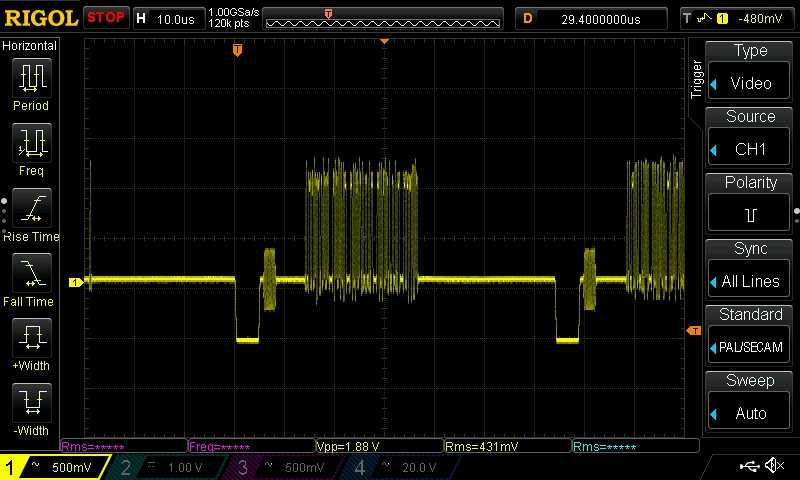
A close-up on a single line of composite video from a Raspberry Pi.

A video system of the type we’re used to is dot-sequential. It splits an image into pixels and transmits them sequentially, pixel by pixel and line by line. This is the same for an analogue video system as it is for many digital bitmap formats. In the case of a fully analogue TV system there is no individual pixel counting, instead the camera scans across each line in a continuous movement to generate an analogue waveform representing the intensity of light. If you add in a synchronisation pulse at the end of each line and another at the end of each frame you have a video signal.

But crucially it’s not a composite video signal, because it contains only luminance information. It’s a black-and-white image. The first broadcast TV systems as for example the British 405 line and American 525 line systems worked in exactly this way, with the addition of a separate carrier for their accompanying sound. Continue reading “How Do PAL And NTSC Really Work?”
Pocket-sized Test Pattern Generator Helps Check Those CRTs

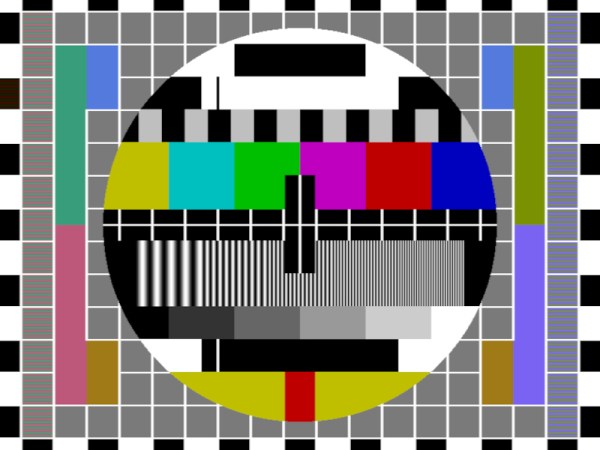
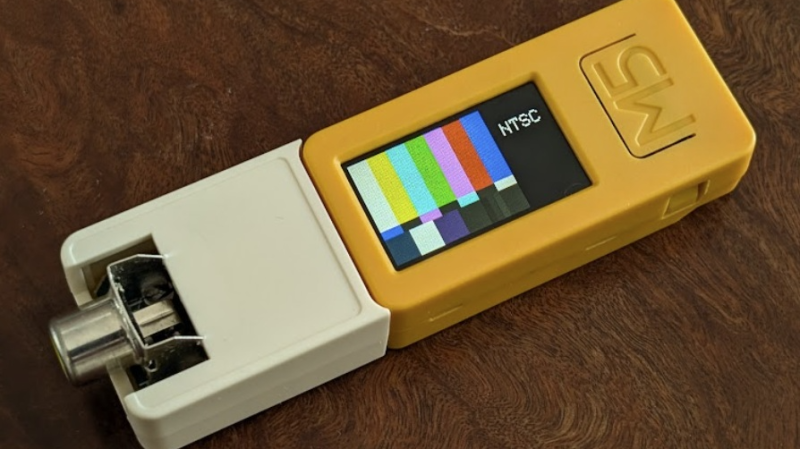
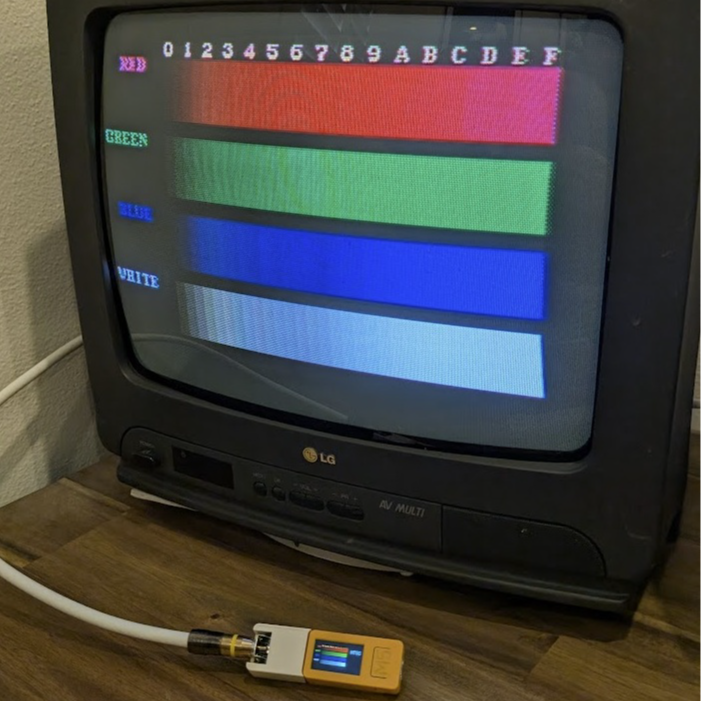
[Nicholas Murray]’s Composite Test Pattern Generator is a beautifully-made, palm-sized tool that uses an ESP32-based development board to output different test patterns in PAL/NTSC. If one is checking out old televisions or CRTs, firing up a test pattern can be a pretty handy way to see if the hardware is healthy or not.

The little white add-on you see attached to the yellow portion is a simple circuit (two resistors and an RCA jack) that allows the microcontroller to output a composite video signal. All one needs to do is power on the device, then press the large button to cycle through test patterns. A small switch on the side toggles between NTSC and PAL video formats. It’s adorable, and makes good use of the enclosures that came with the dev board and proto board.

In a pinch a hacker could use an original Raspberry Pi, because the original Pi notably included a composite video output. That feature made it trivial to output NTSC or PAL video to a compatible display. But [Nicholas]’s device has a number of significant advantages: it’s small, it’s fast, it has its own battery and integrated charger, and the little color screen mirroring the chosen test pattern is a great confirmation feature.

This is a slick little device, and it’s not [Nicholas]’s first test pattern generator. He also created a RP2040-based unit with a VGA connector, the code of which inspired a hacker’s home-grown test pattern generator that was used to service a vintage arcade machine.

Japan’s Forgotten Analog HDTV Standard Was Well Ahead Of Its Time

When we talk about HDTV, we’re typically talking about any one of a number of standards from when television made the paradigm switch from analog to digital transmission. At the dawn of the new millenium, high-definition TV was a step-change for the medium, perhaps the biggest leap forward since color transmissions began in the middle of the 20th century.

However, a higher-resolution television format did indeed exist well before the TV world went digital. Over in Japan, television engineers had developed an analog HD format that promised quality far beyond regular old NTSC and PAL transmissions. All this, decades before flat screens and digital TV were ever seen in consumer households!

Continue reading “Japan’s Forgotten Analog HDTV Standard Was Well Ahead Of Its Time”

New Motherboard Improves Old CRT Television

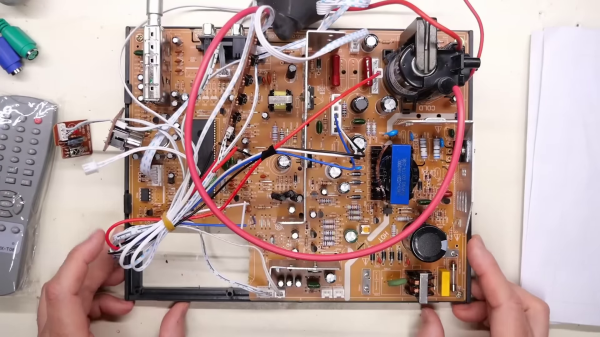
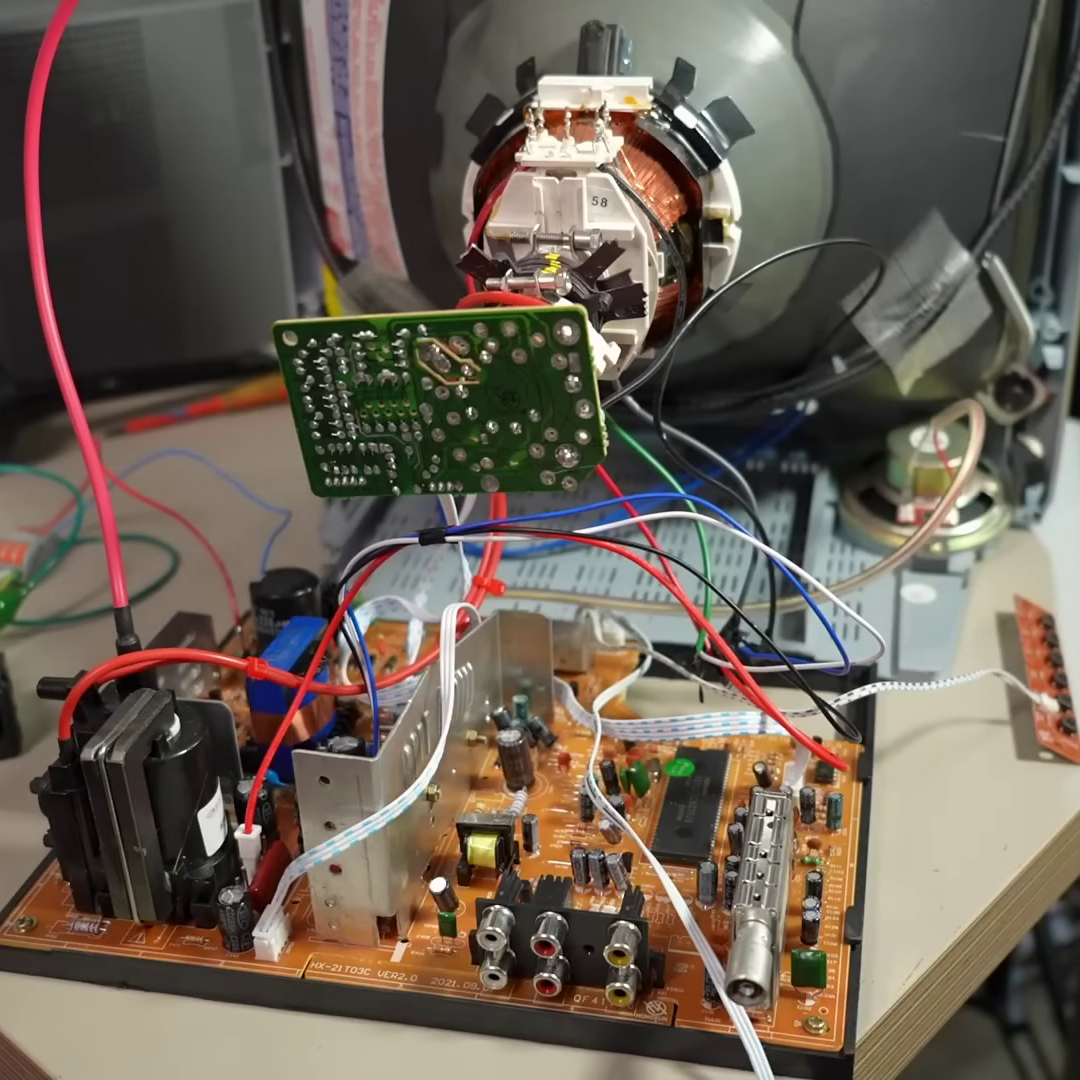
While browsing AliExpress from his digital basement, [Adrian Black] stumbled upon what seemed like a brand-new mainboard for a CRT television set. He decided to take a gamble and ordered one. It finally arrived, and was indeed a brand new product from 2023.

DIGITAL MAIN BOARD OF TV, Work ath [sic] HONGXUN products with the care and precision of a sculptor in each step, wonderful have no limits

CRT Mainboard Transplant in Progress

Dubious marketing descriptions like “High Definition Digital Color TV Driver Board” aside, this turned out to be a fairly well-designed analog TV board. [Adrian] pulls a 20-year-old Magnavox ( Philips ) color television set from storage and begins the transplant operation. One interesting observation is the Magnavox board has almost the same layout as the new board, except for the orientation of the sections. The new CRT neck board had a different connector than the Magnavox set, but was designed to accept multiple sized sockets. [Adrian] just removed the new socket and replaced it with one from the old set. The mechanical issues were a bit more complicated, but nothing that a Dremel tool and a bit of hot glue can’t fix. The 220 VAC power supply was eventually modified to accept 110 VAC, which also enabled him to reconnect the degaussing coil.

[Adrian] has collected some relevant documentation in this GitHub repository, including schematics. Why bother with this at all? Well, until now, he didn’t have any way to test / view PAL RF signals in his lab. He was gambling on the new mainboard having a PAL tuner. It does, but as an unadvertised bonus, it supports NTSC and SECAM as well — but still not “HD digital color TV”, as far as we know. If you want a multi-standard TV in your lab, this solution may be worth considering. It appears there is still a market somewhere for new CRT televisions. If you have any background on this, please let us know down below in the comments.

Continue reading “New Motherboard Improves Old CRT Television”

System Essentially Contradicting American Methods

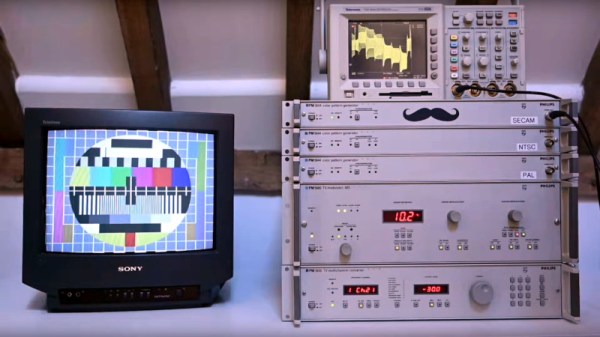
Today, acronyms such as PAL and initialisms such as NTSC are used as a lazy shorthand for 625 and 525-line video signals, but back in the days of analogue TV broadcasting they were much more than that, indeed much more than simply colour encoding schemes. They became political statements of technological prowess as nations vied with each other to demonstrate that they could provide their citizens with something essentially home-grown. In France, there was the daddy of all televisual symbols of national pride, as their SECAM system was like nothing else. [Matt’s TV Barn] took a deep dive into video standards to find out about it with an impressive rack of test pattern generation equipment.

At its simplest, a video signal consists of the black-and-while, or luminance, information to make a monochrome picture, along with a set of line and frame sync pulses. It becomes a composite video signal with the addition of a colour subcarrier at a frequency carefully selected to fall between harmonics of the line frequency and modulated in some form with the colour, or chrominance, information. In this instance, PAL is a natural progression from NTSC, having a colour subcarrier that’s amplitude modulated and with some nifty tricks using a delay line to cancel out colour shifting due to phase errors.

SECAM has the same line and frame frequency as PAL, but its colour subcarrier is frequency modulated instead of amplitude modulated. It completely avoids the NTSC and PAL phase errors by not being susceptible to them, at the cost of a more complex decoder in which the previous line’s colour information must be stored in a delay line to complete the decoding process. Any video processing equipment must also, by necessity, be more complex, something that provided the genesis of the SCART audiovisual connector standard as manufacturers opted for RGB interconnects instead. It’s even more unexpected at the transmission end, for unlike PAL or NTSC, the colour subcarrier is never absent, and to make things more French, it inverted the video modulation found in competing standards.

The video below takes us deep into the system and is well worth a watch. Meanwhile, if you fancy a further wallow in Gallic technology, peer inside a Minitel terminal.

Continue reading “System Essentially Contradicting American Methods”

Generating PAL Video With A Heavily Overclocked Pi Pico

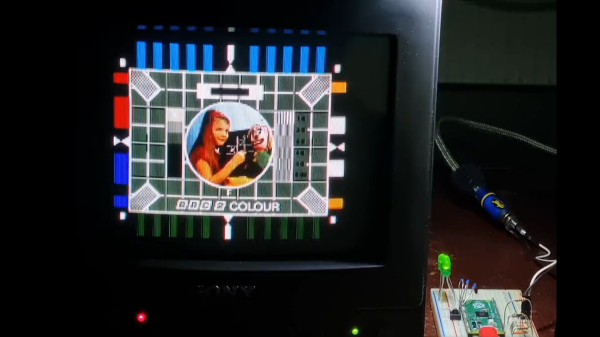
Barely a week goes by without another hack blessing the RP2040 with a further interfacing superpower. This time it’s the turn of the humble PAL standard composite video interface. As many of us of at least a certain vintage will be familiar with, the Phase Alternate Line (PAL to friends) standard was used mainly in Europe (not France, they used SECAM like Russia, China, and co) and Australasia, and is a little different from the much earlier NTSC standard those in the US may fondly recollect. Anyway, [Fred] stresses that this hack isn’t for the faint-hearted, as the RP2040 needs one heck of an overclock (up to 312 MHz, some 241% over stock) to be able to pull off the needed amount of processing grunt. This is much more than yet another PIO hack.

The dual cores of the RP2040 are really being pushed here. The software is split into high and low-level functions, with the first core running rendering the various still images and video demos into a framebuffer. The second core runs in parallel and deals with all the nitty-gritty of formatting the frame buffer into a PAL-encoded signal, which is then sucked out by the DMA and pushed to the outside world via the PIO. There may be a few opportunities for speeding the code up even more, but [Fred] has clearly already done a huge amount of work there, just to get it working at all. The PIO code itself is very simple but is instructive as a good example of how to use multiple chained DMA channels to push data through the PIO at the fastest possible rate.

Continue reading “Generating PAL Video With A Heavily Overclocked Pi Pico”

Tiny TV Celebrates The Forgotten Tech Of CRTs

For those of us who grew up before the Internet, the center of pretty much every house was the TV. It was the shrine before which we all worshipped, gathering together at the appointed times to receive the shared wisdom of mass entertainment. In retrospect, it really wasn’t that much. But it’s what we had.

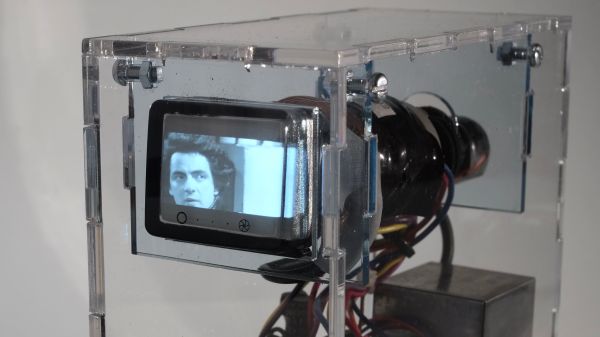
Content aside, one thing all these glowing boxes had in common was that which did the glowing — the cathode ray tube (CRT). Celebrating the marvel of engineering that the CRT represents is the idea behind [Matt Evan]’s tiny desktop TV. The design centers around a 1.5″ CRT that once served as a viewfinder on a 1980s-vintage Sony camcorder. [Matt] salvaged the tube and the two PCB assemblies that drive it, mounting everything in a custom-built acrylic case, the better to show off the bulky but beautiful tube.

The viewfinder originally used a mirror to make the optical path more compact; this forced [Matt] to adapt the circuit to un-reverse the image for direct viewing. Rather than receiving analog signals off the air as we did in the old days — and we liked it that way! — the mini monitor gets its video from a Raspberry Pi, which is set to play clips of TV shows from [Matt]’s youth. Rendered in glorious black and white and nearly needing a magnifying glass to see, it almost recaptures the very earliest days of television broadcasting, when TVs all had screens that looked more like oscilloscope CRTs.

This project is a nice homage to a dying technology, and [Matt] says it has spurred more than one conversation from people you grew up knowing only LCD displays. That’s not to say CRTs are totally dead — if you want to build your own old-school TV, there’s a kit for that.