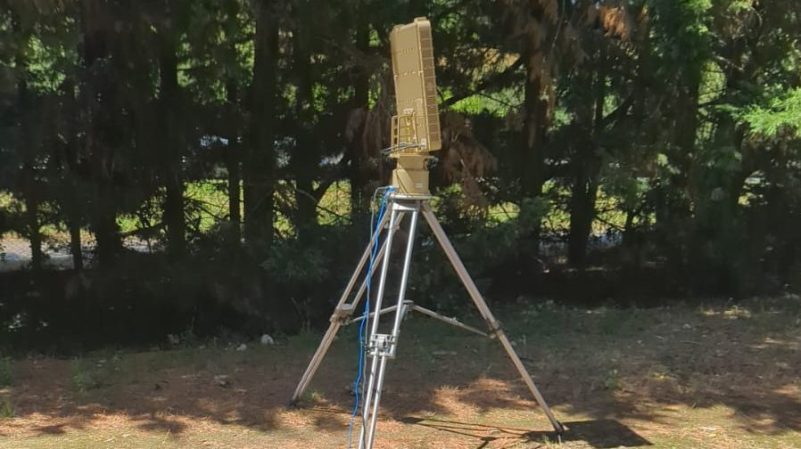
Open Source Radar Has Up To 20 KM Range

Phased-array radars are great for all sorts of things, whether you’re doing advanced radio research or piloting a fifth-generation combat aircraft. They’re also typically very expensive. [Nawfal] hopes to make the technology more affordable with an open-source radar design of their own.

The design is called the AERIS-10, and is available in two versions. Operating at 10.5 GHz, it can be built to operate at ranges between 3 or 20 kilometers depending on the desired spec. The former uses an 8 x 16 patch antenna array, while the latter extends this to a 32 x 16 array. Either way, each design is capable of fully-electronic beam steering in azimuth and can be hacked to enable elevation too—one of the most attractive features of phased array radars. The hardware is based around an STM32 microcontroller, an FPGA, and a bunch of specialist clock generators, frequency synthesizers, phase shifters, and ADCs to do all the heavy lifting involved in radar.

Radar is something you probably don’t spend a lot of time thinking about unless you’re involved in maritime, air defence, or weather fields. All of which seem to be very much in the news lately! Still, we feature a good few projects on the topic around these parts. If you’ve got your own radar hacks brewing up in the lab, don’t hesitate to let us know. 
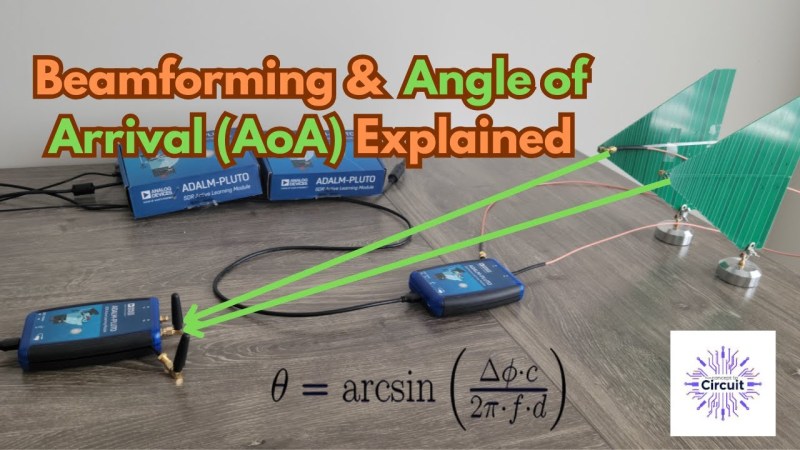
Real-Time Beamforming With Software-Defined Radio

It is perhaps humanity’s most defining trait that we are always striving to build things better, stronger, faster, or bigger than that which came before. Taller skyscrapers, longer bridges, and computers with more processors, all advance thanks to this relentless persistence.

In the world of radio, we might assume that a better signal simply means adding more power, but performance can also improve by adding more antennas. Not only do more antennas increase gain but they can also be electronically steered, and [MAKA] demonstrates how to do this with a software-defined radio (SDR) phased array.

The project comes to us in two parts. In the first part, two ADALM-Pluto SDR modules are used, with one set to transmit and the other to receive. The transmitting SDR has two channels, one of which has the phase angle of the transmitted radio wave fixed while the other is swept from -180° to 180°. These two waves will interfere with each other at various points along this sweep, with one providing much higher gain to the receiver. This information is all provided to the user via a GUI.

The second part works a bit like the first, but in reverse. By using the two antennas as receivers instead of transmitters, the phased array can calculate the precise angle of arrival of a particular radio wave, allowing the user to pinpoint the direction it is being transmitted from. These principles form the basis of things like phased array radar, and if you’d like more visual representations of how these systems work take a look at this post from a few years ago.

Continue reading “Real-Time Beamforming With Software-Defined Radio”

Reverse Engineering A Phased Array System Reveals Surprising Details

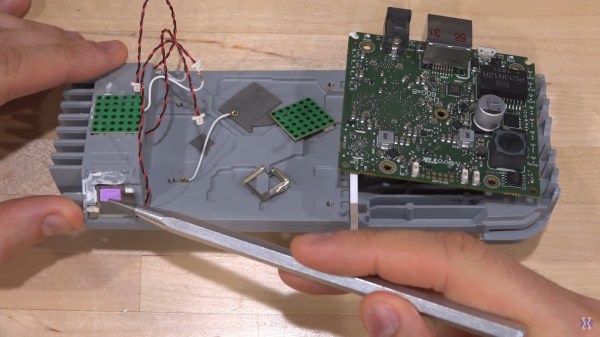
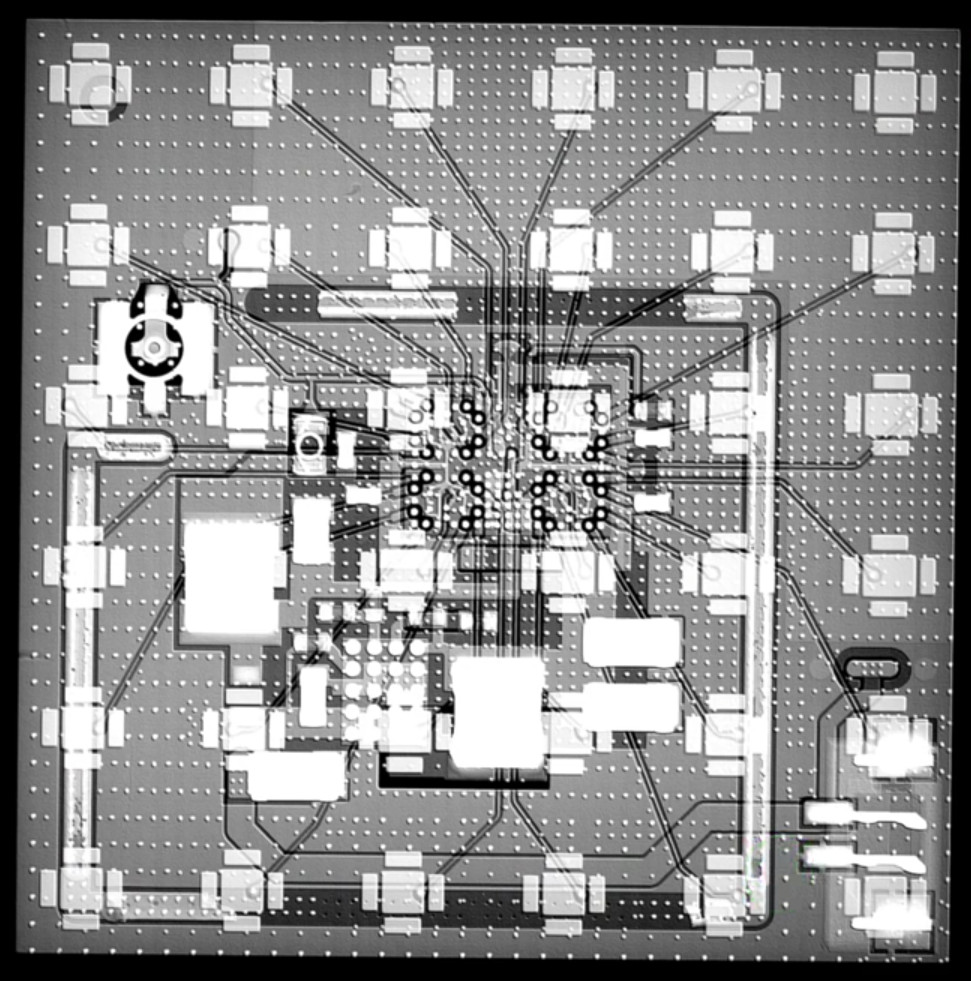
The term “phased array” has been around for a long time, but in recent years we’ve heard more and more about the beam shaping that’s possible with phased array antennae. In the video below the break, [The Signal Path] breaks down a Qualcomm 60GHz WiGig unit, and does a deep dive, even looking at the bare silicon and an x-ray of an antenna.

An X-Ray of the antenna shows the intricate design

Some fascinating highlights include how not only the data signal is sent to the antennae through a standard coaxial cable, but so are control signals and a base clock frequency. [The Signal Path] explains how the manufacturer chose to use what’s called a SuperHeterodyne (aka “superhet”) architecture, which is not all that different from those used in traditional amateur radio transceivers. In theory, anyway.

Another element that is discussed is how the PCB’s themselves are used as waveguides, inductors, and transmission line matches, among other countless little hacks to fit a rather complex system into a truly diminutive space.

If you’re not familiar the concept behind phased arrays, check out this article we published in 2019 that shows how phased arrays can steer a beam without any moving parts. It’s quite fascinating!

Continue reading “Reverse Engineering A Phased Array System Reveals Surprising Details”

Hackaday Links Column Banner

Hackaday Links: May 15, 2022

It may be blurry and blotchy, but it’s ours. The first images of the supermassive black hole at the center of the Milky Way galaxy were revealed this week, and they caused quite a stir. You may recall the first images of the supermassive black hole at the center of the M87 galaxy from a couple of years ago: spectacular images that captured exactly what all the theories said a black hole should look like, or more precisely, what the accretion disk and event horizon should look like, since black holes themselves aren’t much to look at. That black hole, dubbed M87*, is over 55 million light-years away, but is so huge and so active that it was relatively easy to image. The black hole at the center of our own galaxy, Sagittarius A*, is comparatively tiny — its event horizon would fit inside the orbit of Mercury — a much closer at only 26,000 light-years or so. But, our black hole is much less active and obscured by dust, so imaging it was far more difficult. It’s a stunning technical achievement, and the images are certainly worth checking out.

Another one from the “Why didn’t I think of that?” files — contactless haptic feedback using the mouth is now a thing. This comes from the Future Interfaces Group at Carnegie-Mellon and is intended to provide an alternative to what ends up being about the only practical haptic device for VR and AR applications — vibrations from off-balance motors. Instead, this uses an array of ultrasonic transducers positioned on a VR visor and directed at the user’s mouth. By properly driving the array, pressure waves can be directed at the lips, teeth, and tongue of the wearer, providing feedback for in-world events. The mock game demonstrated in the video below is a little creepy — not sure how many people enjoyed the feeling of cobwebs brushing against the face or the splatter of spider guts in the mouth. Still, it’s a pretty cool idea, and we’d like to see how far it can go.

Continue reading “Hackaday Links: May 15, 2022”

Bend It Like (Sonar) Beacon With A Phased Array

Ultrasonic transducers are incredible, with them you can detect distances, as well as levitate and peer through objects. They can emit and receive ultrasonic soundwaves (typically above 18khz) and just like all waves, they can be steered via a phased array. [Bitluni] was trying to accurately measure distances but found the large field of view of the sensor was just too imprecise, so he made a phased array of transducers.

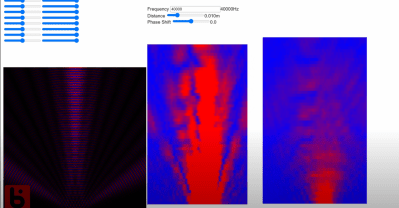
The inspiration came from a Hackaday Supercon talk from 2019 about phased arrays. [Bitluni] walks through an excellent explanation of how the array works with a bucket of water and his finger, as well as a separate simulation. By changing the phase offset of the different array members, the beam can effectively be steered as interference muffs the undesired waves. Using a set of solenoids, he created a test bench to validate his idea in a medium he could see; water. The solenoids fire a single pulse into the water creating a wave. You can see the wave move in the correct direction in the water, which validates the concept. A simple PCB sent off to a fab house with a stencil offers a surface to solder the transducers and drivers onto. An ESP32 drives the 8 PWM signals that go to the transmitters and reads in the single receiver via a small amplifier. Still not content to let the idea be unproven, he sets up the receiver on his CNC gantry and plots the signal strength at different points, yielding beautiful “heat maps.”
bitluni's heatmap for his sonar array

It sweeps a 60-degree field in front of it at around 1-3 frames per second. As you might imagine, turning sound wave reflections into distance fields is a somewhat noisy affair. He projects the sonar display on top of what we can see in the camera and it is fun to see the blobs line up in the correct spot.

We noticed he built quite a few boards, perhaps in the future, he will scale it up like this 100 transducer array? Video after the break.

Continue reading “Bend It Like (Sonar) Beacon With A Phased Array”

Directional Antenna 3-Way

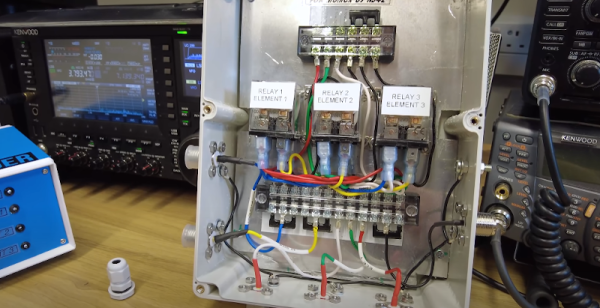
If you read old antenna books, you’ll probably see the idea of phased vertical antennas. These use certain lengths of coax to control the phase of a signal going to three verticals in a triangular configuration. Depending on the phasing, you can cause the array of antennas to be directional in one of three directions. [DX Commander] designed a very modern version of this antenna and shows the theory behind it in a recent video that you can see below.

It seems another ham built the antenna and a control box for it which he’s sent to [DX Commander] although he hasn’t set it up yet to create an 80 meter directional antenna. We’ll be interested in seeing how it works in practice.

Continue reading “Directional Antenna 3-Way”

Ultrasonic spirit writing

Ultrasonic Array Powers This Halloween Spirit Writer

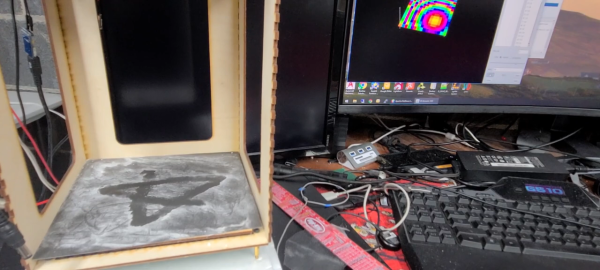
The spooky season is upon us, and with it the race to come up with the geekiest way to scare the kids. Motion-activated jump-scare setups are always a crowd-pleaser, but kind of a cheap thrill in our opinion. So if you’re looking for something different for your Halloween scare-floor, you might consider “spirit writing” with ultrasound.

The idea that [Dan Beaven] has here is a variation on the ultrasonic levitation projects we’ve seen so many of over the last couple of years. While watching bits of styrofoam suspended in midair by the standing waves generated by carefully phased arrays of ultrasonic transducers is cool, [Dan] looks set to take the concept to the next level. Very much still a prototype, the setup has a 256-transducer matrix suspended above a dark surface. Baking powder is sprinkled over the writing surface to stand in for dust, which is easily disturbed by the sound waves reflecting off the hard surface. The array can be controlled to make it look like an unseen hand is tracing out a design in the dust, and the effect is pretty convincing. We’d have chosen “REDRUM” rather than a pentagram, but different strokes.

[Dan] obviously has a long way to go before this is ready for the big night, but the proof-of-concept is sound. While we wait for the finished product, we’ll just file this away as a technique that might have other applications. SMD components are pretty small and light, after all — perhaps an ultrasonic pick-and-place? In which case, sonic tweezers might be just the thing.

Continue reading “Ultrasonic Array Powers This Halloween Spirit Writer”