Unmanned Ocean Crossing

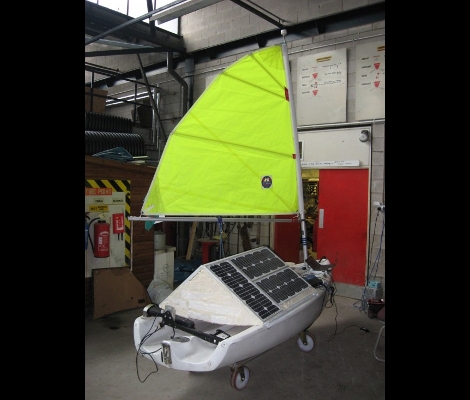
This is the Pinta, an autonomous sailboat built to attempt an ocean crossing from Ireland to Martinique (in the Caribbean). A group of researchers at Aberystwyth University built her as part of the Microtransat Challenge.

To keep tabs on the vessel her creators included an Iridium short burst data modem with a backup system made from a SPOT satellite tracker using a PIC microcontroller to trigger a transmission every six hours. The sailing systems are a conglomeration of a Gumstix board, GPS, a windshield wiper motor to control the sail, and a tiller pilot for steering. A set of solar panels helps to top off the lead-acid batteries that power the system.

Unfortunately the old gal has encountered problems. You can see from the tracking data that, although it sailed 500 km in the last twelve days, she is still just off the coast of Ireland. The primary tracking system has failed, which could signal a system-wide computer failure. We hope the team will eventually recover the vessel as we’re interested in finding out what caused this unfortunate turn of events.
PSGroove On A PIC Microcontroller

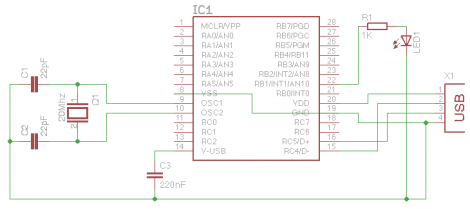
There’s now a method of using PIC microcontrollers to exploit the PlayStation 3. This is centered around a PIC 18F2550 which has been popular in past hacks because of its built-in USB serial port. This again makes use of the PSGroove open source exploit code and, like the TI calculator version, seeks to expand the selection of hardware the code runs on.

In addition to the chip and a PIC programmer you’ll need the CCS compiler as others cannot successfully compile this code. A licensed copy is necessary because the demo version of the CCS compiler doesn’t support this particular chip. Add to that the fact that because of the timing it may take several tries to achieve the exploit and you may find yourself disappointed by this development. But there’s always room for improvement and this is a proven first step on the new architecture.

[Thanks das_coach via PS3Hax via Elotrolado]

Controlling The Power Of A Flash With A Tv Remote

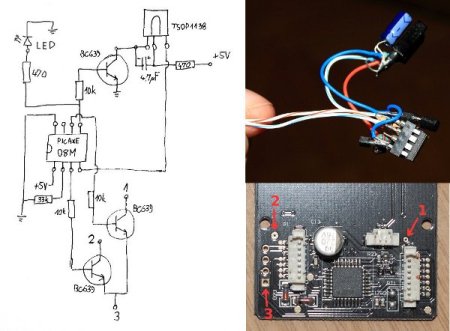
For those who do fancy photography, setting up the lighting ends up being one of the larger tasks of each session. There are flashes out there that can be controlled via a remote control to help ease the process, but they can cost a considerable amount more. [Dsvilko] shares with us a fairly simple circuit that allows you to use a tv remote to control your flash. He’s using a picaxe 08m and he states that before this project, he had never messed with microcontrollers. We say great job on your first microcontroller project. You can catch a video of it in action after the break.

Continue reading “Controlling The Power Of A Flash With A Tv Remote”

Car Computer Requires PIN For Ignition

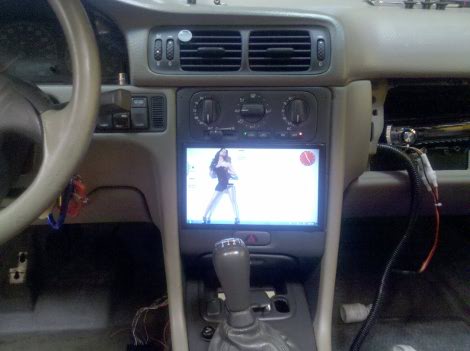
[Ben’s] added some nice goodies to his Volvo in the form of an in-dash computer. The system monitors two pressure sensors for boost and vacuum, as well as reading RPM, O2, and exhaust directly. All of this is tied into the touch interface running on an eeePC 900A. But our favorite feature is that the system requires you to enter a PIN to start the ignition. The forum post linked above is short on details so we asked [Ben] if he could tell us more. Join us after the break for a demonstration video as well as [Ben’s] rundown on the system.

Continue reading “Car Computer Requires PIN For Ignition”

Hacking A Code-protected Hard Disk

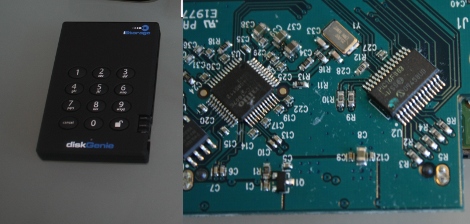
Our friend [Sprite_TM] took a look at the security of a code-protected hard disk. The iStorage diskGenie is an encrypted USB hard drive that has a keypad for passcode entry. After cracking it open he found that the chip handling the keypad is a PIC 16F883 microcontroller. He poked and prodded at the internals and found some interesting stuff. Like the fact that there is an onboard LED that blinks differently based on the code entered; one way for the right code, another for the wrong code of the right number of digits, and a third for a wrong code with the wrong number of digits. This signal could be patched into for a brute force attacking but there’s a faster way. The microcontroller checks for the correct code one digit at a time. So by measuring the response time of the chip an attacker can determine when the leading digit is correct, and reduce the time needed to crack the code. There is brute force protection that watches for multiple incorrect passwords but [Sprite_TM] even found a way around that. He attached an AVR chip to monitor the PIC response time. If it was taking longer than it should for a correct password the AVR resets the PIC before it can write incorrect attempt data to its EEPROM. This can be a slow process, but he concluded it should work. We had fun watching the Flash_Destroyer hammer away and we’d like to see a setup working to acquire the the code from this device.

Wristwatch Board With Throwback Digits

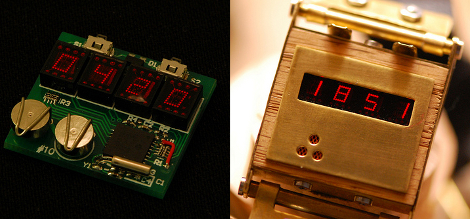
This wristwatch circuit board has some pretty interesting digits. They’re older components that give a classic look to your wristwatch display. On board you’ll find a PIC 16F628A running with an external clock crystal. The display isn’t always illuminated (kind of like Woz’s watch) in order to save the batteries, but can be woken up for a short time with the push of a button. The steam-punk-ish body seen to the left is the just first try. This guy has four more boards left so it should be fun to see what he comes up with.

[Via Hackaday Flickr Pool]

Modem Used In An Alarm System

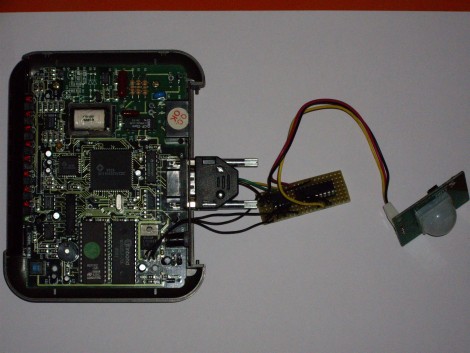
This alarm system senses motion and then alerts you by phone. [Oscar] had an old external modem sitting around and, with some wise hardware choices, he came up with a simple circuit to use it. First up is the PIC 16F628A chosen because it doesn’t require an external crystal. This connects with the modem via a DS275 RS232 transceiver because it requires no external parts for connection. The final portion of the puzzle is a PIR sensor that triggers a pin interrupt in the sleeping PIC, which then dials your number to alert you. It doesn’t look like anything happens other than your phone ringing, but that’s enough for a simple system. We’re just happy to see how easy it was to use that modem… time to go hunting for one in dreaded junk trunk. Don’t miss the clip after the break.

Continue reading “Modem Used In An Alarm System”