Trash Heap Projector

[youtube=http://www.youtube.com/watch?v=S5jymxi62RI]

Being hackers, sometimes we just want to hack something together, not engineer it. This projector is a great example. Made mostly out of cardboard and duct tape (or duck tape if you prefer). He picked up a 12v LED array, a cheap fresnel lens, an LCD from a “back up monitor” and a focusing lens taken from a magnifying glass. Sure, we’ve seen better, much better. But seeing an evenings worth of feverish wire twisting and taping is always pleasant. It may look pretty dim in the video, it may be as well, but keep in mind that it is common for them to appear much brighter in person or if shot with a night setting on a digital camera.
Home Cinema 3D (or Just Tick Off Theatergoers)

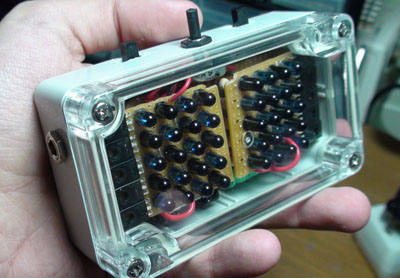
After a visit to the local theater and discovering the use of IR 3D glasses (for films such as Avatar), the team over at Furrtek wondered how they worked, and more importantly, how the glasses could be manipulated to tick off audience members. While the original intentions seem a bit childish, they did mention that their final setup could also be used for a home cinema with IR 3D glasses.

Onto the good stuff: the glasses receive IR light pulses timed with the movie to black out the appropriate eye with the appropriate frame and producing a 3D effect. With the use of IR Investigator the team grabbed said timings; it was then simply a matter of building their own IR projector, and bringing it back to the theater to annoy the crowd setting it up for their 3D home cinema.

Hackaday Links: Sunday January 24

Everyone Remembers Free day right? [The Ideanator’s] Bus Pirate came in such a nice red box – he decided to make it his permanent case.

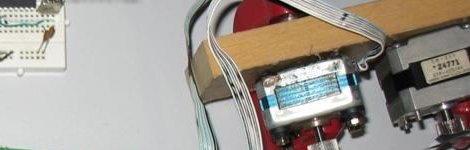
[Chico] is in the middle of making a CNC, but decided to make some music with the steppers in the mean time.

What looks like an old wooden box is actually [Ludvig’s] super sweet retro arcade cabinet. Complete with a giant emergency stop red button.

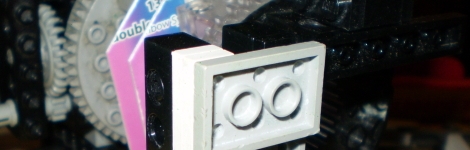
Who says Legos are dead? [Carl] used them to create a simple and cheap diffraction grating projector. Including video!

[Torchris] used an Ethernet shield exactly as it was designed, sending data over Ethernet. Still a nice hack for those needing help working with Ethernet shields and Arduino.

Finally [Robert] let us know about a friends Arduino Binary Clock. But we think his elegant use of tape and a sand blaster to engrave glass is cooler.

Home Made Small Form Factor LED Projector

[youtube=http://www.youtube.com/watch?v=mQ8Kq2wLrf0]

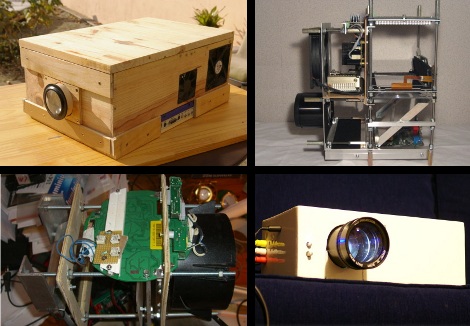
[Newtonn2] dropped a tip in our inbox this morning that made us quite happy. This is a step by step build of a small form factor LED based projector. While the size may not get some of you too excited at first, those of us who have built projectors before know that home made ones are usually quite large. This one is roughly the size of the small office projectors you would see in a large retailer.  He’s using a 30 watt LEd for the light and we didn’t notice a lumen measurement anywhere, but it looks bright enough to be watchable. Pictures usually turn out dark, so in person, the projection probably looks more bright and crisp. Now he just needs to find a high definition LCD that size.

Update: Realtime 3D For You Too!

[Kyle McDonald] has kept himself busy working on 3D scanning in realtime. He’s posted a writeup that takes us through the concepts, tools, and assembly of a DIY 3d scanning camera. You should remember a preview of this method posted earlier this month, but now it’s time to build your own. You’ll need a camera, a projector, and some open source software to process the image data. Using these simple tools, [Kyle] turned out much better video than before. Take a look after the break to see his results from scanning at 60 fps using a PS3 Eye. The trick to this setup is getting the correct synchronization between the projector and the camera, something that could be improved with a bit of extra hacking.

Does [Kyle’s] name sound familiar? It should, he’s got a long history of quality hacks that we’ve featured over the years. If you’re looking to use a scanner as a multitouch, add some music to tea time, or play with your skittles his work will give you a shove in the right direction.

Continue reading “Update: Realtime 3D For You Too!”

Shadow Buttons

This art installation uses buttons made of light. A projector fills up the walls and ceiling of a room while a webcam monitors the pattern for changes. When the luminosity of a given area changes due to a shadow, a midi event is triggered. The software that controls the system is written in C# and uses the Emgu CV library to handle the image processing. In the video after the break you can see that creating shadows with your hands prompts changes in the image as well as the sound.

Continue reading “Shadow Buttons”