Dust Off Those AM Radios, There’s Something Good On!

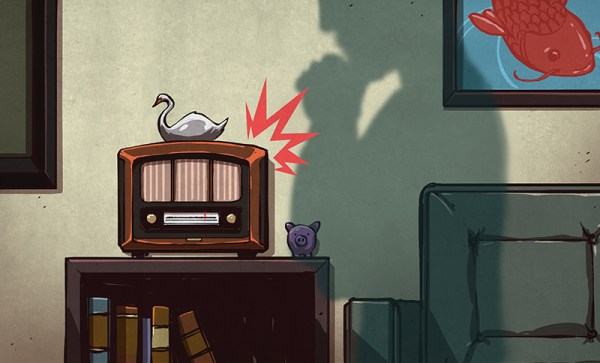
If you are into vintage electronics or restoring antique radio equipment you may be very disappointed with the content offerings on AM broadcast radio these days. Fortunately there is a way to get around this: build your own short-range AM broadcast station and transmit curated content to your radios (and possibly your neighbors). There are several options for creating your own short-range AM broadcast station, and this gives you something fun to tune into with your vintage radio gear.

Continue reading “Dust Off Those AM Radios, There’s Something Good On!”

Amazon Echo Dot Upgraded To Retro Futuristic Look

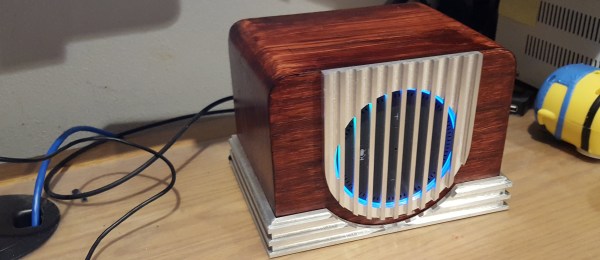
It takes a surprising amount of planning and work if you want something to look old. [vemeT5ak] wanted the Echo Dot sitting on his desk to fit a different aesthetic motivated by a 1940s Canadian radio. Armed with Solidworks, a Tormach CNC, and some woodworking tools at Sector67 hackerspace, he built a retro-futuristic case for the Amazon Alexa-enabled gadget. Future and past meet thanks to the design and material appearance of the metal grille and base molding wrapping the wood radio case. The finishing touch is of course the ring of blue light which still shines through from the Echo itself.

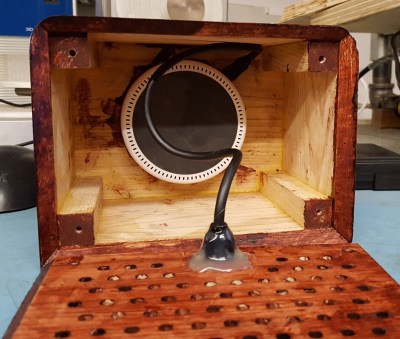
A short USB extension cable connects the Echo Dot to the back of the enclosure, and the cavernous inside plus ample holes provide a nice rich sound.

It took about 15 hours of modeling, scaling, and tweaking in Solidworks with an interesting design specification in mind: single-bit operation. This single-bit is not in the electrical sense, but refers to the CNC milling operation. All pieces are cut with a 1/4″ end mill, without any tool changes. Metal pieces were milled from 6061 aluminum and the hickory case (with burgundy stain) was mostly cut on a table saw, but the holes were CNC machined.

What looks like an otherwise perfect build has a single flaw that eats up [vemeT5ak]’s soul; the Echo Dot has a draft angle that wasn’t considered during modeling, and the hole is ever so slightly too wide, meaning it didn’t press fit perfectly flush. Fortunately it’s not noticeable behind the metal grill, and unless you knew (please help keep his dirty little secret), you would think everything turned out perfectly.

It turns out building a case for the Echo Dot is challenging for a few reasons; the rubbery material on the bottom doesn’t allow anything to stick to it, and the sides are smooth and featureless with a taper that makes it difficult to lock it in. Many cases resort to clipping over the top to hold it in place. Others install it into a fish or a furby.

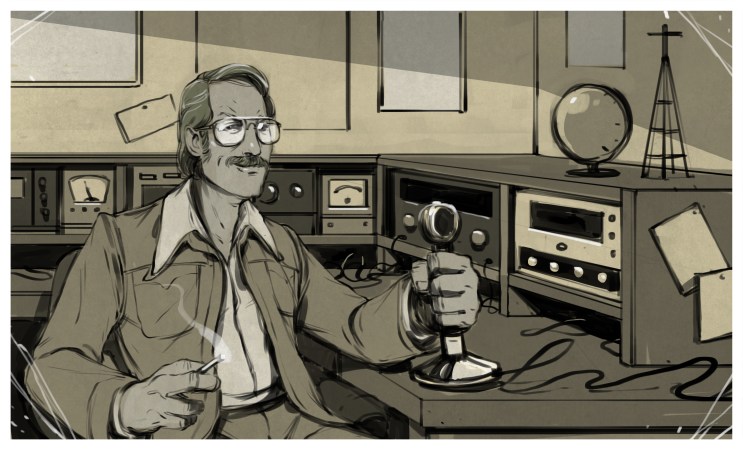
Radio Amateuring Like It’s 1975

It was a tweet from an online friend in the world of amateur radio, featuring a transmitter design published in Sprat, the journal of the G-QRP club for British enthusiasts of low-power radio. The transmitter was very simple, but seriously flawed: keying the power supply line would cause it to exhibit key clicks and frequency instability. It would probably have been far better leaving the oscillator connected full-time and keying the supply to the amplifier, with of course a suitable key click filter.

[M0CVO]'s Tweet that started it all
[M0CVO]’s Tweet that started it all
We’ve all probably made projects that get the job done at the expense of a bit of performance and economy, and from one angle this circuit is a fantastic example of that art. But it’s not the shortcomings of direct PSU keying a small transmitter that has brought it here, but observation instead of what it represents. Perhaps my social group of radio amateurs differs from the masses, but among them the universal lament is that there is nothing new in a simple transistor transmitter that could just as well have been published in 1977 as 2017.

To explain why this represents a problem, it’s worth giving some background. Any radio amateur will tell you that amateur radio is a wonderful and diverse pastime, in fact a multitude of pastimes rolled into one. Working DX? Got you covered. Contesting? UR 599 OM QRZ? Digital modes pushing the envelope of atmospheric propagation? Satellites? SDRs? GHz radio engineering? All these and many more can be yours for a modest fee and an examination pass. There was a time when radio was electronics, to all intents and purposes, and radio amateurs were at the vanguard of technology. And though electronics has moved on from those days of purely analogue communications and now stretches far beyond anything you’d need a licence and a callsign to investigate for yourself, there are still plenty of places in which an amateur can place themselves at the cutting edge. Software defined radio, for instance, or digital data transmission modes. With an inexpensive single board computer and a few components it is now possible to create a software-defined digital radio station with an extremely low power output, that can be copied on the other side of the world. That’s progress, it’s not so long ago that you would have required a lot of dollars and a lot of watts to do that. Continue reading “Radio Amateuring Like It’s 1975”

Grabbing Better Images From A Newer Russian Satellite

The Soviet Union took the world by surprise when it sent its Sputnik satellite into low earth orbit way back in 1957. The event triggered a space race between the Soviets and the United States and ushered in technologies that would go on to touch the lives of every human on earth. Today, several nations have a space program. And one of the more useful things to put in orbit are weather satellites.

In 2014, the Russians launched their Meteor N M-2 weather satellite into a polar orbit. The part that were most interested in is the fact that it transmits images at 137.1 MHz using the standard LRPT protocol. However, the newer Meteor N M-2 transmits images at twelve times the resolution of US NOAA satellites. No typo there –  that’s twelve (12!) times. Have we got your attention now?

We shouldn’t have to tell you to jump on over to [phasenoise’s] blog which gives you everything you need to start grabbing some of these awesome images.

Now, before you get your jumper wires in a bunch – we are well aware that receiving satellite images is nothing new.

Thanks to [Roy Tremblay] for the tip!

Skin (Effect) In The Game

We love to pretend like our components are perfect. Resistors don’t have capacitance or inductance. Wires conduct electricity perfectly. The reality, though, is far from this. It is easy to realize that wire will have some small resistance. For the kind of wire lengths you usually encounter, ignoring it is acceptable. If you start running lots of wire or you are carrying a lot of current, you might need to worry about it. Really long wires also take some time to get a signal from one end to the other, but you have to have a very long wire to really worry about that. However, all wires behave strangely as frequency goes up.

Of course there’s the issue of the wire becoming a significant part of the signal’s wavelength and there’s always parasitic capacitance and inductance. But the odd effect I’m thinking of is the so-called skin effect, first described by [Horace Lamb] in 1883. [Lamb] was working with spherical conductors, but [Oliver Heaviside] generalized it in 1885.

Put simply, when a wire is carrying AC, the current will tend to avoid traveling in the center of the wire. At low frequencies, the effect is minimal, but as the frequency rises, the area in the center that isn’t carrying current gets larger. At 60 Hz, for example, the skin depth for copper wire — the depth where the current falls below 1/e of the value near the surface — is about 0.33 inches. Wire you are likely to use at that frequency has a diameter less than that, so the effect is minimal.

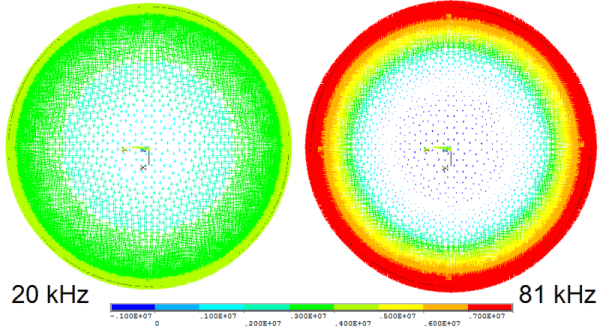
However, consider a 20 kHz signal — a little high for audio unless you are a kid with good ears. The depth becomes about 0.018 inches. So wire bigger than 0.036 inches in diameter will start losing effective wire size. For a 12-gauge wire with a diameter of 0.093 inches, that means about 25% of the current-handling capacity is lost. When you get to RF and microwave frequencies, only the thinnest skin is carrying significant current. At 6 MHz, for example, copper wire has a skin depth of about 0.001 inches. At 1 GHz, you are down to about 0.000081 inches. You can see this (not to scale) in the accompanying image. At DC, all three zones of the wire carry current. At a higher frequency, only the outer two zones carry significant current. At higher frequencies, only the outer zone is really carrying electrons.

Continue reading “Skin (Effect) In The Game”

Scratch That SDR!

When you think of a software defined radio, what language might you consider reaching for to create the software part of the equation? C? C++, maybe?

How about Scratch?

“What, Scratch as in the visual programming language aimed at young people?”, we hear you cry incredulously. It’s not exactly the answer you’d expect for an SDR, but thanks to [Andrew Back]’s work there is now ScratchRadio, a set of Scratch extensions for software defined radio. Why on earth do this? The aim is to lower the barrier to entry for software defined radio as far as possible, and to place it in a learning environment such as Scratch seems an ideal way to achieve that.

Of course, Scratch itself isn’t powerful enough for the heaviest of heavy lifting, so in reality this is a Scratch wrapper for a LuaRadio backend. It was created with the LimeSDR Mini in mind, but given that LuaRadio is not specific to that hardware we’d expect it to work with other SDRs such as the ever-popular RTL chipset TV sticks. It gives an owner of a Raspberry Pi 3 the ability to experiment with SDR coding without the need for a huge level of experience, and that to our mind can only be a good thing.

If you fancy trying ScratchRadio, you can find the code in its GitHub repository, and take it from there. Meanwhile we covered LuaRadio last year, so if Scratch is a little basic for you and GNU Radio too advanced, give it a try.

Radio icon: [Sakurambo], (CC BY-SA 3.0).

Scratch cat logo: MIT Media Lab.

LoRa Is The Network

We’ve become used to seeing LoRa appearing in projects on these pages, doing its job as a low-bandwidth wireless data link with a significant range. Usually these LoRa projects take the form of a client that talks to a central Internet connected node, allowing a remote wireless-connected device to connect through that node to the Internet.

It’s interesting then to see a modest application from [Mark C], a chat application designed to use a set of LoRa nodes as a peer-to-peer network. In effect LoRa becomes the network, instead of simply being a tool to access it. He optimistically describes peer-to-peer LoRa networks as the new FidoNet in his tip email to us, which might be a bold statement, but we can certainly see some parallel. It’s important to note that the application is merely a demonstrable proof-of-concept as it stands, however we’d agree that it has some potential.

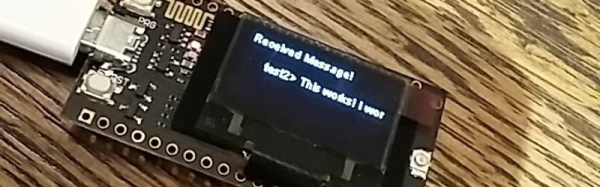
The hardware used for the project is the Heltec ESP32-based LoRa board, which comes with a handy OLED screen on which the messages appear. As it stands a PC connection is required to provide text input via serial, however it’s not impossible to imagine other more stand-alone interfaces. If it interests you the code can be downloaded from the GitHub repository, so maybe this can become the seed for wider peer-to-peer LoRa networks.

There have been no shortage of LoRa projects featured here over the years. Recent ones include a handy local LoRa packet sniffer, and news of an extreme distance record from a LoRa node on a balloon.