An SSB Transceiver On Only One Type Of Transistor

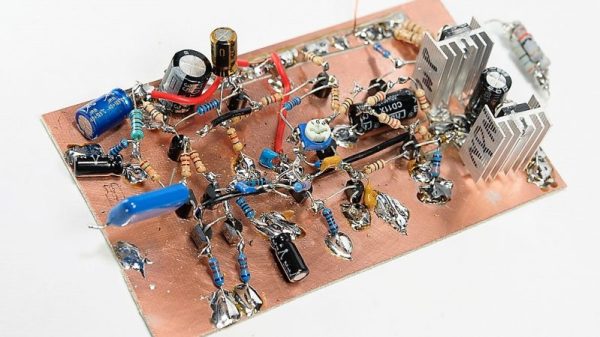
There are a multiplicity of transmission modes both new and old at the disposal of a radio amateur, but the leader of the pack is still single-sideband or SSB. An SSB transmitter emits the barest minimum of RF spectrum required to reconstitute an audio signal, only half of the mixer product between the audio and the RF carrier, and with the carrier removed. This makes SSB the most efficient of the analog voice modes, but at the expense of a complex piece of circuitry to generate it by analog means. Nevertheless, radio amateurs have produced some elegant designs for SSB transmitters, and this one for the 80m band from [VK3AJG] is a rather nice example even if it isn’t up-to-the-minute. What makes it rather special is that it relies on only one type of device, every one of its transistors is a BC547.

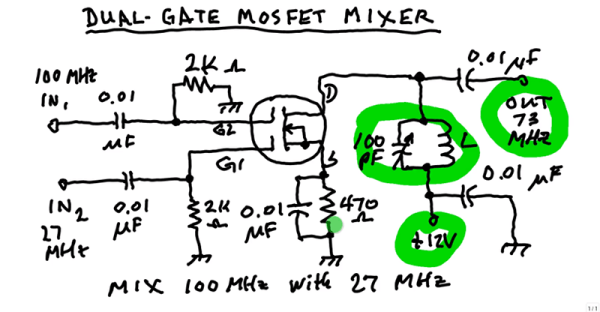
In design terms, it follows the lead set by other simple amateur transmitters, in that it has a 6 MHz crystal filter with a mixer at either end of it that switch roles on transmit or receive. It doesn’t use the bidirectional amplifiers popularised by VU2ESE’s Bitx design, instead, it selects transmit or receive using a set of diode switches. The power amplifier stretches the single-device ethos to the limit, by having multiple BC547s in parallel to deliver about half a watt.

While this transmitter specifies BC547s, it’s fair to say that many other devices could be substituted for this rather aged one. Radio amateurs have a tendency to stick with what they know and cling to obsolete devices, but within the appropriate specs a given bipolar transistor is very similar to any other bipolar transistor. Whatever device you use though, this design is simple enough that you don’t need to be a genius to build one.

Via [G4USP]. Thanks [2ftg] for the tip.

Monitor Foot Traffic Using Radio

We talk a lot about information security around here, but in reality it’s not at the forefront of everyone’s minds. Most people are content to walk around with their phones constantly looking for WiFi or Bluetooth connections despite the dangers. But if you’re not a black hat sort of person, you can do something like [Verkehrsrot] did and use all of these phones to do something useful and harmless.

[Verkehrsrot]’s project involves building a radio listening device in order to get an estimate of the amount of traffic in a particular area. The device polls for and detects WiFi and Bluetooth devices nearby and tallies them. For the privacy-minded, it doesn’t persistently store any information about the people or the devices that it detects. The project also runs on a variety of platforms, although you can get the whole thing up and running with little more than an ESP32 and a small lithium-ion battery.

If you’re looking for a useful way to tally the number of people in a given area, this project could be the thing for you. Not everyone keeps their WiFi and Bluetooth turned on, but even so this is still a good way to estimate. But if you need to count everyone going into a room, for example, you’ll need another way to count them.

Speaking The Same Language As A Wireless Thermometer

Temperature is a delicate thing. Our bodies have acclimated to a tight comfort band, so it is no wonder that we want to measure and control it accurately. Plus, heating and cooling are expensive. Measuring a single point in a dwelling may not be enough, especially if there are multiple controlled environments like a terrarium, pet enclosure, food storage, or just the garage in case the car needs to warm up. [Tim Leland] wanted to monitor commercially available sensors in several rooms of his house to track and send alerts.

The sensors of choice in this project are weather resistant and linked in his project page. Instead of connecting them to a black box, they are linked to a Raspberry Pi so your elaborate home automation schemes can commence. [Tim] learned how to speak the thermometer’s language from [Ray] who posted about it a few years ago.

The system worked well, but range from the receiver was only 10 feet. Thanks to some suggestions from his comments section, [Tim] switched the original 433MHz receiver for a superheterodyne version. Now the sensors can be a hundred feet from the hub. The upgraded receiver is also linked on his page.

We’ve delved into thermocouple reading recently, and we’ve featured [Tim Leland] and his 433MHz radios before.

Review: LimeSDR Mini Software Defined Radio Transceiver

It’s fair to say that software-defined radio represents the most significant advance in affordable radio equipment that we have seen over the last decade or so. Moving signal processing from purpose-built analogue hardware into the realm of software has opened up so many exciting possibilities in terms of what can be done both with more traditional modes of radio communication and with newer ones made possible only by the new technology.

It’s also fair to say that radio enthusiasts seeking a high-performance SDR would also have to be prepared with a hefty bank balance, as some of the components required to deliver software defined radios have been rather expensive. Thus the budget end of the market has been the preserve of radios using the limited baseband bandwidth of an existing analogue interface such as a computer sound card, or of happy accidents in driver hacking such as the discovery that the cheap and now-ubiquitous RTL2832 chipset digital TV receivers could function as an SDR receiver. Transmitting has been, and still is, more expensive.

The LimeSDR Mini's chunky USB stick form factor.
The LimeSDR Mini’s chunky USB stick form factor.

A new generation of budget SDRs, as typified by today’s subject the LimeSDR Mini, have brought down the price of transmitting. This is the latest addition to the LimeSDR range of products, an SDR transceiver and FPGA development board in a USB stick format that uses the same Lime Microsystems LMS7002M at its heart as the existing LimeSDR USB, but with a lower specification. Chief among the changes are that there is only one receive and one transmit channel to the USB’s two each, the bandwidth of 30.72 MHz is halved, and the lower-end frequency range jumps from 100 kHz to 10 MHz. The most interesting lower figure associated with the Mini though is its price, with the early birds snapping it up for $99 — half that of its predecessor. (It’s now available on Kickstarter for $139.)

Continue reading “Review: LimeSDR Mini Software Defined Radio Transceiver”

An Autonomous Drone For Working Rare Squares

Amateur radio is an extremely broad church when it comes to the numerous different activities that it covers. Most of the stories featuring radio amateurs that we cover here have involved home-made radios, but that represents a surprisingly small subset of licence holders.

One activity that captivates many operators is grid square collecting. The map is divided into grid squares, can you make contact with all of them? Land-based squares in Europe and North America are easy, those in some more sparsely populated regions a little less so, and some squares out in the ocean are nigh-on impossible. As an attempt to solve this problem, the Jupiter Research Foundation Amateur Radio Club have put an HF transceiver and associated electronics in a WaveGlider autonomous seagoing vehicle. The idea is that it will traverse the ocean, and you can work it, thus getting the contact you require to add those rarest of grid squares to your list.

The transceiver in question is a commercial portable one, an Elecraft KX3, and the brain of the payload is a Raspberry PI. It’s operating the FT8 mode, and will respond to a call on 14074 kHz in an automated fashion (Or it would, were its status page not telling us that it is offline due to power issues). It’s currently somewhere in the Pacific ocean, having been at sea now for a couple of months.

We spotted this through a spirited online discussion as to whether working an automated station is really a proper contact at all, with one amateur commenting that it might be a way for him to keep on going post mortem. But the ethics of the contact aside, it’s an extremely interesting project and one we hope eventually will come back online.

Thanks Sotabeams, via [AE5X].

At 71,572 KM, You Won’t Beat This LoRa Record

A distance record for LoRa transmission has been set that you probably won’t be able to beat. Pack up your gear and go home, nothing more to achieve here. At a superficial reading having a figure of 71,572 km (44,473 miles) seems an impossible figure for one of the little LoRa radio modules many of us have hooked up to our microcontrollers, but the story isn’t quite what you’d expect and contains within it some extremely interesting use of technology.

So the folks at Outernet have sent data over LoRa for that incredible distance, but they did so not through the little ISM band modules we’re used to but over a suitably powerful Ku-band uplink to a geostationary satellite. They are also not using the LoRaWAN protocols of the earthbound systems, but simply the LoRa modulation scheme. So it’s not directly comparable to terrestrial records such as the 702 km we reported on last year, and they are the first to admit that.

Where their achievement becomes especially interesting though is in their choice of receiver. We are all used to Ku-band receivers, you may even have one on your house somewhere for satellite TV. It will probably involve a parabolic dish with a narrow beam width and an LNB whose horn antenna is placed at its focus. It would have required some skill and effort to set up, because it has to be pointed very carefully at the satellite’s position in the sky. Outernet’s mission of delivering an information service with the lowest possible barrier to entry precludes the extra expense of shipping a dish and providing trained staff to align it, so they take a very different approach. Their receiver uses either an LNB horn or a small patch antenna pointing at the satellite, with none of the dishes or phased arrays you might be used to in a Ku-band installation.

You might wonder how such a receiver could possibly work with such a meagre antenna, but the secret lies in LoRa’s relatively tiny bandwidth as well as the resistance to co-channel interference that is a built-in feature of the LoRa modulation scheme. Even though the receiver will be illuminated by multiple satellites at once it is able to retrieve the signal and achieve a 30 kb/s data rate that they hope with technical refinements to increase to 100 kb/s. This rate will be enough over which to push an SD video stream to name just one of the several examples of the type of content they hope to deliver.

It’s likely that the average Hackaday reader will not be hiring satellite uplink time upon which to place their LoRa traffic. But this story does provide a demonstration of LoRa’s impressive capabilities, and will make us look upon our humble LNBs with new eyes.

Via ABOpen.

You All Know Reginald Fessenden. Who?

Quick, name someone influential in the history of radio. Who do did you think of? Marconi? Tesla? Armstrong? Hertz? Perhaps Sarnoff? We bet only a handful would have said Reginald Fessenden. That’s a shame because he was the first to do something that most of us do every day.

Few know this Canadian inventor’s name even though he developed quite a few innovations. Unlike Colpitts and Hartley we don’t have anything named after him. However, Fessenden was the first man to make a two-way transatlantic radio contact (Marconi’s was one way) and he was a pioneer in using voice over the radio.

He did even more than that. He patented transmitting with a continuous wave instead of a spark, which made modern radio practical. This was unpopular at the time because most thought the spark was necessary to generate enough energy. In 1906, John Fleming (who gave us tubes that are sometimes still called Fleming valves) wrote that “a simple sine-curve would not be likely to produce the required effect.” That was in 1906, five years after Fessenden’s patent.

Continue reading “You All Know Reginald Fessenden. Who?”