Open-Source Grinder Makes Compression Screws For Plastic Extruders Easy

In a world that’s literally awash in plastic waste, it seems a pity to have to buy fresh rolls of plastic filament to feed our 3D-printers, only to have them generate yet more plastic waste. Breaking that vicious cycle requires melding plastic recycling with additive manufacturing, and that takes some clever tooling with parts that aren’t easy to come by, like the compression screws that power plastics extruders.

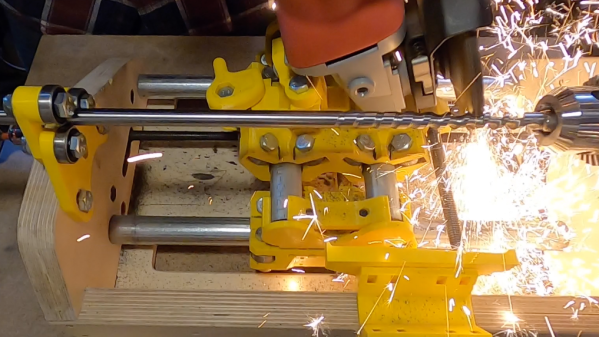
This open-source compression screw grinder aims to make small-scale plastic recyclers easier to build. Coming from the lab of [Joshua Pearce] at the Michigan Technological University in collaboration with [Jacob Franz], the device is sort of a combination of a small lathe and a grinder. A piece of round steel stock is held by a chuck with the free end supported by bearings in a tailstock. On the bed of the machine is an X-Y carriage made of 3D-printed parts and pieces of electrical conduit. The carriage moves down the length of the bed as the stock rotates thanks to a pulley and a threaded rod, carrying a cordless angle grinder with a thick grinding wheel. A template attached to the front apron controls how deep the grinder cuts as it tracks along the rod; different templates allow the screw profile to be easily customized. The video below shows the machine in action and the complicated screw profiles it’s capable of producing.

We’ve seen lots of homebrew plastic extruders before, most of which use repurposed auger-type drill bits as compression screws. Those lack the variable geometry of a proper compression screw, so [Joshua] and [Jacob] making all the design documents for this machine available should be a boon to recycling experimenters.

Continue reading “Open-Source Grinder Makes Compression Screws For Plastic Extruders Easy”

Living At The Close Of The Multiway Era

After over a decade of laptop use, I made the move a couple of months ago back to a desktop computer. An ex-corporate compact PC and a large widescreen monitor on a stand, and alongside them a proper mouse and my trusty IBM Model M that has served me for decades. At a stroke, the ergonomics of my workspace changed for the better, as I no longer have to bend slightly to see the screen.

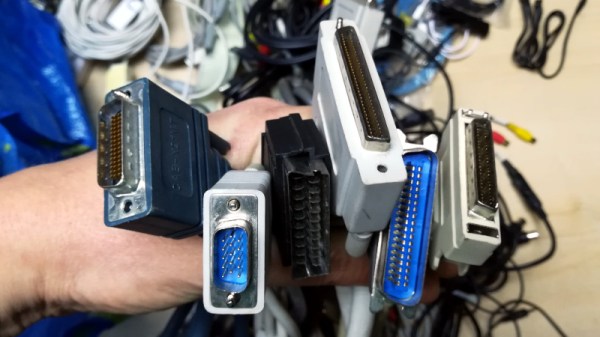
The previous desktop PC was from an earlier time. I think it had whatever the AMD competitor to a Pentium 4 was, and if I recall correctly, its 512 MB of memory was considered to be quite something. On the back it had an entirely different set of sockets to my new one, a brace of serial ports, a SCSI port, and a parallel printer port. Inside the case, its various drives were served by a set of ribbon cables. It even boasted a floppy drive. By contrast the cabling on its successor is a lot lighter, with much less bulky connectors. A few USB plugs and a network cable, and SATA for its disk drive. The days of bulky multiway interconnects are behind us, and probably most of us are heaving a sigh of relief. Continue reading “Living At The Close Of The Multiway Era”

From Fail To Wail: Guitar Picks Made From 3D Printed Waste

Between failed prints and iterative designs that need a few attempts before you nail them down, a certain amount of wasted material is essentially unavoidable when 3D printing. The good news is that PLA is a bioplastic and can be broken down via industrial composting, but even still, any method that allows you to reuse this material at home is worth taking a look at.

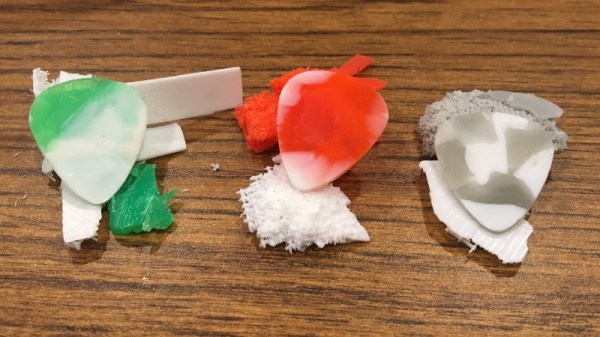
In a recent video, [Noah Zeck] details one potential use for your scrap plastic by turning his failed 3D prints into guitar picks. The idea here could really be applied to anything you can make out of thin plastic sheeting, but the fact that you can easily and cheaply produce picks with a commercially available punch makes this application particularly appealing.

The first step in this process is about as low-tech as it gets: wrap your scrap printed parts in rags, and beat them with a sledge hammer. This breaks them up into smaller and more manageable pieces, which is important for the next step. If the parts are small enough and you’ve got a decently powerful blender you don’t mind devoting to plastic recycling, we imagine that would make short work of this step as well.

Once suitably pulverized, [Noah] puts the plastic on a piece of glass and gets it warmed up with a heat gun. PLA has a fairly low glass transition temperature, so it shouldn’t take much time to soften. Then he puts a second piece of glass on top and squeezes them together to get a thin, flat sheet of plastic. Once cooled, he punches his guitar picks out of the sheet, with bonus points if the colors swirled around into interesting patterns. If you’re not musically inclined, we’ve seen a very similar method used to produce colorful floor tiles.

Continue reading “From Fail To Wail: Guitar Picks Made From 3D Printed Waste”

Hackaday Links Column Banner

Hackaday Links: November 3, 2019

Depending on how you look at it, the Internet turned 50 years old last week. On October 29, 1969, the first message was transmitted between two of the four nodes that made up ARPANET, the Internet’s predecessor network. ARPANET was created after a million dollars earmarked for ballistic missile defense was diverted from the Advanced Research Projects Agency budget to research packet-switched networks. It’s said that ARPANET was designed to survive a nuclear war; there’s plenty of debate about whether that was a specific design goal, but if it was, it certainly didn’t look promising out of the gate, since the system crashed after only two characters of the first message were sent. So happy birthday, Internet, and congratulations: you’re now old enough to start getting junk mail from the AARP.

Good news for space nerds: NASA has persuaded Boeing to livestream an upcoming Starliner test. This won’t be a launch per se, but a test of the pad abort system intended to get astronauts out of harm’s way in the event of a launch emergency. The whole test will only last about 90 seconds and never reach more than 1.5 kilometers above the White Sands Missile Range test site, but it’s probably a wise move for Boeing to be as transparent as possible at this point in their history. The test is scheduled for 9:00 AM Eastern time — don’t forget Daylight Savings Time ends this weekend in most of the US — and will air on NASA Television.

Speaking of space, here’s yet another crowd-sourced effort you might want to consider getting in on if you’re of an astronomical bent. The Habitable Exoplanet Hunting Project is looking for a new home for humanity, and they need more eyes on the skies to do it. An introductory video explains all about it; we have to admit being surprised to learn that the sensitive measurements needed to see exoplanets transiting their stars are possible for amateur astronomers, but it seems doable with relatively modest equipment. Such are the advances in optics, CCD cameras, and image processing software, it seems. The project is looking for exoplanets within 100 light-years of Earth, perhaps on the hope that a generation ship will have somewhere to go to someday.

Space may be hard, but it’s nothing compared to running a hackerspace right here on Earth. Or at least it seems that way at times, especially when those times include your building collapsing, a police raid, and being forced to operate out of a van for months while searching for a new home, all tragedies that have befallen the Cairo Hackerspace over the last few years. They’re finally back on their feet, though, to the point where they’re ready to host Egypt’s first robotics meetup this month. If you’re in the area, stop by and perhaps consider showing off a build or even giving a talk. This group knows a thing or two about persistence, and they’ve undoubtedly got the coolest hackerspace logo in the world.

And finally, no matter how bad your job may be, it’s probably not as bad as restoring truck batteries by hand. Alert reader [rasz_pl] tipped us off to this video, which shows an open-air shop in Pakistan doing the dirty but profitable work of gutting batteries and refurbishing them. The entire process is an environmental and safety nightmare, with used electrolyte tossed into the gutter, molten lead being slung around by the bucketful, and not a pair of safety glasses or steel-toed shoes (or any-toed, for that matter) to be seen. But the hacks are pretty cool, like pouring new lead tabs onto the plates, or using a bank of batteries to heat an electrode for welding the plates together. We’ve talked about the recyclability of lead-acid batteries before and how automated plants can achieve nearly 100% reuse; there’s nothing automated here, though, and the process is so labor-intensive that only three batteries can be refurbished a day. It’s still fascinating to watch.

Continue reading “Hackaday Links: November 3, 2019”

Automate Sorting Your Trash With Some Healthy Machine Learning

Sorting trash into the right categories is pretty much a daily bother. Who hasn’t stood there in front of the two, three, five or more bins (depending on your area and country), pondering which bin it should go into? [Alvaro Ferrán Cifuentes]’s SeparAItor project is a proof of concept robot that uses a robotic sorting tray and a camera setup that aims to identify and sort trash that is put into the sorting tray.

The hardware consists of a sorting tray mounted to the top of a Bluetooth-connected pan and tilt platform. The platform communicates with the rest of the system, which uses a camera and OpenCV to obtain the image data, and a Keras-based back-end which implements a deep learning neural network in Python.

Training of the system was performed by using self-made photos of the items that would need to be sorted as these would most closely match real-life conditions. After getting good enough recognition results, the system was put together, with a motion detection feature added to respond when a new item was tossed into the tray. The system will then attempt to identify the item, categorize it, and instruct the platform to rotate to the correct orientation before tilting and dropping it into the appropriate bin. See the embedded video after the break for the system in action.

Believe it or not, this isn’t the first trash-sorting robot to grace the pages of Hackaday. Potentially concepts like these, that rely on automation and machine vision, could one day be deployed on a large scale to help reduce how much recyclable material end up in landfills. Continue reading “Automate Sorting Your Trash With Some Healthy Machine Learning”

No Filament Needed In This Direct Extrusion 3D-Printer

Ground plastic bits go in one end, finished 3D-prints come out the other. That’s the idea behind [HomoFaciens]’ latest build: a direct-extrusion 3D-printer. And like all of his builds, it’s made from scraps and bits most of us would throw out.

Pellet agitator is part of the extruder. All of this travels along with the print head.

Take the extrusion screw. Like the homemade rotary encoders [HomoFaciens] is known for, it appears at first glance that there’s no way it could work. An early version was just copper wire wrapped around a threaded rod inside a Teflon tube; turned by a stepper motor, the screw did a decent job of forcing finely ground PLA from a hopper into the hot end, itself just a simple aluminum block with holes drilled into it. That worked, albeit only with basically powdered PLA. Later versions of the extruder used a plain galvanized woodscrew soldered to the end of a threaded rod, which worked with chunkier plastic bits. Paddles stir up the granules in the hopper for an even flow into the extruder, and the video below shows impressive results. We also picked up a few tips, like using engine gasket paper and exhaust sealant to insulate a hot end. And the slip coupling, intended to retract the extruder screw slightly to reduce stringing, seems brilliant but needs more work to make it practical.

It’s far from perfect, but given the inputs it’s pretty amazing, and there’s something attractive about reusing all those failed prints. It reminds us a bit of the trash printer we featured recently, which is another way to stick it to the filament man. Continue reading “No Filament Needed In This Direct Extrusion 3D-Printer”

Trash Printer Directly Uses Recycled Plastics

3D printing is all well and good, but it can get expensive having to purchase roll after roll of filament. Various projects exist that attempt to take unwanted 3D prints and turn them back into filament to be used again. However, [Sam Smith] took a different path. The Trash Printer is a 3D print head that works with recycled plastic, with less intermediate processing steps.

The Trash Printer is a print head is intended to work with shredded plastics directly, rather than by first turning them back into a filament. Thus far, [Sam] has tested the Polypropylene and HDPE, and results are promising. While the prints aren’t of the same quality as using pre-prepared filament, the parts are still viable and fit for purpose.

The print head consists of an auger, along with a cartridge heater, which work together to push plastic to the print head. The head is constructed out of laser-cut parts and a few off-the-shelf components, making it easy to replicate. [Sam] has spent significant time honing the design, and has several ideas for ways in which it could be developed further. We’re eager to see how far this technology can go, and can’t wait to see what comes next. We’ve seen other attempts to recycle plastics for 3D printing, too. Expect to see further developments in this space coming thick and fast.