Controllable LEDs Spice Up The Living Room

[youtube=http://www.youtube.com/watch?v=YyjDcAzNJQ0]

[Sprite_tm] brings us another great hack by lighting up the living room. Unsatisfied with just replacing incandescent bulbs with an LED alternative he went with strips of LEDs to illuminate the length of a wall. Starting with a seven-meter strip of the lights, he cut it down to fourteen pieces in order to make the RGB devices individually controllable. [Sprite_tm] whipped up a design for controller boards using RS-485 to communicate with each, and sourcing an ATtiny2313 for the PWM necessary to generate any color. As you can see in the video above, the finished project is brilliant. Oh, and the Lounge Music as a background is nice too.

RGV Laser

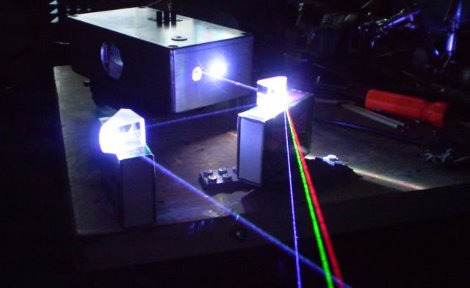
[Carl] sure has come a long way with laser modifications, now introducing his portable RGV Full Colour Laser. Although it feels just like yesterday when he showed us his green spiro and his Lego diffraction grating projector.

But enough of the past, the RGV laser is built using a White Fusion Mixing Kit and his own Full Colour Driver Extension. We couldn’t find any circuit diagrams or code to build your own at the moment, but it appears fairly straight forward and you can always take a look at [c4r0’s] Colour Laser.

RGB Display Development

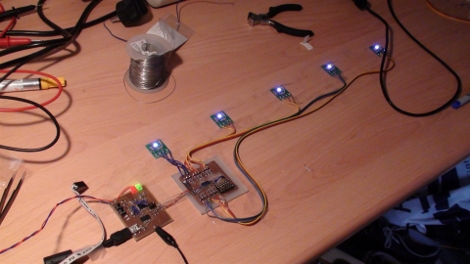
[SeBsZ] tipped us off that he’s working on a display using RGB LEDs. He’s etched some nice surface mount controller boards to carry the ATmega8 microcontroller and NXP PCA9635 drivers. This setup uses the I2C bus to address each expansion board of 5 LED modules. Theoretically this hardware would allow for 638 RGB modules but because of power and refresh rate issues he’s set his sights on reaching somewhere between 100-125, a total of about 25 expansion boards.

There’s not a ton to show off yet. But we expect big things from the project. Partly because one of his goals is to generate a display that can be rolled up and easily moved, and partly because his large-scale light bulb displays are so impressive. Take a look at the video of his 60-bulb unit after the break.

Continue reading “RGB Display Development”

You’re Not Seeing Double: RGB Christmas Trees

[youtube=http://www.youtube.com/watch?v=GAt6A98lXQw]

[mrpackethead], created this monster of a tree.  As shown in the video, it’s capable of showing animations, patterns, and potentially video. The 6m tall creation is studded with 2000 waterproof RGB LED modules. Software for the tree was written in Apple’s own Quartz Composer and integrated into Madrix, a piece of software designed with the purpose of controlling LEDs. The 600W system is 100% Arduino-free and costs less than the equivalent of 0.04USD per hour to run in New Zealand.

[Geoist] opted for the Arduino way to rig up his own smaller RGB Christmas tree. Finding a slightly kitschy fiber-optic model in his local department store, [Geoist] was eager to harness its colour-changing powers. Upon opening it up, it was discovered that it was controlled by nothing more than a light bulb and a spinning disk of coloured light filters. [Geoist] gutted the setup in favour of a breadboard with 3 RGB lights hooked up to an Arduino. The sketch for it is available on his site.

RGB Keylock Shield

Hackaday alum [Will O’Brien] cleaned up his messy breadboard with an RGB keylock Arduino shield. You may remember this two-part project from last year. It uses buttons backlit by an RGB LED to operate a door lock.

[Will] is still mulling over what type of kit options he will offer. We’re happy to see if the most important part, a laser-cut key bezel, will be available. This makes for a professional looking finish that made the original project difficult to replicate.

DIY Mood Lamp Looks Store-bought

[NeZoomie] built an RGB mood lamp as his first electronics project. He certainly hit it out of the park with this one, ending up with a design so clean it could be a commercial product. The controller is an Arduino board (further proof that this is a fantastic entry-level platform) that interfaces with 8 RGB LEDs. He’s built an enclosure out of thick polypropylene that does a great job of diffusing the light and adding a stylish look. The control system features a rotary potentiometer from SparkFun and what he calls a tilt-potentiometer of his own design after drawing inspiration from Hack a Day.

Blinky things are fun and that’s why we see a lot of mood lamps around here. Take a look at the video after the break and if you’ve got the parts, give this one a try!

Continue reading “DIY Mood Lamp Looks Store-bought”

Wireless RGB Light Bulb

img_3953

Want to make the above yourself? [Sprite_tm] did a thorough job documenting the build step by step (complete with pics, schematics, graphs, and links to the parts used). In summary, [Sprite_tm] busted open an Ikea CFL bulb to reuse the housing. Inside, he installed a scavenged power supply, ATtiny44, RGB LED module, and a radio receiver. A remote control allows [Sprite_tm] to change the lighting of his room to nearly any color. The cost of the project is a little under $30. The price tag isn’t so steep when one considers the insanely long lifetime of LEDs.