It might not be as elegant or technologically-advanced as a Segway or a motorized unicycle, but this easily constructed 2-wheeled robot might be a fun project for a free afternoon. The heart of the balancing mechanism is an SPDT switch with a button cell attached that reverses the motor when the robot begins to tip in one direction. It’s not controllable and it tends to fall over quite a bit, but it’s a good starting point and could be refined by lowering the center of gravity or figuring out a simple way to change the motor speed based on how far the robot has tipped over. There are no accelerometers or tilt switches so the components could be sourced from a parts bin, and its simple design definitely leaves a lot of room for improvement.
robot1034 Articles
Remote Controlled Pill-bot

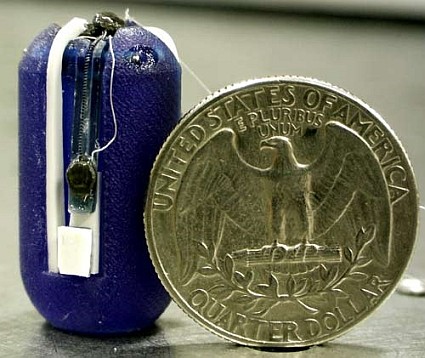
The NanoRobotics Lab at Carnegie Mellon University has come up with a medical robot that can be swallowed, and is then able to be controlled from outside the body. The device has small arms with adhesives that can attach to slippery internal surfaces, which has previously proven difficult. Once inside the body, it can be used to view damaged areas, deliver drugs, as well as biopsy questionable tissues, and possibly even be used to cauterize bleeding wounds with a small laser. The device could be stopped, and even reversed to get a better look at areas that may have gone unnoticed otherwise. This would be a major advancement in diagnosing intestinal problems, and could lead to potentially life saving treatments. Did we mention that it has lasers?
[via Neatorama]
Electric Screwdriver Robot Hand

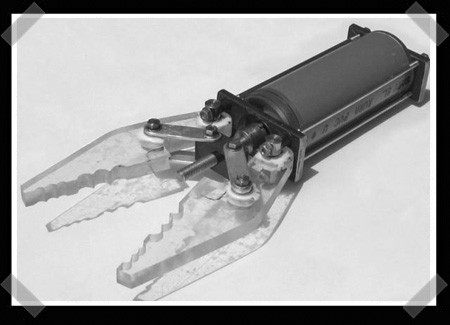
Here’s an interesting grabber hand built for use on an ROV. This grabber is a novel use of a very common and extremely cheap electric screwdriver, that is probably found in everyone’s toolbox. It is also a great way to reuse that small electric screwdriver you have kicking around that uses proprietary batteries that are not worth replacing. Many of the ROV’s covered previously could benefit from such a powerful device built from very common materials off his parts list. Because the screwdriver was extremely cheap the designer chose not to completely seal the housing.
It seems like this simple design that could be used in many robotic projects and by simply changing the jaws could yield other creative uses. The first thing that comes to mind is to upsize this hack into something bigger and stronger. Either way, you might not want to get your fingers in there.
Robot Red Snapper

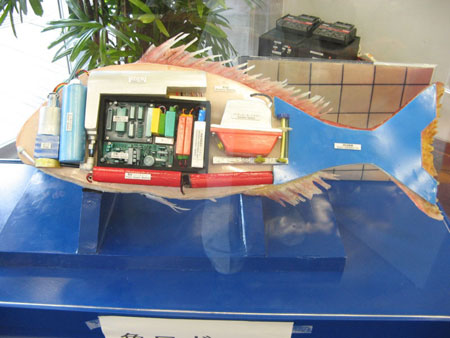
Engineers at the University of Kitakyushu have built this red snapper robot. Intended for wildlife surveys, this robot sports an array of sensors as well as a hand painted silicon body. It is decidedly more realistic looking than the Robofish and the Essex University robot fish. They say that the life like construction will aid in getting information about natural behavior of sea animals since it won’t stand out. It features a “unique” propulsion system that allows it to swim like a real fish. More information on that system would be nice. You can see more pictures of it here, but the descriptions are all in Japanese.
Hackit: Crap Modding

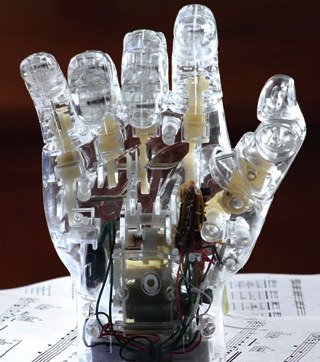
When Boing Boing Gadgets posted about this $13 robot hand music box, we immediately thought “OH EXPLOITABLE!”. Over the years, we’ve acquired quite a bit of cheap trash just operating under the assumption that we would turn it into something else. Most of our acquisitions are Woot‘s fault. Just this morning we were dismayed to find out that the purveyor of cheap electronics had already sold out of animatronic Elvis heads. Now that would have been fun. We’ve purchased things like Tony Hawk helmet cams, jumbo remotes, Bluetooth headphones, Gyration mice, IMFree chatpads, and many other items of questionable use thinking that some day we’d use it. How about you? What sort of irrational purchases have you made and what would you do with a $13 mechanized hand?
[Just as we were wrapping this up, Woot posted a $49 HMD; you better believe we bought that.]
Build A ROBONOVA-I
On the latest episode of Systm, they talk to [David Calkins], founder of the RoboGames competition, about humanoid robotics. The robots featured in the episode are Hitec’s ROBONOVA-I. The ROBONOVA is about a foot high and has 16 servos with support for up to 24, all connected to an Atmel controller. The episode is quite long: At around 15 minutes, they demonstrate the programming enviroment. You can program it traditionally or pose the bot to work out the motions. At 30 minutes, [David] mentions that next year’s competition will allow airsoft weapons to be attached, but bots have to be controlled from a first person perspective. If you’re interested in one of these kits, they have a ROBONOVA special of $900 or as low as $500 for educational institutions (that’s us, right?). Now is the perfect time to get one since you’ll have nearly a full year to prepare for RoboGames.
Related: You’ll hear builder [Matt Bauer]’s name mentioned several times.
[via BotJunkie]
BiPed Robot Version 3

Instructables user [alex.v] posted version 3 of his BiPed Robot. This robot is designed to mimic the control and movements of a human’s lower body. It has 12 degrees of freedom and a nice custom framework CNC’d from acryl sheets. The electronics consist of servos controlled by a custom board built around an ATmega8 and 3 ATtiny26s all programmed in assembly. He also has custom desktop software written in VB which allows direct control of the robot and graphs sensor data. His site contains pictures, videos, and design materials.