Space-Saving Servo Tester Console Looks Space-Worthy

You know how it goes — sometimes you just have to stop in the middle of a project and build yourself a tool that vastly improves your workflow as soon as it’s completed. [Ikkalebob] aka [Will Cogley] on YouTube is working on some super secret project that requires a whole bunch of servos. And since all of them have to be tested and set, he built this adorable servo tester as a time-saving gift to himself.

This tester revolves around an Adafruit 16-channel servo driver and an Arduino Uno. The servos show up on the screen in groups of four, and can be tested four at a time with the pots. The buttons let [Ikkalebob] move up and down between the groups. The SainSmart LCD proved to be more difficult to set up than others, but [Ikkalebob] did you a solid and tweaked the library. It’s available along with his code and STLs.

Speaking of STLs, we really dig the mini NASA console look and the folding enclosure. Leveraging the print process to build hinges and other things is awesome, and so is getting away with using fewer fasteners. You can see a bit of how [Ikkalebob] designed it in the video after the break.

Depending on what you’re doing with servos, you might want a different kind of testing suite. Here’s one that’s geared toward RC pilots.

Continue reading “Space-Saving Servo Tester Console Looks Space-Worthy”

2D-Platform Seeks Balance With A Touch Screen

It’s the [Bruce Land]-iest season of all, when the Cornell professor submits the projects his microcontroller class students have been working on all semester. Imagination does not seem to be in short supply with these students, and we always look forward to these tips this time of year.

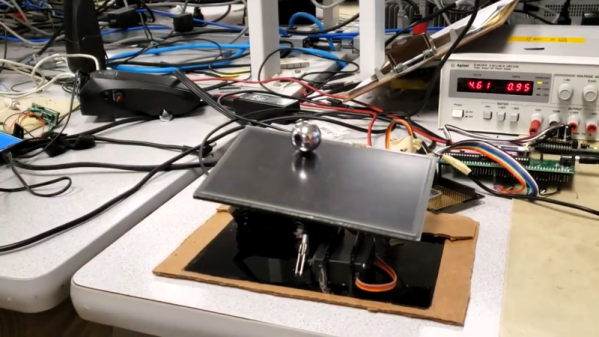
[Greg] and [Sam]’s touch-screen two-dimensional ball balancer is a good example of what [Land]’s students turn out. The resistive touch screen is supported by a 3D-printed gimballed platform and tilted in two axes by hobby servos. [Greg] and [Sam] chose to read the voltage outputs from the touch screen directly using the ADC on a PIC32, toggling between the two axes at 2 kHz. Two PID control loops were implemented to keep the ball as centered as possible on the platform, and the video below shows that there’s still some loop tuning to do. But given the positional inaccuracies of hobby servos and the compliance in the gimbal, we’re impressed that they were able to keep the system under control at all.

Of course we’ve seen ball-balancers before, but most of them have closed the loop using either cameras or microphones. Seeing direct sensing on the platform like this is a nice change of pace. Continue reading “2D-Platform Seeks Balance With A Touch Screen”

Cat Diner Now Under New Management

Most of these stories start with a cat standing on someone’s chest, begging for food at some obscene hour of the morning. But not this one. Chaz the cat is diabetic, and he needs to get his insulin with breakfast. The problem is that Chaz likes to eat overnight, which ruins his breakfast appetite and his chances at properly metabolizing the insulin. [Becky] tried putting the bowl away before bed, but let’s face it — it’s more fun to solve a problem once than to solve the same problem every night.

[Becky]’s solution was to design and print a bowl holder with a lid, and to cover the bowl when the cat diner is closed using a small servo and a NodeMCU. It looks good, and it gets the job done with few components. Chaz gets his insulin, [Becky] gets peace of mind, and everybody’s happy. This isn’t going to work for all cats, because security is pretty lax. But Chaz is a senior kitty and therefore disinterested in pawing at the lid to see what happens. Claw your way past the break to see [Becky]’s build/demo video featuring plenty of cat tax coverage.

We’ve seen a lot of cat feeding apparatus around here, but few that solve a specific problem like this one. If it’s overengineering and cat metrics you want, come and get it.

Continue reading “Cat Diner Now Under New Management”

Rescue An Expensive Servo With Some Reverse Engineering

[Andrew] had a servo damaged by someone connecting the power supply to the wrong pins (whoops) which fried the microcontroller and a logic level shifter. With a bit of reverse engineering, he successfully restored basic servo functionality by writing some new code. The new code implements only basic features, but that’s enough to save the device from the junk bin.

FAULHABER 2232DBHHO ring any bells? Google came up empty.

Why bother reverse engineering a servo? Well, if dollars are reasons then there are many for saving a HerkuleX DRS-0602 from the junk heap; they cost around 320 USD before shipping. Another reason to try is that the microcontroller turned out to be an AVR XMega, which gave [Andrew] confidence in writing some new code.

If you want to understand more about how these servos work, [Andrew] provides good photos of the insides and identifies the major components and their connections and functions. There are some mysteries (such as details of the motor and embedded encoder, which are FAULHABER 2232DBHHO) but [Andrew] figured out enough to write some basic code to allow the servo to work as a standard servo with a UART interface.

Sometimes curiosity drives reverse engineering and repair efforts, sometimes it’s cost, and sometimes it’s both. A $320 servo is certainly worth trying to save, and so are huge observatory telescopes with obsolete servo amps.

Steel Tubes And Ground Plates Form The Skeleton Of This DIY Vertical CNC Mill

If you’re going to do it yourself, you might as well outdo yourself. That seems to be the thinking behind this scratch-built CNC mill, and it’s only just getting started.

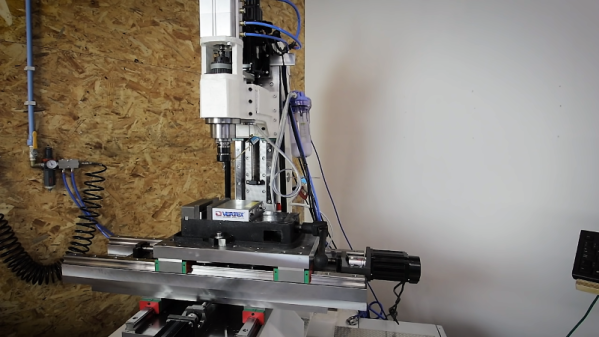
According to [Kris Temmerman], the build will cost about $10,000 by the time he’s done. So it’s not cheap, and a personal CNC from Tormach can be had for less, but that’s missing the point entirely. [Kris] built most of the structural elements for the vertical mill from cheap, readily available steel tubing, of the kind used for support columns in commercial buildings. Mounted to those are thick, precision-ground steel plates, which eat up a fair fraction of the budget. Those in turn hold 35 mm linear bearings and ball screws for the three axes, each powered by a beefy servo. The spindle is a BT30 with a power drawbar, belt-driven by an external motor that [Kris] doesn’t share the specs on, but judging from the way it flings chips during the test cut in the video below, we’d say it’s pretty powerful.

There’s still plenty to do, not least of which is stiffening the column; perhaps filling it with epoxy granite would do the trick? But it sure looks like [Kris] is building a winner here, and if he keeps the level of craftsmanship up going forward, he’ll have a top-quality machine on his hands.

Continue reading “Steel Tubes And Ground Plates Form The Skeleton Of This DIY Vertical CNC Mill”

Dambusting, R/C Style

Disclaimer: no dams were actually busted in the making of the video below. But that doesn’t mean that a scale-model homage to the WWII Dam Busters and their “Bouncing Bombs” isn’t worth doing, of course.

In a war filled with hacks, [Barnes Wallis]’ Bouncing Bomb concept might just be the hackiest. In the video below, [Tom Stanton] explains that [Wallis] came up with the idea of skipping a bomb across the surface of a lake to destroy enemy infrastructure after skipping marbles across the water. Using barrel-shaped bombs, he built a rig that could give them the proper amount of backspin and release them at just the right time, letting them skip across the surface of the lake while the bomber made an escape. Upon hitting the rim of the dam, the bomb would sink to explode near the base, maximizing damage.

[Tom]’s scale rig ended up being a clever design with spring-loaded arms to release a 3D-printed barrel after being spun up by a brushless motor. He teamed up with R/C builder [James Whomsley], who came up with a wonderful foam-board Lancaster bomber, just like RAF No. 617 Squadron used. With a calm day and smooth water on the lake they chose for testing, the R/C Lanc made a few test runs before releasing the first barrel bomb. The first run was a bit too steep, causing the bomb to just dive into the water without skipping. Technical problems and a crash landing foiled the second run, but the third run was perfect – the bomb skipped thrice while the plane banked gracefully away. [Tom] also tried a heavy-lift quadcopter run with the bomb rig, something [Barnes Wallis] couldn’t even have dreamed of back in the day.

Hats off to [Tom] and [James] for collaborating on this and getting the skipping to work. It reminds us a bit of the engineered approach to rock-skipping, though with less deadly intentions.

Continue reading “Dambusting, R/C Style”

Giant Analog CO2 Meter Sweeps Away Doubt

Most of us are aware that trees turn CO₂ into oxygen, but we’d venture to guess that many people’s knowledge of this gas ends there. Is it feast or famine out there for the trees? Who can say? We admire [rabbitcreek]’s commitment to citizen science because he’s so focused on making it easy for people to understand their environment. His latest offering, a giant analog CO₂ meter, might be our favorite so far.

The brains of the operation is an Adafruit Feather Adalogger. It reads the CO₂ sensor that’s mounted close to the business end of the nautilus, and becomes the quill that writes the CO₂ value to a FeatherWing e-ink screen. For the giant needle, this lovely meter uses one of those fiberglass poles you mark your driveway with so you can find it under a blanket of snow. The needle is counter-balanced with washers encased in printed plastic.

As you can see in the GIF, there’s a decent delay between the CO₂ blast and the needle response — we like to imagine the CO₂ spiraling slowly through the nautilus like a heavy, ill wind on its way to gravely move the needle.

Want a way to monitor air quality that’s a bit more discreet? Slip this portable meter into your pocket.