Tiny Transforming Beer Can Robot

beer_can_robot

The next time you reach for a cold one, you might want to take a look at the can to ensure that your beer won’t suddenly sprout legs and start skittering across the table.

You might remember [Ron Tajima] from some of his previous creations, including this Roomba-based baby cradle and the PacMan Roomba mod. This time around, he has created a cool little transforming robot that fits inside a beer can.

The robot’s brains are stored just underneath the top of the beer can on a custom-built board. On one side of this board, you will find an mbed controller which is used to manage all of the robot’s functions, and on the other side, four batteries provide all of the device’s power. The robot’s three legs are controlled by six servos, allowing for movement in several different planes. The beer-bot’s movements are controlled with a Wiimote, so we’re assuming he has crammed a Bluetooth module somewhere in there as well.

[Ron] mentions that it moves a bit slowly when standing on end, but we think the robot is pretty awesome as is, and we can’t wait to see what improvements the next version might bring.

Stick around to see a video demonstration of the robot in action.

[Thanks Sascha]

Continue reading “Tiny Transforming Beer Can Robot”

Android Controlled Labyrinth

[Pcdevltd] pulled an all-nighter to get his first Android Developer Kit project up and running. Basing the project off of the example that Google used when unveiling the new accessory development hardware, he set to work controlling a marble labyrinth game using his smart phone. What began at 7pm was wrapped up by 5am to produce the results seen in the video after the break.

These ball mazes use two knobs to pivot the playing surface, changing gravity’s pull on the ball to get it to go where you want. [Pcdevltd] pulled off the bottom on his labyrinth and installed two small servo motors. These connect to the Android Open Accessory Development Kit via a small cable. Connect that to the phone and you can then use the internal accelerometer to play the game. If you have an Android phone and an Arduino this should be pretty easy to replicate since we know you can already use the ADK with Arduino. Get to work on your own projects and don’t forget to send us a link to your project log.

Continue reading “Android Controlled Labyrinth”

Automatic Espresso Loader For Those Late Night Hack Sessions

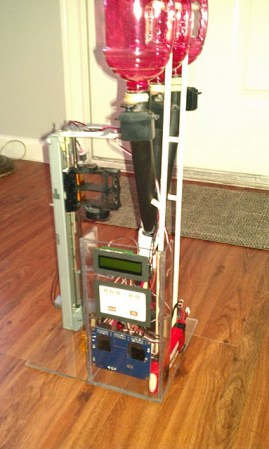
For [Roy’s] graduate electronics class, he decided to make something that many in and out of the hacking world would certainly love, an automatic espresso loader.  One can choose from three flavors available. In order to accomplish this, a Parralax Propeller board is used to control three servos that regulate the amount of coffee dispensed, chosen by a handy LCD HMI (human machine interface).

After the coffee is dispensed, the chute swings out of the way. A modified inkjet cartridge carrier (from a dead printer) is then used to compact the beans. Check out the video of this machine in action after the break. Continue reading “Automatic Espresso Loader For Those Late Night Hack Sessions”

The Kinect Controlled Zombie Skeleton

Although there is no shortage of Kinect hacks out there, this one from Dashhacks seems especially cool.  According to them, the software part of this design uses a “modified OpenNI programming along with GlovePIE to send WiiMote commands to the cyborg such as jaw and torso movement along with MorphVOX to create the voice for the cybernetic monstrosity.” As pointed out in the video, this robotic zombie also has a “pause” feature, and a feature to loop movements like what would be done at an amusement park.

The other great thing about this hack is how well the skeleton is actuated via servo motors. Although it’s difficult to tell how many servos were used for this robot, it certainly has 10 or more degrees of freedom between the head, both arms, and the torso. To control all of this a hacked Wiimote and Nunchuck is used in conjunction with the Kinect. Check out the video after the break.

Continue reading “The Kinect Controlled Zombie Skeleton”

Building A One-ton Linear Servo

one_ton_servo_jack

A while back, [Windell] from Evil Mad Scientist Laboratories wrote up an article for Make Magazine detailing how he built a one-ton, servo-controlled scissor jack for under $100. He dropped us a line to let us know that the project details have been released for free at Make Projects, so we stopped by to take a look.

The project starts out by pulling apart an electronic scissor jack to get access to the solder pads for the up and down buttons. Once wires are added there, a servo is the next victim. [Windell] recommends using an old servo with a busted motor, but you can use a good one just the same. The servo’s pots are replaced with 10 turn pots, and then wired up to a controller board, to which the jack is also connected. Then, to provide feedback to the servo, a string is looped around the top of the jack, which is used to turn the pots added in the previous step.

[Windell] says that the setup works quite well, though we imagine the duty cycle might be a bit short before adjustments are required. Regardless, it’s a quick way to get a heavy load lifted with servo precision.

Washing Machine Mechanical Timer Replaced With Microcontroller

After the electromechanical timer on [Paul Canello’s] washing machine broke for the third time he decided he needed to stop repairing it and find a more permanent fix. He decided to build his own microcontroller-based system for washing his clothes (translated). Caution: The image links on [Paul’s] page seem to be broken and will unleash a never-ending storm of empty pop-up windows if you click on them. We’ve embedded all of the images after the break to save you some hassle.

The controller on a washing machine is nothing more than a mechanical alarm clock. It starts the cycle, then moves through various modes based on the passage of time. [Paul] started his hack by observing how long the delay between cycles was meant to be, and recording which parts of the machine were switched on and off at each stage.

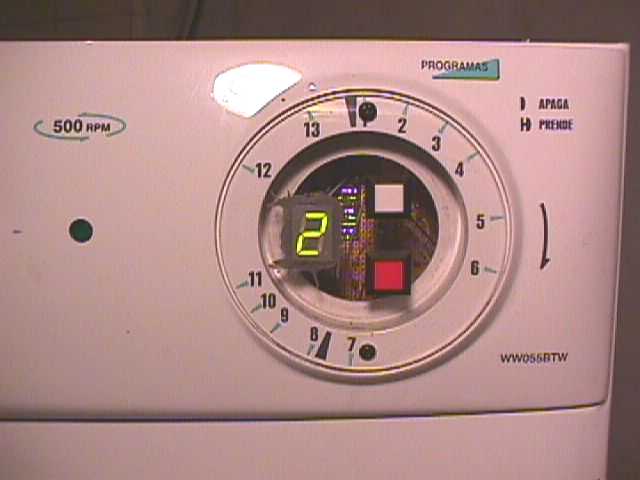
It turns out that when the mechanical knob is turned, it reroutes how water flows through the detergent chamber. Since that knob won’t be in the new system [Paul] came up with a way for the microcontroller to handle this by using a servo motor. The rest of the control involves relays to control the motor, and solenoid valves for the water. There are also pressure switches that give feedback for the level of the water in the machine. A PIC 16F872 serves as the new controller, with the help of a 7 segment display, a buzzer, and a pair of buttons as the user interface.

This is an older project, but after reading about the Arduino controlled dishwasher [Ramiro] sent us a link. Thanks! Continue reading “Washing Machine Mechanical Timer Replaced With Microcontroller”

Trick Mouse Keeps The Screen Saver At Bay

mouse_wiggler

[Jerry] wrote in to share a little device he built to solve a problem he was having at work. You see, every computer in his office has a policy-enforced idle timeout, requiring the user to enter a password in order to regain access to their desktop.

This is a huge pain, since he sporadically uses an old computer for the sole purpose of monitoring some applications running in his data center. With the computer timing out every 10 minutes, he is constantly required to enter his password in order to take a 10 second glance at the screen to ensure everything is OK.

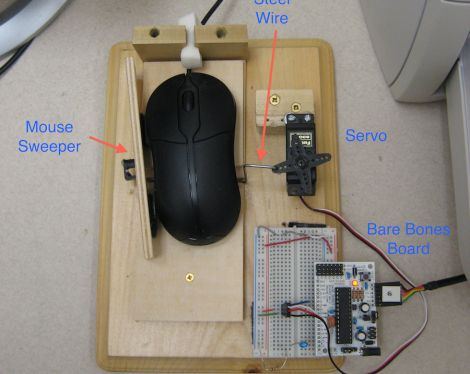
Rather than circumvent the screen saver using a local security policy or by implementing a microcontroller-based signal generator, he opted to create a mechanical solution instead. His computer’s optical mouse resides inside a wooden frame, and is periodically swept from side to side by an ATmega-controlled servo, keeping the screensaver permanently at bay.

Call it a hack, call it a kludge, call it what you will. All we know is that while we might have done it a little differently, it works just fine for [Jerry], and it generates all sorts of interesting conversation to boot.

Stick around for a quick video demonstration of his mouse wiggler box.

Continue reading “Trick Mouse Keeps The Screen Saver At Bay”