Washing Machine Mechanical Timer Replaced With Microcontroller

After the electromechanical timer on [Paul Canello’s] washing machine broke for the third time he decided he needed to stop repairing it and find a more permanent fix. He decided to build his own microcontroller-based system for washing his clothes (translated). Caution: The image links on [Paul’s] page seem to be broken and will unleash a never-ending storm of empty pop-up windows if you click on them. We’ve embedded all of the images after the break to save you some hassle.

The controller on a washing machine is nothing more than a mechanical alarm clock. It starts the cycle, then moves through various modes based on the passage of time. [Paul] started his hack by observing how long the delay between cycles was meant to be, and recording which parts of the machine were switched on and off at each stage.

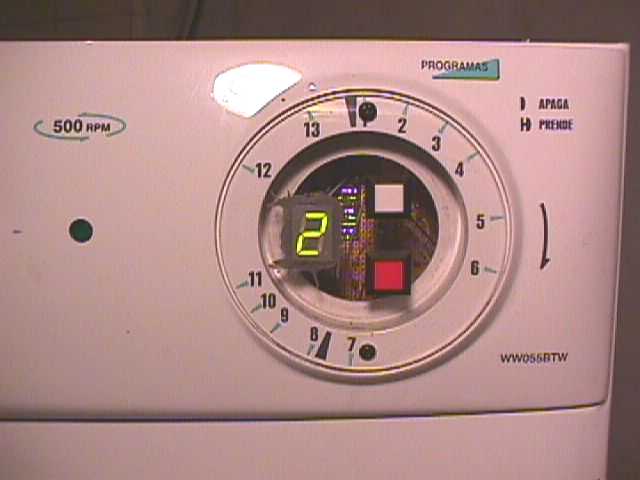
It turns out that when the mechanical knob is turned, it reroutes how water flows through the detergent chamber. Since that knob won’t be in the new system [Paul] came up with a way for the microcontroller to handle this by using a servo motor. The rest of the control involves relays to control the motor, and solenoid valves for the water. There are also pressure switches that give feedback for the level of the water in the machine. A PIC 16F872 serves as the new controller, with the help of a 7 segment display, a buzzer, and a pair of buttons as the user interface.

This is an older project, but after reading about the Arduino controlled dishwasher [Ramiro] sent us a link. Thanks! Continue reading “Washing Machine Mechanical Timer Replaced With Microcontroller”

Trick Mouse Keeps The Screen Saver At Bay

mouse_wiggler

[Jerry] wrote in to share a little device he built to solve a problem he was having at work. You see, every computer in his office has a policy-enforced idle timeout, requiring the user to enter a password in order to regain access to their desktop.

This is a huge pain, since he sporadically uses an old computer for the sole purpose of monitoring some applications running in his data center. With the computer timing out every 10 minutes, he is constantly required to enter his password in order to take a 10 second glance at the screen to ensure everything is OK.

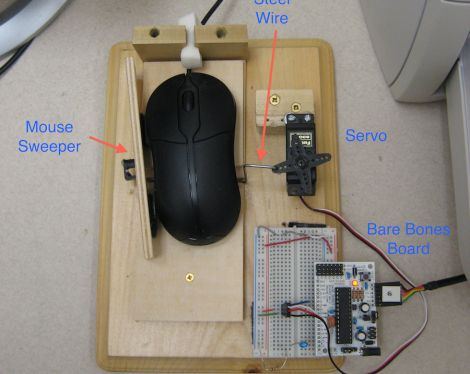
Rather than circumvent the screen saver using a local security policy or by implementing a microcontroller-based signal generator, he opted to create a mechanical solution instead. His computer’s optical mouse resides inside a wooden frame, and is periodically swept from side to side by an ATmega-controlled servo, keeping the screensaver permanently at bay.

Call it a hack, call it a kludge, call it what you will. All we know is that while we might have done it a little differently, it works just fine for [Jerry], and it generates all sorts of interesting conversation to boot.

Stick around for a quick video demonstration of his mouse wiggler box.

Continue reading “Trick Mouse Keeps The Screen Saver At Bay”

Aquabot Gets Around More Than You’d Think

This doesn’t have the flashy futuristic appeal that we’d like to see from high-tech robots, but this amphibious wanderer is well suited for it’s intended purpose. It was developed by researchers at the University of Minnesota to navigate mostly wet environments, collecting data about water quality as part of a distributed army of sensor bots.

The two little arms sticking out in front of it are made of carbon fiber and attached to servo motors inside. The video below the fold shows the trapezoidal body tumbling end-over end to get around. But the awkward, baby-turtle-like locomotion isn’t the only thing in its bag of movement tricks. It can also adjust its buoyancy to float, sink, or hover somewhere in the wet stuff.

To get a better look at what went into developing this, take a look at the Adelopod developed at UMN a couple of years back. We also embedded a video of that tumbling robot because they share the build details we’re always on the lookout for.

Continue reading “Aquabot Gets Around More Than You’d Think”

Wireless Rover Has Two Guns…one For Each Of Ya

texas_ranger_airsoft_rover

We never really get bored with remote-controlled rovers around here, especially when they involve reusing some old hardware as well as lasers. [Tycoon] wrote in to share his creation, which he has dubbed “Texas Ranger”.

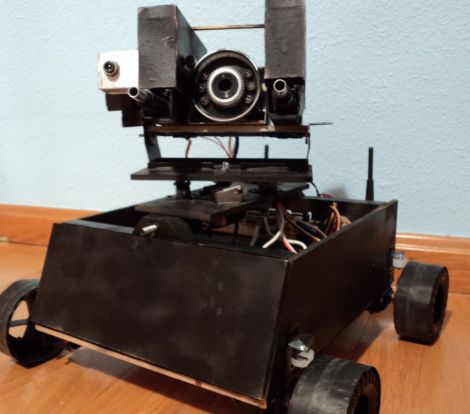
Texas Ranger is built around an old Linksys WRT54GL router, which provides the rover’s WiFi connectivity as well as the serial interface through which everything else is controlled. The rover features a pair of PIC microcontrollers, which handle all of the servo control as well as telemetry calculations.

An onboard camera gives the operator a driver’s seat view of the action, allowing for precise control of the vehicle. Laser triangulation is used to help measure object distance, and a pair of airsoft pellet guns straddle the camera for whenever [Tycoon] feels like making his presence known. One feature we are especially fond of is the pair of Wii nunchucks which the rover uses to monitor its position. Always aware of its operating angle, it auto-adjusts the camera to compensate for uneven surfaces, guaranteeing that [Tycoon] doesn’t have to tilt his head to see straight.

Keep reading to see a quick demo video he shot of Texas Ranger in action.

Continue reading “Wireless Rover Has Two Guns…one For Each Of Ya”

Facebook Notifier Uses Some Papercraft And Simple Electronics

This weekend project will tell you when you’ve got something new to look at on your Facebook page (translated). The yellow flag on the side of the mini-mailbox automatically goes up, alerting you to your recent online popularity.

[Rocco’s] craftwork on this project is fantastic. We love the scale, the colors, and especially the artificial grass that adorns the base. Inside the mailbox an Arduino controls a small servo motor attached to the new mail flag. As with other Arduino-based notifiers (be it the Internet Furby, or our own troll sniffing rat) the USB connection makes it incredibly easy to convert online information to real-world signals. The client side of this is a Python script. It uses a package that we were previously unfamiliar with called mechanize. We’ve just made a cursory examination of how that package is used, but we’re going to keep it in mind as an alternative to our usual go-to package, BeautifulSoup, which tends to be a bit hairy when you’re just looking for some basic data.

BAMF2011: Google’s SKPR Bot, Not For Arachnophobes

Google’s Maker Faire exhibit space is swarmed with robots…er, androids. Amidst some cool bipeds and Segway-balancers, our inner sci-fi nerd was most smitten with this hexapod design, which they’ve dubbed SKPR Bot. The “Skipper” is on hand to showcase the ease of various Google technologies: SketchUp, Android OS and the Android Open Accessory Development Kit. The whole project came together in less than six weeks.

18 servos are mounted to a framework designed in SketchUp and laser-cut by Ponoko. The low-level servo PWM control is handled by the Dev Kit (essentially a rebadged Arduino Mega, as we’ve seen), while an Android OS phone provides a slick GUI and handles all the inverse kinematics calculations required as the robot takes each step. The coolest bit is that it’s all up for grabs. At this moment you’ll have to scrounge around the ’net a bit to find the plans and code, but some time post-Faire they plan to bring everything together at the SKPR Bot site.

Cutting Paper Scrolls With Frickin’ Lasers

This circuit illustration adds a scrolling paper feeder to the bed of a laser cutter. In the video after the break you can see that the actual assembly is put on the bed of the laser cutter. After the laser has cut out the specified pattern, the scroll is wound to move an un-cut portion into place. It uses a servo motor to drive one of the spools.

An Arduino Uno with a servo shield is being used for this application. It has one button which winds one spool for a pre-programmed period of time. There’s a few issues with this setup, namely that it’s not tied into the CNC program that runs the laser. There’s also a lack of precision when using a continuously rotating servo like this. If it were upgraded to use a stepper motor and patched into the CNC hardware this would make cutting new scrolls for your player piano a breeze.

Here’s a project that does the opposite, it takes old player piano rolls and digitizes them.

Continue reading “Cutting Paper Scrolls With Frickin’ Lasers”