USB Gameboy Cart

gamecart

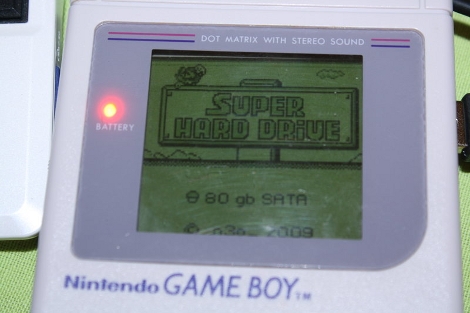
[Jose Torres] sent in his latest attempt at creating a custom Gameboy game cartridge. We’ve featured his projects before, and he’s come a lot closer over the last 2 years. He’s aiming to create an easy interface for homebrewers that doesn’t require any other special equipment. In this revision, he’s using a PIC and a memory controller to interface between an SD card and the Gameboy. The cart also has USB support for uploading files to the SD card and reprogramming the PIC. Because it’s just USB mass storage, it will work on almost any modern OS. He’s currently testing the device, but hopes to be selling them soon for $40.

Arduino USB Host Shield

UsbHostShield

Circuits@Home has been journaling their development of a USB host mode shield for Arduino, which could bring the platform a veritable explosion of mass storage, keyboard input and countless other peripheral options (and a corresponding raft of new hacks). Currently at the prototype stage, a ready-made shield and library are forthcoming, so keep checking back. Meanwhile, for embedded developers wanting to learn the ropes of USB, the in-progress articles will likely provide some valuable insights.

[thanks Kersny]

Reverse Engineering USB Drivers

luxeed_keyboard

When [Jespersaur] purchased a Luxeed LED keyboard, he was disappointed to find that the drivers were not open source and didn’t support all the features he wanted. His solution? Hack the drivers that come with it, and implement his own. In his article, he gives a basic rundown of beginning reverse engineering by multiple methods and a brief introduction to libusb. For the Linux drivers, check out [Kurt Stephens]’s site, where he supplies a link to the source code, instructions on building it, and a tutorial on sending commands to the keyboard.

Tiny Bluetooth Teardown

minibluetooth

The folks at SparkFun were startled by how small USB bluetooth adapters had become so they split one open. They noted a few interesting design features. It has a small folded trace antenna on the board edge. The metal USB housing acts as the RF shield. The bluetooth IC is an AS3620QA. Now we wonder what those tiny Buffalo drives look like inside.

Related: Eye-Fi teardown, storage/WiFi in an SD card

1wire Attic Cooling

blower

[RagingComputer] built this 1-wire attic cooling fan. He’s using an Ubuntu server loaded with OWFS to control everything. The 1-wire temperature sensor is interfaced using USB while a serial x10 module sends out commands to be received by another x10 module near the fan. Back in the day we had covered a linux home automation project. We also covered HVAC hacks such as the smart attic fan and a 1-Wire HVAC monitoring system.

Black Hat 2009: Powerline And Optical Keysniffing

sniff

The 2009 edition of the Black Hat security conference in Las Vegas has just begun. The first interesting talk we saw was [Andrea Barisani] and [Daniele Bianco]’s Sniff Keystrokes With Lasers/Voltmeters. They presented two methods for Tempest style eavesdropping of keyboards.

Continue reading “Black Hat 2009: Powerline And Optical Keysniffing”

AVR ISP Programming Via Arduino

ardunio avr isp programming

We found this Arduino AVR ISP programmer particularly interesting. AVR microcontrollers can utilize an interface called In-System-Programming. ISP allows the chip to be programmed or reprogrammed while in an actual circuit via a pin header. Atmel’s solution is the AVR ISP MKII programing tool. The MKII can also be reprogrammed just as an AVR. The difference here is that most people are not likely to modify the MKII to be used as anything but a programmer. On the other hand if you already have the Arduino, fetch the avr.isp.03 firmware and AVRdude. Then program a device, for example an ATtiny13 using the Ardunio as the programmer. All the project information is provided under the CC BY-NC-SA 3.0 license. On a related note we covered a Microcontroller cheat sheet which covers AVR devices and ISP pinouts.