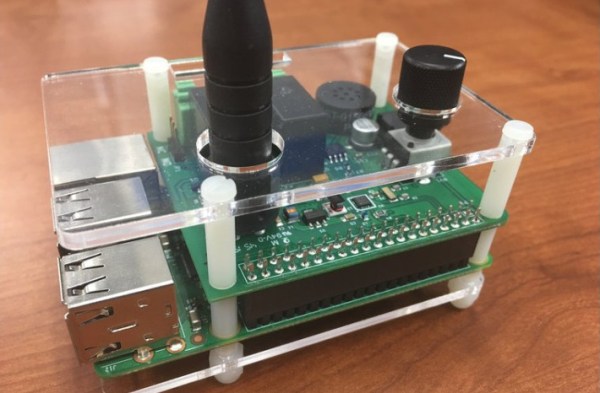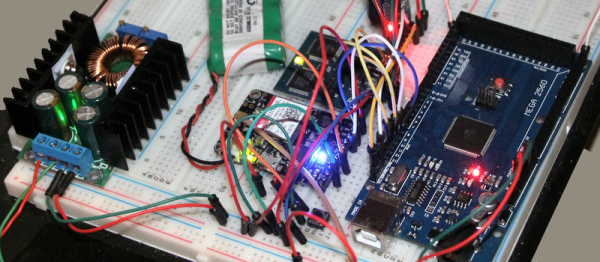
Stephen Hawking, although unable to speak himself, is immediately recognizable by his voice which is provided through a computer and a voice emulator. What may come as a surprise to some is that this voice emulator, the Emic2, has been used by many people, and is still around today and available for whatever text-to-speech projects you are working on. As a great example of this, [TegwynTwmffat] has built a weather forecasting station using an Emic2 voice module to provide audible weather alerts.
Besides the unique voice, the weather center is a high quality build on its own. An Arduino Mega 2560 equipped with a GPRS module is able to pull weather information once an hour. After the voice module was constructed (which seems like a project in itself) its relatively straightforward to pass the information from the Arduino over to the module and have it start announcing the weather. It can even be programmed to sing the weather to you!
All of the code that [TegwynTwmffat] used to build this is available on the project site if you’re curious about building your own Emic2 voice system. It’s also worth noting that GPRS is available to pretty much anyone and is a relatively simple system to start using to do things like pull weather information from, but you could also use it to roll out your own private cell phone network with the right equipment and licensing.
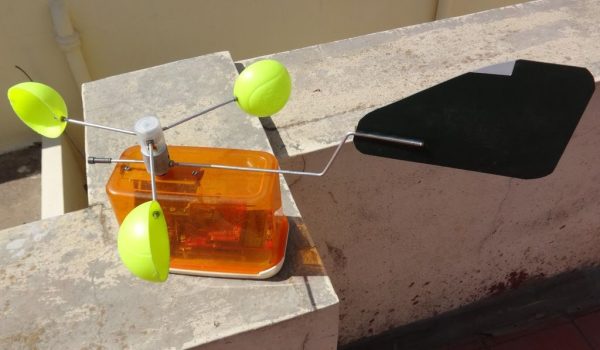
 We have to admit that when we first saw [Ajoy Raman]’s Instructables post, we figured that he used a universal motor to generate a voltage from the anemometer. But [Ajoy]’s solution to the coaxial shafts problem is far more interesting than that. A discarded universal motor donated its rotor and bearings. The windings were stripped off the assembly leaving nothing but the commutator. 1kΩ SMD resistors were soldered across adjacent commutator sections to form a series resistance of 22kΩ with taps every 1k, allowing 0 to 2.2V to be read to the ADC of a microcontroller depending on the angle of the vane.