Party Canoe Lights Up The Water

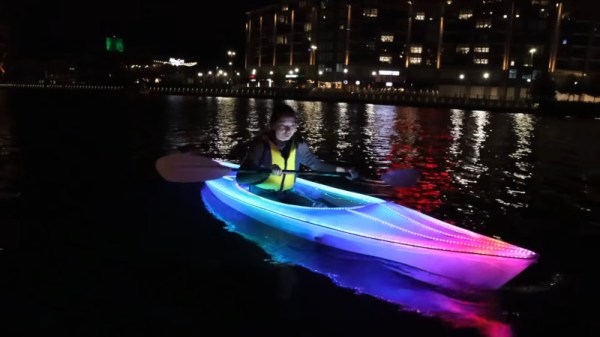
Generally, any activity out on the water is more dangerous when done at night. Hazards are less visible, and it can be easy to get into trouble. [Xyla Foxlin]’s party canoe can’t help with that, but it does look the business after dark.

The canoe is made out of fiberglass, directly formed onto an existing canoe to make getting the shape right easy. It was formed in two halves, with special care taken to make the final result as clear as possible. Obviously, fiberglass is never going to be perfectly transparent, but [Xyla] does a great job of getting a nice translucent frosted look. The final effect means that it’s the perfect canoe to stuff full of addressable LEDs. A string of WS2812Bs, hooked up to an Arduino, make for an appealing lightshow when boating at night.

The diffusive nature of the fiberglass really makes the difference here. We’ve talked about the topic before – it’s the key to making your glowy project really pop. Video after the break.

Continue reading “Party Canoe Lights Up The Water”

Weather Note Tells You What You Need To Know, And No More

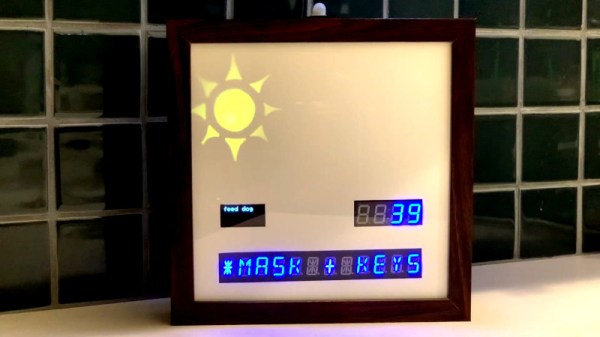
Smartphones are portals to an overwhelming torrent of information. Yes, they’re a great way to find out the time, your bus schedule, and the weather, but they’re also full of buzzers and bells going off every three minutes to remind you that your uncle has reposted a photo of the fish he caught ten years ago. Sometimes, it’s better to display just the essentials, and that’s what Weather Note does.

It’s built around the Adafruit Feather Huzzah, a devboard built around the venerable ESP8266. It’s a great base for an Internet of Things project like this one, with WiFi built-in and ready to go. The Weather Note talks to a variety of online platforms to scrape weather data and helpful reminders, with the assistance of If This Then That, or IFTTT. Reminders to walk the dog or get some milk are displayed on a small OLED screen, while there’s also a bunch of alphanumeric displays for other information. WS2812 LEDs are used behind a shadowbox to display weather conditions, with cute cloud, rain, and sun icons. It’s all wrapped up in a tidy frame perfect for the mantlepiece or breakfast table.

It’s a great build to learn about programming for the Internet of Things, and with those bright LED displays, it’s probably a viable nightlight too. It’s a rare project that can both tell you about the weather and keep you from stubbing your toe in the kitchen, after all. Those desiring a stealthier build should consider going down the smart mirror route instead. Video after the break.

Continue reading “Weather Note Tells You What You Need To Know, And No More”

Slim RGB Matrix Puts LEDs Inside The PCB

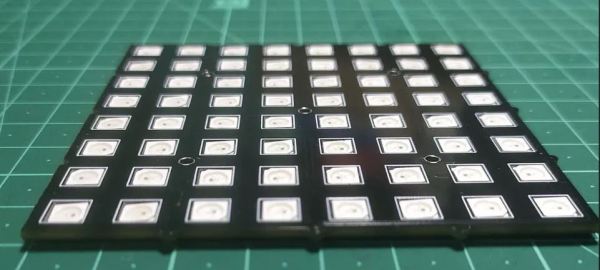
Sometimes all that’s required to build something interesting is to put the same old pieces together differently. [Sayantan Pal] did this for the humble RGB LED matrix, creating an extra-thin version by recessing WS2812b NeoPixel LEDs inside a PCB.

The popular WS2812B is 1.6 mm in height, which happens to be the most commonly used PCB thickness. Using EasyEDA, [Sayantan] designed a 8×8 matrix with modified WS2812B footprints. A slightly undersized cutout was added to create a friction-fit for the LEDs, and the pads were moved to the back side of the panel just outside the cutout, and their assignment were flipped. The PCB is assembled face down, and all the pads are soldered by hand. Unfortunately this creates rather large solder bridges which slightly increases the overall thickness of the panel, and is probably also unsuitable for production with conventional pick-and-place assembly.

We’ve seen some similar methods with PCB assemblies that use layered PCBs. Manufacturers are starting to even embed components inside multilayer PCBs.

RGB Party Bike Flashes With The Beat

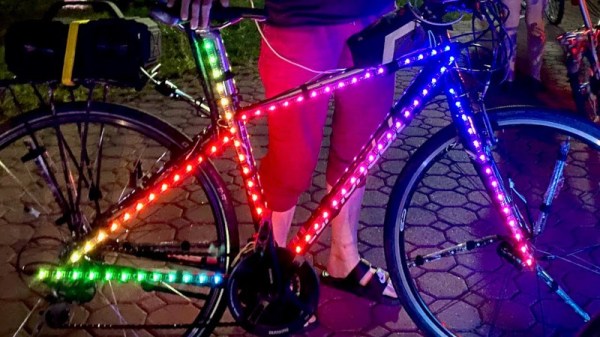
One of the biggest dangers to a cyclist is not being seen at night. To counteract this, all manner of lighting and reflective gear is available to help ensure bicycles are seen on the streets. Of course, you don’t have to stop at the purely practical. [TechnoChic] decided to have some fun with her ride, festooning her party bike with many, many LEDs.

As you’d expect, the RGB illuminations are thanks to WS2812B LED strips. Running the show is  a trio of Arduino Nano 33 IoTs – one for the LEDs on the bike’s frame, the other two mounted on the front and back wheels respectively. This allowed for the easy control of LEDs on the spokes without having to pass data and power lines to the rotating wheels. The LEDs on the frame are even music-reactive, with the Arduino sampling music input via one of its analog-to-digital converters.

Paired with a boombox on the bike, the build makes for a great way to hype up group rides through the city at night. We can imagine such a bike being an absolute hit at Critical Mass, though you’ve probably gotta add a laser or glitter cannon if you’re going to draw attention at Burning Man. If you’re tired of pedaling, you might consider an electric conversion, too. Video after the break.

Continue reading “RGB Party Bike Flashes With The Beat”

Colorful Quinary Clock Makes The Most Out Of Five Neopixels

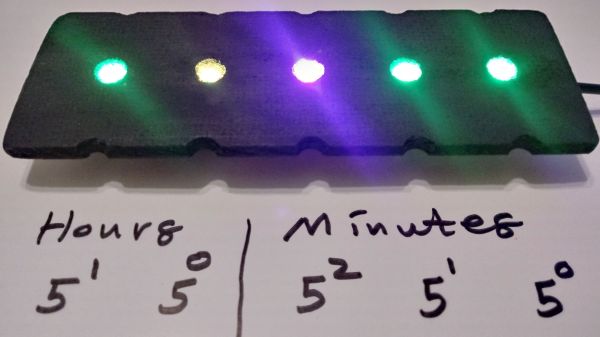
If binary digits are bits, are quinary digits “quits”? Perhaps, but whatever you call them, you’re going to have to wrap your head around some new concepts in order to make sense of this quinary display clock.

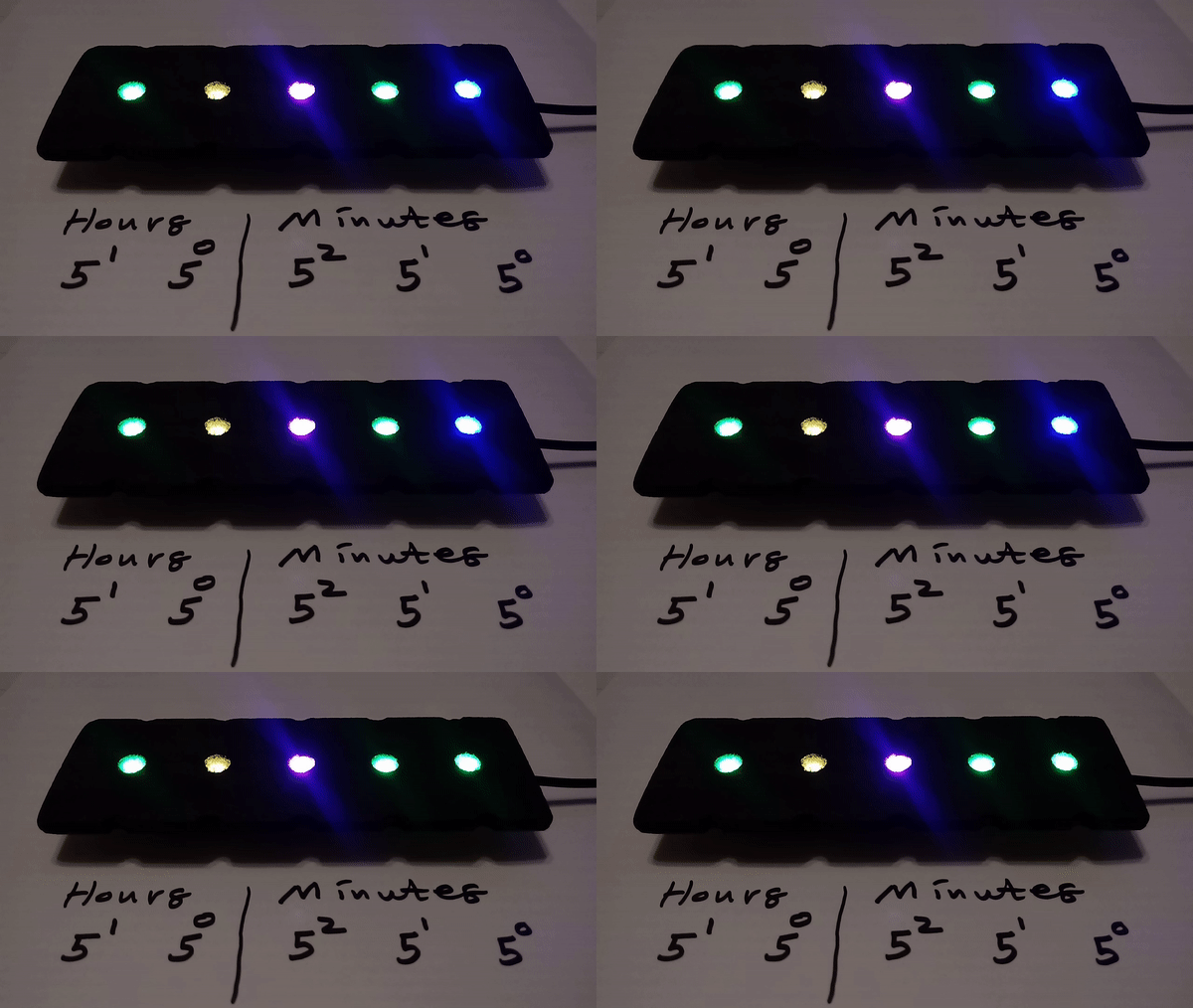
The transition between 15:42 and 15:43.

Why quinary? [Spike Snell] wanted to minimize the number of LEDs, and 52 is enough to cover all 24 hours. Binary clocks may have geek chic, but there are only so many ways to display ones and zeros.

[Spike]’s clock is unique because it shows each quit using a single WS2812 Neopixel. The values zero through four are each represented by a different color, meaning the user needs to memorize which color goes with which value, which we suspect is the hardest part of learning this clock. The clock’s software is fairly simple and runs on an ESP8266, and uses NTP to keep on track. The clock self-adjusts for Daylight Savings time, and it has a nice feature that dims the display in the evening to make living with it easier.

Even for those not up on their base-five arithmetic,  [Spike]’s clock is still a nice, slowly evolving abstract art piece. And for those who grok the quinary clock, perhaps a career awaits you in an alternate future where bi-quinary relay computers caught on.

Running Way More LED Strips On A Raspberry Pi With DMA

The Raspberry Pi is a powerful computer in a compact form factor, making it highly useful for all manner of projects. However, it lacks some of the IO capabilities you might find on a common microcontroller. This is most apparent when it comes to running addressable LED strings. Normally, this is done using the Pi’s PWM or audio output, and is limited to just a couple of short strings. However, [Jeremy P Bentham] has found a way to leverage the Pi’s hardware to overcome these limitations.

The trick is using the Raspberry Pi’s little-documented Secondary Memory Interface. The SMI hardware allows the Pi to shift out data to 8 or 16 I/O pins in parallel using direct memory access (DMA), with fast and accurate timing. This makes it perfect for generating signals such as those used by WS2812B LEDs, also known as NeoPixels.

With [Jeremy]’s code and the right supporting hardware, it’s possible to run up to 16 LED strips of arbitrary length from the Raspberry Pi. [Jeremy] does a great job outlining how it all works, covering everything from the data format used by WS2812B LEDs to the way cache needs to be handled to avoid garbled data. The hack works on all Pis, from the humble Pi Zero to the powerful Pi 4. Thanks to using DMA, the technique doesn’t overload the CPU, so performance should be good across the board.

Of course, there are other ways to drive a ton of LEDs; we’ve seen 20,000 running on an ESP32, for example.

[Thanks to Petiepooo for the tip!]

Surfboard LED Strips Light Up The Waves

Surfing is an activity predominantly enjoyed during the day, primarily for reasons of warmth and water safety. Of course, if you prefer to carve the waves at night, you might enjoy the latest project from [Moritz Sivers] – a surfboard kitted out with motion-reactive LEDs.

The build consists of a regular surfboard, with a channel cut around the perimeter into which WS2812B LED strips are glued. Powered by a lithium rechargable battery, commands are given by an Arduino Nano hooked up to a MPU6050 3-axis gyroscope. This allows the Arduino to change the light patterns based on the movement of the board. Left and right turns, pumping the board, and surfing down a wave all come with their own animations.

It’s a fun twist on night surfing, and makes it easier to spot a downed surfer, too. It’s a build we expect to see recreated in a high-end 4K surf film before the year is out. Of course, if you just need to know if the conditions are right before you head out, this surf weather station might be just the build for you. Video after the break. Continue reading “Surfboard LED Strips Light Up The Waves”