Playing video games for a college application

posted Feb 9th 2012 11:58am by
filed under: ATtiny hacks

As a senior in high school, [Owen] has been waiting to hear from the colleges he applied to for months now. Some of his applications wanted a mid-year report to see if he didn’t come down with senioritis. [Owen] realized these colleges allowed additional materials beyond a high school transcript, so he built a tiny video game that shows his electrical and programming skills.

The Demomite, as [Owen] calls his build, is an amazing piece of work. The entire system is based around an ATtiny2313 with a measly 2kB of program memory. Aside from a graphic LCD from Sparkfun and a repurposed NES controller, there isn’t much else to the build. As a study in minimalism and simplicity, [Owen] gets a big congrats from us.

The entire game fits in the 2kB of flash on the ATtiny, mostly due to coding the entire thing in assembly. You can check out [Owen]‘s time-lapse construction video, software demo, and the video he sent to colleges after the break.

Read the rest of this entry »

DIY dimmable clapper for all your lazy lighting needs

posted Jan 15th 2012 12:25pm by
filed under: misc hacks

For the lazy man who can’t be bothered to buy a proper wattage lamp here’s the Clever Clapper, a Clapper that finally has the ability to dim the lights.

Like the clapper we saw last month, [Pete]‘s version uses an ATtiny2313 and an electret mic. What sets [Pete]‘s version apart from the vintage 80s model is the ability to dim the lights. Like any clapper, two hand claps within a second toggles the relay. Clapping three times within one second puts the lamp into fading mode. In this mode, the lights dim up and down with PWM until a fourth clap is detected.

[Pete] saw that the program memory in his ATtiny2313 wasn’t 100% full, so he added a few more capabilities. If you shine a laser onto his circuit, a relay trips and turns on a decorative moon lamp. There’s also a ‘lecture mode’ that feeds the microphone directly into the microcontroller to vary the PWM signal. The result is a light that brightens with more intense sound. Check that feature out after the break after the demo video of [Pete]‘s Clever Clapper.

Read the rest of this entry »


DIY clapper is the ideal gift for the laziest person in your life

posted Dec 20th 2011 6:01am by
filed under: home hacks

diy-clapper

If you haven’t yet wrapped up your Christmas shopping, you may want to consider building [AlanFromJapan’s] implementation of the ever-classic “Clapper”. With its theme song burned into the brain of anyone old enough to remember the 80s, the clapper was a wonderful device that certainly put the “L” in laziness.

Looking for an excuse to play around with an opamp and microphone [Alan] decided to build his own version of the Clapper based off this similar circuit, which he calls the ClapClap. He built the device using an electret mic that feeds a signal through a small amplifier on the way to the ADC of an ATmega328 microcontroller. The mcu constantly polls the ADC looking for the sound of clapping hands, a solution that works, but isn’t as clean as [Alan] wanted.

He went back to the drawing board, this time building a circuit around an ATtiny2313 microcontroller. Most of the other components remained the same, though the new, smaller design sports some nice PCBs he had made at Seeedstudio. Rather than constantly polling the ADC, this version of the ClapClap looks for peaks in the signal coming from the mic to identify the clapping of hands.

He says that the newer version works great, though he still has a software bug or two that need fixing before he parks himself on the couch for all eternity.

Shutter trigger remote with some nice design considerations

posted Nov 4th 2011 12:00pm by
filed under: digital cameras hacks, Microcontrollers

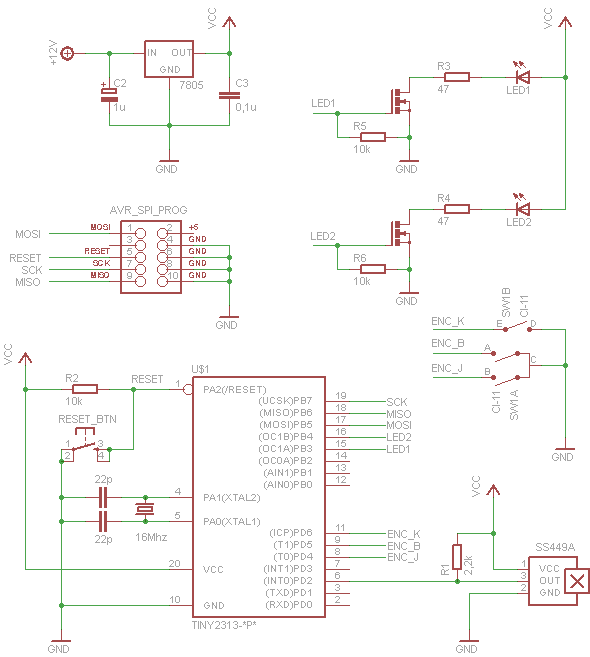
Here are the guts of [Lukasz's] infrared camera remote control. He based it off of an existing design, but looked for places where improvements could be made. He felt the ATtiny2313 was a bit wasteful in this case. But further investigation led him to see why it was chosen. If you were to drop down to an ATtiny13 the ability to connect a crystal oscillator is lost (that chip only offers a 1-pin clock signal input) and the internal RC oscillator isn’t quite up to his standards for reliable IR communications.

Instead of driving the IR LED directly from an AVR pin he used a transistor in hopes that it will allow the maximum current to flow through the diode when in use. We’re not sure if it’s necessary, but we can see how it makes sense. Power is received from an unregulated 3 volt coin cell, so maybe as that voltage drops over time this will come into play.

Speaking of that coin cell, battery life is a concern here. [Lukasz] is using the sleep functions of the AVR after three seconds of use. This should keep the cell alive for quite a long time. But his 0 volt measurement is an anomaly with the multimeter he’s using. To get a precise measurement for tiny current flow you need extra equipment, like [Dave Jones'] uCurrent adapter.

The schematic for this Canon camera compatible project is only provided in Eagle format so we’ve embedded an image of it after the break for your convenience. You should have no problem making this work with a Nikon if you swap out some of the code from the TV-B-Gone shutter release we saw on Thursday.

Read the rest of this entry »

Gaming scoreboard and storage box in one

posted Oct 4th 2011 1:01pm by
filed under: Microcontrollers

This game storage box will also keep score for you. [Marcus] built it for playing the card game Munkin, but some clever programming could adapt it for most needs. The hardware is built around an ATtiny2313 to do the thinking, and a MAX7219 to drive the 7-segment displays. Each player has their own two-digit score readout, which is perfect for this game which only tracks scores from -9 up to 10.

In the video after the break you can see [Marcus'] explanation of the user interface. One player acts as scorekeeper for the game. That person uses three buttons to adjust the score as necessary, and to move the current player marker, expressed as a decimal point on one of the displays. Pressing all three keys will put the unit into programming mode. This lets you select the number of players and at which position they are sitting, as well as make adjustments to the score if necessary.

Read the rest of this entry »


Roland 808 synced to MIDI

posted Sep 20th 2011 3:01pm by
filed under: musical hacks

Reading this week’s ATtiny-themed builds, [Thomas] was reminded one of his coolest builds. His midi808 project used an ATtiny2313 to sync a vintage Roland 808 drum machine to his Logic workstation.

Even though MIDI had been around for a few years when 808s were being made, the CPU in the 808 isn’t exactly up to the task of handling MIDI. Instead, the 808 used an interface known as DIN Sync that was designed to keep 808s, 707s, and 303s in time with each other. MIDI to DIN Sync boxes do did exist, but even the auxiliary equipment to use an 808 is getting hard to find.

The build takes a MIDI signal and passes it through an opto-isolator per the MIDI spec. The microcontroller reads the MIDI signal and passes it out through the DIN Sync port. The DIN Sync protocol is only 24 pulses per quarter note output with TTL voltages, and the project code is easy enough to follow. It’s a nice build for one of the greatest drum machines ever made. Listen to a track [Thomas] made with his new setup after the break.

Read the rest of this entry »

ATtiny hacks: 2313 driving a 4x4x4 LED cube

posted Sep 18th 2011 6:00am by
filed under: led hacks

ATtiny Hacks Theme Banner

[Kirill] wrote in to share his ATtiny hack, a 4x4x LED cube. The 64 LED display is a great choice to fully utilize the hardware he chose. It’s multiplexed by level. Each of the four levels are wired with common cathodes, switched by a 2N3904 transistor. The anodes are driven by two 595 shift registers, providing a total of 16 addressable pins which matches the 4×4 grid perfectly. All said and done it only takes seven of the ATtiny2313′s pins to drive the display. This is one pin more than the chip’s smaller cousins like the ATtiny85 can provide. But, this chip does include a UART which means the project could potentially be modified to receive animation instructions from a computer or other device.

You may have noticed the USB port in the image above. This is serving as a source for regulated power in lieu of having its own voltage regulation hardware and is not used for data at all. Check out the animations that [Kirill] uses on the display by watching the video after the break. You’ll find a link to the source code there as well.

Read the rest of this entry »

AVR HVSP on a tiny breadboard

posted Apr 6th 2011 11:30am by
filed under: Microcontrollers

AVR chips are convenient because you can program them in circuit at their operating voltage. That is, unless you screw up the fuse settings and they’ll no longer listen to an In System Programmer. If you find yourself facing this problem, just build this circuit on a breadboard and ‘unbrick’ by holding down the button.

The circuit seen above is a High Voltage Serial Programmer. This is one of two high voltage protocols used by AVR chips; HVSP is for chips that don’t have enough pins to use High Voltage Parallel Programming. This rendition uses a 12V power source, which is the level necessary for the high voltage method. A 7805 linear regulator joins the mix to provide operational voltage, along with one transistor, an ATtiny2313 to control the circuit, a four-digit 7-segment display for feedback, and one button for control.

Watch the video after the break to see an ATtiny13 programmed to disable the reset pin using a breadboarded programmer. That chip is then easily rescued, having been automatically recognized by using its device signature.

Read the rest of this entry »


Hack a Day serves up fresh hacks each day, every day from around the web as well as hacking related news.

Send us your hacks


Hacks

Resources