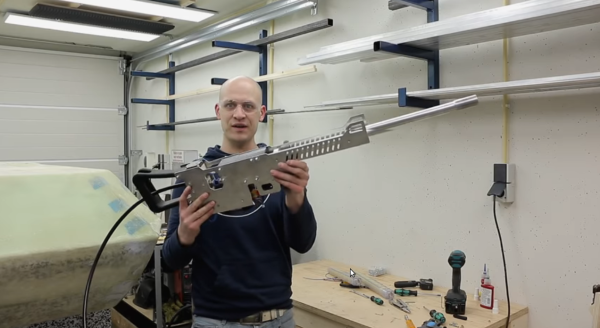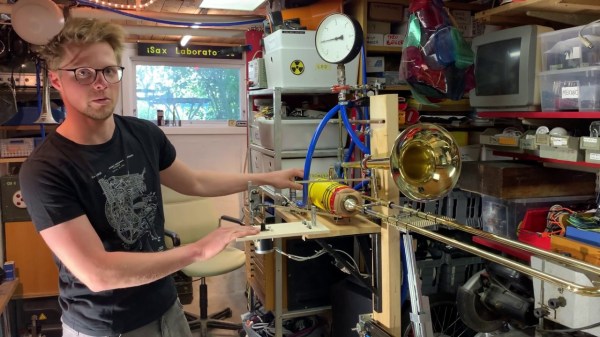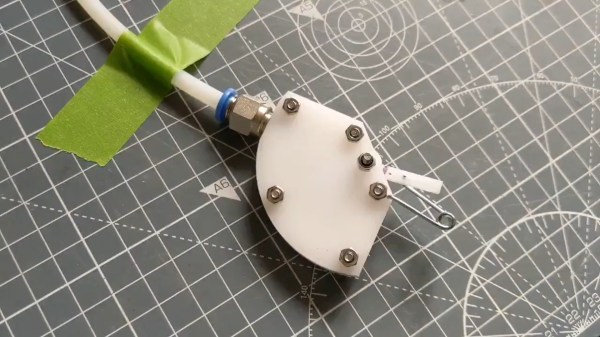
This rifle-shaped water cannon looks great and packs a big punch. We guess you could say that it’s a water balloon launcher, but the balloons are torn off and drop like the wad from a shotgun shell when fired. So we think this launches water blobs, or orbs, or something along those lines.
[Wolf] built it using PVC and some brass fittings that allow for the injection of compressed air. There’s a slick valve system that he developed which we don’t get a great look at in the build pictures. Fortunately, there’s an animated GIF that shows the various stages. Using his valve there’s no need for any electrical system like a lot of other pneumatic launcher systems use.
Just like the water-filled ping-pong gun, you’ve got to be careful with this thing. As you can see in the clip after the break there’s lethal force behind these projectiles. Especially when [Wolf] swaps out the water balloons for big steel darts.
[Scott] built a confetti canon to spice up the party. It’s pneumatic and re-purposes a fire extinguisher as the air tank. He had a refillable extinguisher that used water instead of chemical retardant. After emptying the water and ensuring all of the pressure had been release he swapped the hose and nozzle for a sprinkler solenoid valve. Securing the extinguisher’s actuator lever with a pipe clamp holds the internal valve open, leaving the solenoid to control the pressure release. This way the canon can be fired electronically, or manually.
posted Jul 18th 2010 1:18pm by Mike Szczys
filed under: news
[Daniel Eindhoven] put together this 11,344 Joule capacitor bank that he says would be perfect for weapons such as a rail gun, coil gun, or electrothermal-chemical gun. He machined a couple of aluminum plates to act as a positive and negative bus. The two are separated by a denuded sheet of PCB (making us wonder how he got the copper to peel off like that). Once charged there’s the little problem of how to discharge the system without getting bit, which [Daniel] solved by building a pneumatic switch. We didn’t find the test-fire footage very interesting but we did embed the demonstration of his switch after the break.
Move over Steve and PEART… there’s yet another robotic drummer in town. [Fauzii] tipped us off to his own MIDI-controlled creation – WizardFingers. According to him, WizardFingers is already capable of 64th note rolls at over 250 beats per minute. That’s on every drum simultaneously. Each drum is hit with a lever attached to a linear pneumatic actuator. A laptop running MAX/MSP generates MIDI sequences, which are sent to Doepfer MTC64 board. All of these actuators are hooked up to the board, which sets them off in sequence.
[Fauzii] ultimately hopes to develop AI software that will allow WizardFingers to compose its own tunes on not only a drum kit, but bar chimes and an organ as well. His site documents the whole concept quite well (just watch out for wild cats).
[Tony's] trying to scare the kids again this Halloween. This year’s creation is a skeleton that springs up from a coffin. His creepy coffin is built from plywood and in the classic style it gets narrower at each end. Inside, there’s a full-sized rubber skeleton affixed to a 2×4. Pneumatic rams are used to lift the lid and spring forth the skeleton from the dead.
He’s planned his performance well. The finished system uses a fog machine and looped audio for ambiance. A motion sensor detects innocent victims approaching, kills the music, opens the coffin lid, and adjusts the lighting. The coffin is right next to the door so when the doorbell is pushed and the skeleton springs upright this should scare the bejesus out of you. See how effective this in the video after the break. Read the rest of this entry »
[Backroads] has put together this nicely detailed writeup explaining how to make a low cost popup prop. He’s using a single pneumatic valve and a home made PVC piston to raise and lower a scary mask. He’s using an off-the-shelf 110v AC valve controller to control the valve. A flickering light, a “screamer” and a fog machine help fill out the project. The result is quite nice. We would be tempted to put a pressure sensor in front of it to optimize the scare timing.
[casafear1] has put out this video detailing how to build the “ground-breaker”, a zombie escaping from the grave. It is a simple frame for the arms and shoulders, with a couple pneumatic pistons to make it jerk as though it were pulling itself from the grave. He goes into a decent amount of detail explaining the physical construction, offering several tips to prolong the life of this prop. Unfortunately, he doesn’t enlighten us as to his control scheme. Is it manually controlled? Is it automated? Does it get activated by passers by or is it always going?
Last year, we posted most of the Halloween projects after Halloween. This year we would like to try to get you those ideas and inspiration far enough ahead of time to help you put them to use. Send us your favorite Halloween projects so we can get them published.
For four years, this guy has been using this Pneumatic bed alarm clock to wake up. Apparently “I’m a really heavy sleeper” is an understatement. It is computer controlled and runs from two seperate air sources. He entered it in a radio show contest and we’re guessing he won. You can see the test run at the radio station after the break. We really can understand the fun of building this. But actually using it for four years, without suffering any major injuries, is an accomplishment of it’s own.