Fake Graphics Cards And How To Fix Them

When shopping online, there’s plenty of great deals out there on modern graphics hardware. Of course, if you’re like [Dawid] and bought a GTX1050 Ti for $48 from Wish, you probably suspect it’s too good to be true. Of course, you’d be correct.

[Dawid] notes from the outset that the packaging the card ships in is unusual. While it’s covered in NVIDIA and GeForce branding, there’s no note of the model number or even the overarching series. The card is loosely packed in bubblewrap, free to bounce around in transit. Upon installation, the card reports itself as a GTX1050 Ti, but refuses to properly work with NVIDIA drivers and routinely causes a Blue Screen of Death.

Upon disassembly, it becomes apparent that the card is merely a poorly manufactured GTS450 Revision 2, over five generations older than the card it was advertised as. Thanks to the mismatch between the actual hardware and what the card reports as, the drivers are unable to properly work with the card.

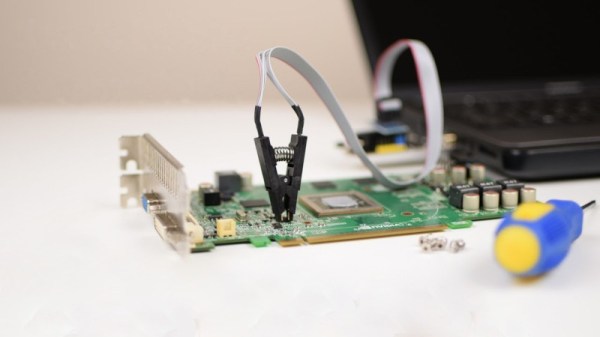
For those that have been scammed, there is some hope. [Phil] has had experience with several of these cards, which similarly misreport their actual hardware. To correct this, the cards need to have their BIOS flashed to reflect reality, but the fake cards don’t work with NVIDIA’s NVFlash tool. Instead, they must be flashed manually using an EEPROM programmer. Once the cards are flashed with an appropriate BIOS, they can be used with the proper drivers and will function properly, albeit with much less performance than was advertised.

It’s an interesting insight into the state of online shopping platforms, and the old adage remains true – if it’s too good to be true, it probably is. Plus, hacking GPUs can often have great results. Video after the break.

Continue reading “Fake Graphics Cards And How To Fix Them”

Headphones Pexels Sega Square Sony MP3

MDFourier Project Seeks The Genesis Of SEGA 16-bit Sound

It always sounded a bit crunchy, but crunchy in a good way. SEGA’s 16-bit console, whether you call it the Genesis or Mega Drive, always had a unique sound thanks to it’s Yamaha YM2612 sound chip. The chip’s ability to reproduce shredding guitars and blasting bass drums was a joy to hear when placed in the hands of capable game developers. Games such as Toe Jam & Earl, Streets of Rage 2, and Sonic the Hedgehog 3 provided some of the most incredible game soundtracks of the ’90s; and while the retail shelf life of those games may have passed, their influence on sound design should not. One individual that is seeking to preserve that quintessential SEGA sound is [Artemio] whose MDFourier project seeks to capture it for future generations to hear.

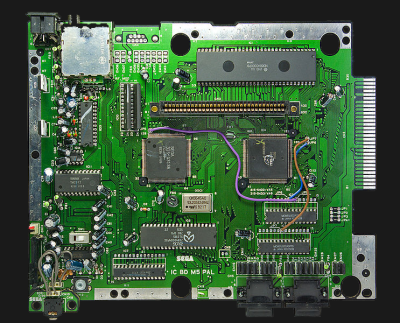
Sega Mega Drive model 1 motherboard. (Bertram, Wikimedia Commons)

MDFourier is a crowd sourced project. Users are asked to use two pieces of software to first generate common audio through a videogame console, and another to analyze the output as to form an audio signature of that machine. Of course SEGA were not always known for their stellar manufacturing record. Throughout the dozen or so board revisions of the Model 1 console there were factory bodge wires, there was also the Model 2 console, Model 3 console, Nomad handheld, Mega Jet, CDX/Multi-Mega, and Wondermega karaoke machine. Each new revision of machine created a slightly new soundscape, and no single piece of emulation software takes them all into account. [Artemio] wants to aggregate all of this data in order to improve SEGA Genesis/Mega Drive emulators, FPGA implementations, or whatever else the future may hold.

Fans of the suite of SEGA consoles, or even fans of great documentation, can take a look at some of initial results as well as the written procedure for contributing to the MDFourier project. For those seeking a more visual step-by-step approach there is this video from YouTube channel RetroRGB below: If you’d like that Sega sound for your MIDI instrument, take a look at this MIDI synth using a Genesis sound chip.

Continue reading “MDFourier Project Seeks The Genesis Of SEGA 16-bit Sound”

A Farewell To YouTube Sub Counters Set To Break With API Change

Of all the things you never would have guessed you’d need just ten years ago, a YouTube subscriber counter would probably rank highly. You would have guessed that the little hits of dopamine accompanying each tick upward of a number would be so addictive?

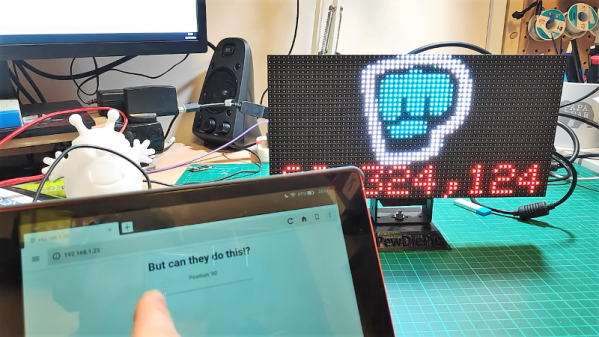
As it turns out, lots of people wanted to keep a running total of their online fans, and a bewilderingly varied ecosystem of subscriber counters has cropped up. All of them rely on the API that YouTube exposes for such purposes, which as [Brian Lough] points out is about to change and break every subscription counter ever made. In the YouTube sub counter space, [Brian] is both an enabler – he built an Arduino wrapper to fetch YT sub counts easily – and a serial builder of displays for other YouTubers. The video below shows a collection of his work, many based on RGB LED matrix display, like the one used in his Tetris-themed sub counter. They’re all well-built, nice to look at, and sadly, destined for obsolescence sometime in August when the API changes.

The details of the API changes were made public in April, and for the subs count it amounts to rounding the count and displaying large counts as, for instance, 510k as opposed to 510,023. We’re confident that [Brian] and other display builders will be able to salvage some of their counters with code changes, but others will probably require hardware changes. Thanks, YouTube.

Continue reading “A Farewell To YouTube Sub Counters Set To Break With API Change”

Quilting Desk Is An Absolute Unit

Most hobbies come with a lot of tools, and thread injecting is no different. Quilting itself may be Queen Hobby when it comes to the sheer volume of things you can buy: specialized templates, clips, thimbles, disappearing ink pens, and so on. And of course, you want it all within arm’s reach while sitting at the machine.

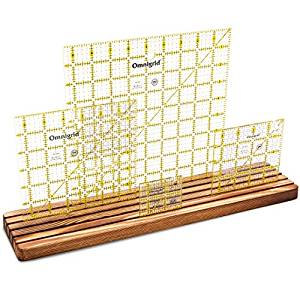
Ruler rack via Amazon.

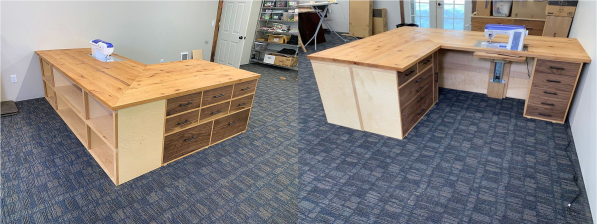
Years ago, [KevsWoodworks] built an impressive custom quilting desk for his wife. He’d added on to it over the years, but it was time for a bigger one. This beautiful beast has 21 drawers and 6 large cubbyholes for plastic bins. At the wife’s request, one of the drawers is vertical. [Kev] doesn’t say what she put in there, but if it were our desk, that’s where we’d stash all our large plastic rulers that need to be kept flat (or vertical). There’s also a lift, so any sewing machine can be brought up flush with the enormous top.

Fortunately for us, [Kev] likes to teach. He documented the build in a series of videos that go nicely with his CAD drawings, which are available for download. Thread your way past the break to see those videos.

Want to do some thread injecting, but don’t want to spend hundreds on a machine? We got lucky with our entry-level injector. If yours is a piece of scrap or has limited stitch options, replace the motor, or add an Arduino.

Continue reading “Quilting Desk Is An Absolute Unit”

Boost Your WiFi Range With Cookware

WiFi was the killer technology that made home networking easy. No more messing around with hubs and cables and drilling holes in walls, simply turn the devices on and hit connect. Over time the speed and range has increased, but those with larger houses or granny flats out back have suffered. There are tricks to boost range however, and some of them involve cookware.

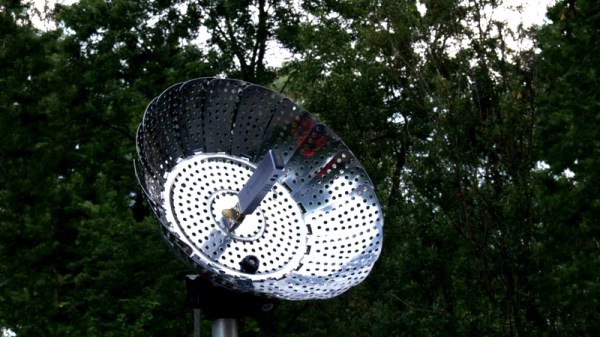
The clever hack here is to use a metal strainer as a parabolic reflector, to capture signals and focus them onto the PCB antenna in a USB WiFi dongle. The strainer is drilled out, and a USB extension cable has its female end glued into the base. This allows the dongle to be positioned inside the strainer. For best results, the dongle should be positioned so that its antenna elements are sitting at the focal point of the parabola; this can be determined through mathematics or simply by experimenting with positions to see what gives the best signal strength.

It’s a design that is quite directional, and should help boost signals as well as block out those from unwanted stations. The build is simple, and can even be tripod mounted which helps with aiming and looks cool to boot.

For many, WiFi antenna hacks are old school, but it’s always good to keep the techniques in mind as you never know when it will come in handy to solve a new problem. Some crazy things are possible with the right gear, too.

CPAP Monitor Alerts Wearer To Malfunctions

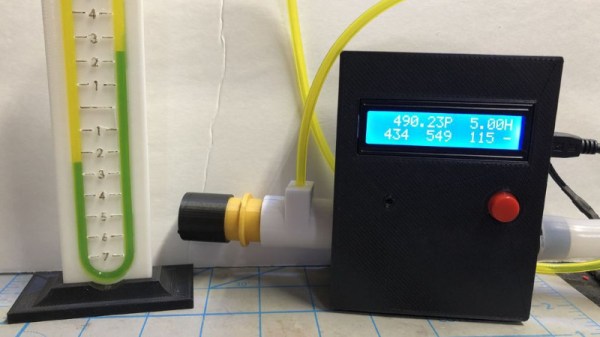
Continuous Positive Airway Pressure machines are a common treatment tool for sleep apnea and other respiratory issues. A common problem with their use is that the mask becomes dislodged during sleep, and thus fails to provide airway pressure to the patient. [Bin Sun] decided to take a stab at solving this problem.

The project consists of an Arduino fitted with a MPXV7002DP pressure sensor. The sensor is used to monitor the pressure in the CPAP pipes. If the pressure varies regularly, it is likely the system is working. If however, the pressure remains at a roughly constant level, that suggests the mask is no longer properly fitted to the wearer, or that there is another problem. In this event, the device sounds a buzzer to wake the wearer, alerting them to check the equipment.

It’s a simple solution to the problem, and something we’re surprised isn’t built into most CPAP machines from the factory. It’s important to be careful before modifying any medical equipment, though we see plenty of hackers taking the plunge to innovate in this area.

Abraham Wald’s Problem Solving Lesson Is To Seek What’s Not There

You may not know the name Abraham Wald, but he has a very valuable lesson you can apply to problem solving, engineering, and many other parts of life. Wald worked for the Statistical Research Group (SRG) during World War II. This was part of a top secret organization in the United States that applied elite mathematical talent to help the allies win the war. Near Columbia University, mathematicians and computers — the human kind — worked on problems ranging from how to keep an enemy plane under fire longer to optimal bombing patterns.

One of Wald’s ways to approach problem was to look beyond the data in front of him. He was looking for things that weren’t there, using their absence as an additional data point. It is easy to critique things that are present but incorrect. It is harder to see things that are missing. But the end results of this technique were profound and present an object lesson we can still draw from today.

Continue reading “Abraham Wald’s Problem Solving Lesson Is To Seek What’s Not There”