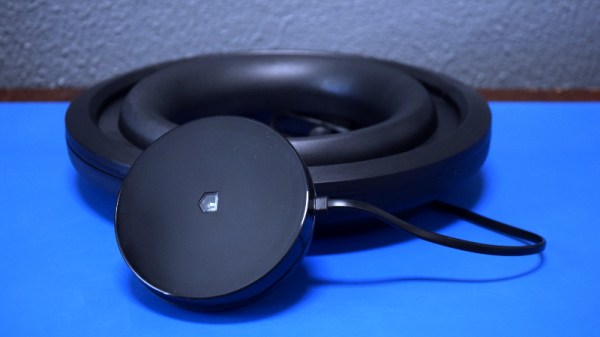
Teardown: Refuel Propane Tank Monitor

Regular Hackaday readers will know that the clearance section of your local big box retailer is a great place to pick up oddball gadgets and gizmos for dirt cheap. In an era where manufacturers are rushing to make their products “smart” whether they need to be or not, the occasional ideas which fail to gain traction are just the cost of doing business. If you keep an eye out, you’re almost guaranteed to see one of these Internet of Things rejects collecting dust on a back aisle, often selling for pennies on the dollar.

Case in point, the “Refuel” propane tank monitor from Wink. Though there’s also logos for Quirky and GE on the package as well, and even a picture of the guy who came up with the idea. Essentially what we have here is a digital scale that reports the current weight of your grill’s propane tank to your phone via the Internet. A trick we might consider a fairly simple hack with a load cell and an ESP8266 under normal circumstances, but as this is a commercial product with an MSRP of $49.99 USD, its naturally been over-complicated to the point of absurdity.

Of course, one could simply lift the propane tank and get a decent estimate of its contents; a trick mastered by weekend grill masters since time immemorial. But then you wouldn’t have to make an account with Wink, or go through the very strange process of attempting to configure the device by using the flashing light of your smartphone’s screen (seriously). All so you can check how much propane is left in your grill while you’re away from home. You know, as one does.

Frankly, it’s hard for me to imagine who would actually have purchased such a thing at full retail. But of course, that’s likely why I was able to pick it up for the princely sum of $5. At that price, we can’t afford not to take a peek into this gizmo from Wink, Quirky, GE, and Anthony from Boston.


Continue reading “Teardown: Refuel Propane Tank Monitor”

Fritzing Is Back, And This Time It’s Written In JavaScript!

Fritzing has been stuck in the mud for just over a year now. There were no updates for many months, and members of the community wondered what was going on. Now, things might be turning around: Fritzing is being rebooted by community members, and there’s a roadmap of upcoming features.

The biggest takeaway from the GitHub discussion is that there simply aren’t enough developers for Fritzing. Fritzing is written in C++ and Qt, and there simply aren’t enough skilled devs to work on it. Future versions of Fritzing will be written in JavaScript.

Other developments in store for Fritzing include clearing out the number of open issues, making a new alpha, generally clean up the entire codebase, and prepare for a release. To that end, there’s also the Freetzing community to rebase the entire project with an emphasis on modularity.

Yes, Fritzing died a terrible death due to legal and funding issues. That still doesn’t mean Fritzing isn’t a valuable tool, though. With these new developments, and entirely new generation of hardware makers can dip their toes into the world of hardware development the easy way, and an entirely new generation of Open Source developers can work on making Fritzing the best tool it can be. There’s never been a better time to get started in Fritzing.

Hacking A Cheap EBay Frequency Counter

eBay is a wondrous land, full of Star Wars memorabilia in poor condition, old game consoles at insane markups, and a surprising amount of DIY electronics. [TheHWCave] found himself tinkering with a common frequency counter kit, and decided to make a few choice improvements along the way (Youtube link, embedded below).

The frequency counter in question is a common clone version of [Wolfgang “Wolf” Büscher]’s minimalist PIC design. Using little more than a PIC16F628 and some seven-segment displays, it’s a competent frequency counter for general use. Clone versions often add a crystal oscillator tester and are available on eBay for a fairly low price.

[TheHWCave] found that the modifications were less than useful, and developed a way to turn the tester components into a more useful signal preamp instead. Not content to stop there, custom firmware was developed to both improve the resolution and also add a tachometer feature. This allows the device to display its output in revolutions per minute as opposed to simply displaying in hertz. By combining this with an optical pickup or other RPM signal, it makes a handy display for rotational speed. If you’re unfamiliar with the theory, read up on our phototachometer primer. If you’re looking to modify your own kit, modified firmware is available on Github.

We’ve seen other eBay kit specials modified before. Being cheap and using commodity microcontrollers makes them a ripe platform for hacking, whether you just want to make a few tweaks or completely repurpose the device.

[Thanks to Acesoft for the tip!]

Continue reading “Hacking A Cheap EBay Frequency Counter”

3D Printing A Lifting Body Aircraft

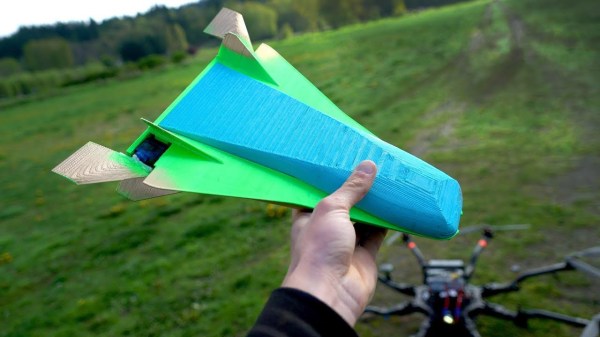
When you think of unconventional aircraft, flying wings have had plenty of time in the sun over the last few decades. With striking designs like the B-2 Spirit and F-117A Nighthawk on the flight line, it’s no surprise. The lifting body never really caught on, however, and it languishes in ignominy to this day. Despite their obscurity, [rctestflight] decided to 3D print a few lifting bodies for himself and take them out for a field test (YouTube video, embedded below).

Most aircraft have a body designed with low drag, and wings designed to provide lift. Lifting body aircraft focus the body design on providing that lift and often have no real wing to the design, needing only control surfaces to compliment the body. For this project, several different designs were constructed, with the craft being drop-launched from a multirotor at significant altitude. Initial tests were hamstrung by stability problems, both due to center of gravity issues and uncertain aerodynamic phenomena. The early designs were particularly prone to suddenly entering an unrecoverable flat spin. Later modifications included the addition of further stabilizers, which helped performance somewhat.

3D printing is a great way to experiment with aerodynamic phenomena, as it’s easy to create all manner of complicated geometries to tinker with. [rctestflight] has done solid work developing a basic craft, and we’d love to see the work continue with powered tests and more development. If flying wings are more your jam, though, you can 3D print those too. Video after the break.

Continue reading “3D Printing A Lifting Body Aircraft”

Benchmarking A Garbage Disposal Using The 3DBenchy Tugboat

We’ve always had a love-hate relationship with 3DBenchy, the tugboat-shaped 3D printer calibration target. On one hand, it’s incredibly useful to have a common, widely used, and challenging benchmark object to evaluate printer performance and improve tuning, but we’d somehow like to get back the countless frustrated hours we’ve spent trying to get the damn thing perfect with various printers. So, it was with no little joy that we watched the video below by [Eric R Mockler], in which he uses 3DBenchy prints to benchmark his newest acquisition: a new-in-box garbage disposal he scored off Craigslist. Take that, tugboat!

[Eric] is considering using the disposal as the first step in a failed-print-recycling method to ultimately turn the waste back into filament, presumably to print more tugboats. The tiny bits produced by the disposal should provide a reasonable substitute for pelleted plastic feedstock going into a filament extruder, if the disposal is up to the task, that is. Reasoning that any device capable of grinding chicken bones should handle little plastic tugboats just as well, [Eric] gave it shot, and found that the ⅓-horsepower disposal had no problem grinding even 100%-infill PLA prints.

The video is short and to-the-point, so we’ll even excuse the portrait orientation, just this once. If you’re considering recycling your failed prints, too, you’ll also need a filament extruder, and we’ve got you covered with a low-cost version, or a high-throughput one.

Continue reading “Benchmarking A Garbage Disposal Using The 3DBenchy Tugboat”

Build A Plotter Using Scrap DVD Drives

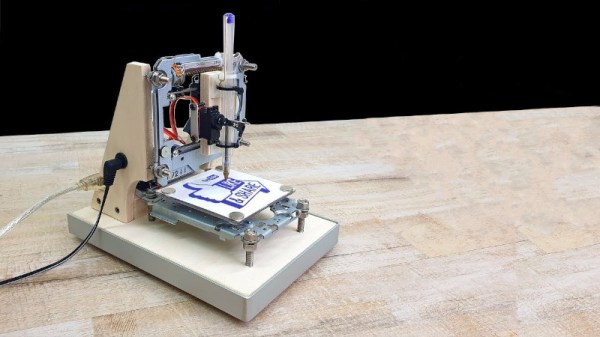
Building your own CNC machine can present a series of varied challenges. There are the software considerations, but also the mechanical side of things – motors, shafts, screws and slides all need to be addressed in a working design. Of course, you can always outsource some of the work – and that’s precisely what [Daniele Tartaglia] did with this pen plotter build (Youtube link, embedded below).

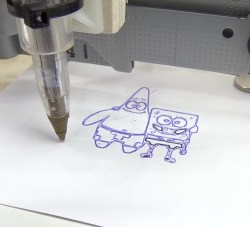
It’s a capable plotter, able to nicely reproduce both graphics and text.

The build gains X and Y axes by virtue of two salvaged DVD drives. The tray mechanisms come ready to go with stepper motors and lead screws already assembled, and make a great basis for a compact plotter. A wooden frame is constructed to hold everything together. The pen is held against the paper with a rubber band which helps the ballpoint to draw a nice dark line, with a servo used as a pen retract mechanism. An Arduino Uno with a stepper driver shield is then employed to run the show.

It’s a tidy build, with neat cable management and smart design choices giving it a pleasing aesthetic. The CNC fundamentals are good, too – with minimal backlash and slop, the plotter is able to draw quite effectively. Old optical drives are a popular choice for plotter builds, as it turns out. Video after the break.

Continue reading “Build A Plotter Using Scrap DVD Drives”

Flying Sticks Are Now A Thing

Fixed-wing planes and helicopters are no longer the darling of the RC world. Even quadcopters and other multirotors are starting to look old hat, as the community looks to ever more outrageous designs. [rctestflight] has slimmed things down to the extreme with this coaxial bicopter build, also known as the Flying Stick (Youtube video, embedded below).

The initial design consists of two brushless outrunner motors fitted with props, rotating in opposite directions to cancel out their respective torques. Each is mounted on a gimbal, setup to provide control authority. iNav is used as a flight controller, chosen due to its versatile motor mixing settings. The craft was built to test its ability at recovery from freefall, as a follow-on from earlier attempts at building a brushless “rocket” craft.

Performance is surprisingly good for what is fundamentally two props on a stick. Initial tests didn’t quite manage a successful recovery, but the repaired single-gimbal version almost achieves the feat. Multirotors in general struggle with freefall recovery, so more research in this area is definitely worthwhile. Video after the break.

Continue reading “Flying Sticks Are Now A Thing”