Automate The Freight: Amazon’s Robotic Packaging Lines

In the “Automate the Freight” series, I’ve concentrated on stories that reflect my premise that the killer app for self-driving vehicles will not be private passenger cars, but will more likely be the mundane but necessary task of toting things from place to place. The economics of replacing thousands of salary-drawing and benefit-requiring humans in the logistics chain are greatly favored compared to the profits to be made by providing a convenient and safe commuting experience to individuals. Advances made in automating deliveries will eventually trickle down to the consumer market, but it’ll be the freight carriers that drive innovation.

While I’ve concentrated on self-driving freight vehicles, there are other aspects to automating the supply chain that I’ve touched on in this series, from UAV-delivered blood and medical supplies to the potential for automating the last hundred feet of home delivery with curb-to-door robots. But automation of the other end of the supply chain holds a lot of promise too, both for advancing technology and disrupting the entire logistics field. This time around: automated packaging lines, or how the stuff you buy online gets picked and wrapped for shipping without ever being touched by human hands.

Continue reading “Automate The Freight: Amazon’s Robotic Packaging Lines”

Robotic Cheetah Teaches A Motors Class

It seems like modern roboticists have decided to have a competition to see which group can develop the most terrifying robot ever invented. As of this writing the leading candidate seems to be the robot that can fuel itself by “eating” organic matter. We can only hope that the engineers involved will decide not to flesh that one out completely. Anyway, if we can get past the horrifying and/or uncanny valley-type situations we find ourselves in when looking at these robots, it turns out they have a lot to teach us about the theories behind a lot of complicated electric motors.

This research paper (gigantic PDF warning) focuses on the construction methods behind MIT’s cheetah robot. It has twelve degrees of freedom and uses a number of exceptionally low-cost modular actuators as motors to control its four legs. Compared to other robots of this type, this helps them jump a major hurdle of cost while still retaining an impressive amount of mobility and control. They were able to integrate a brushless motor, a smart ESC system with feedback, and a planetary gearbox all into the motor itself. That alone is worth the price of admission!

The details on how they did it are well-documented in the 102-page academic document and the source code is available on GitHub if you need a motor like this for any other sort of project, but if you’re here just for the cheetah doing backflips you can also keep up with the build progress at the project’s blog page. We also featured this build earlier in its history as well.

Etching Aluminium Coins, Just For Fun

[MakeFailRepeat] was heading to MakerCentral in Birmingham, an event to which many makers were bringing coins to swap and trade. Wanting to get in on the action, he decided to etch some coins of his very own.

Etching aluminium is a simple process, readily accessible to the average maker. [MakeFailRepeat] started with an aluminium bar, and applied sticky-backed vinyl to the surface. This was then lasercut with the coin artwork, and the pieces removed to leave a negative space design for etching. With the resist layer in place, the aluminium was placed in a bath of salt water, and attached to the positive electrode of a DC supply or battery. With the negative electrode attached to a bolt, the aluminium is left to etch, with care taken to avoid over-etching. As a final finishing step, the coins were then placed in a cobbled-together rock tumbler, using scrap 3D printer filament as media.

The coins are a little rough around the edges, but we think they’re great for a first attempt. There’s plenty of different ways to etch; toner transfer is a particularly popular method. Video after the break.

Continue reading “Etching Aluminium Coins, Just For Fun”

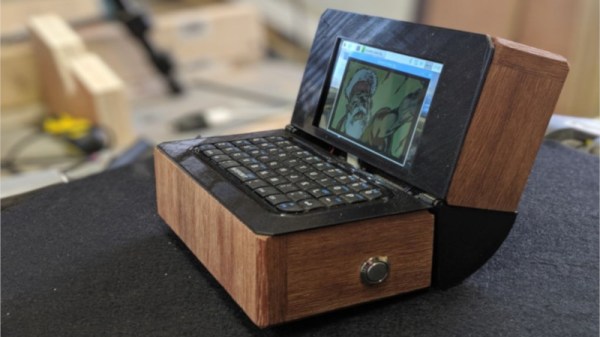
Tiny Wooden Laptop Packs Raspberry Pi

Building a handheld Raspberry Pi rig is practically a hacker rite of passage these days. Off-the-shelf parts keep getting better, and we’re now starting to see affordable compact LCD screens with decent resolution become common. [MakeFailRepeat] got his hands on a HyperPixel screen, and decided to whip up a neat project with it.

The result is a charming little laptop, packing a 4″ screen with 800×480 resolution. Input is via multi-touch, as well as an integrated keyboard. The frame of the laptop is wooden, with a 3D printer supplying parts for the hinge mechanism. To round out the aesthetics, the top of the device was given a decorative copper inlay. Power management is via a UPS hat, which allows the device to switch seamlessly between battery and mains power.

A project like this is a great way to learn a wide range of valuable skills. It involves woodworking and 3D design, as well as the basic configuration of a single board computer. They come in all shapes and sizes, like this tiny RetroPie handheld, or this slick laptop build. Video after the break.

Continue reading “Tiny Wooden Laptop Packs Raspberry Pi”

Please Meet ‘Capability Inquiry’, Part Of The MIDI 2.0 Standard

It may have passed you by in the news, but the MIDI Manufacturers Association (MMA) has recently unveiled more details about the upcoming MIDI 2.0 standard. Previously we covered the prototyping phase start of this new standard. The original Musical Instrument Digital Interface standard was revealed all the way back in August of 1983, as a cooperation between companies including Moog Music, Roland, Yamaha, Korg, Kawai and others. It was the first universal interface that allowed one to connect and control all kinds of musical instruments.

Over the years, MIDI has seen use with the composing of music, allowing instruments to be controlled by a computer system and to easily share compositions between composers. Before MIDI such kind of control was limited to a number of proprietary interfaces, with limited functionality.

The MMA lists the key features of MIDI 2.0 as: Bidirectional, Backwards Compatible, and the enhancing of MIDI 1.0 where possible. Using a new technology called MIDI Capability Inquiry (MIDI-CI), a MIDI 2.0 device can exchange feature profiles and more with other 2.0 devices. 1.0 is the fallback if MIDI-CI finds no new functionality. MIDI-CI-based configuration can allow 2.0 devices to automatically configure themselves for their environment.

Suffice it to say, MIDI 2.0 is a far cry from the original MIDI standard. By transforming MIDI into a more versatile, bidirectional protocol, it opens new ways in which it can be used to tie musical devices and related together. It opens the possibility of even more creative hacks, many of which were featured on Hackaday already. What will you make with MIDI 2.0?

See a brief demonstration of this feature of MIDI 2.0 in the below video:

Continue reading “Please Meet ‘Capability Inquiry’, Part Of The MIDI 2.0 Standard”

Routing IP Over Instant Messages Is Possible Yet Impractical

Telegram is an instant messaging app, well known for its focus on security and encryption. It’s used by government officials, journalists, and the paranoid, and can also handle VoIP calls, in addition to its text messaging capability. [PiMaker] wondered if all this encryption could be put to good use, and decided to try and route IP over Telegram, as you do.

The project is called Teletun, and it works! It uses telgram-cli, a command line interface for the instant messaging network. The actual IP routing is handled with a Python script, and [PiMaker] recommends that in use, the user should “pray to the gods for mercy”. Reports are that bandwidth is limited, but latency can go as low as 100ms, which suggests Telegram is indeed a fairly instant messenger.

Tunneling over instant messaging services is good practice for any aspiring hacker, but likely to be unwieldy for any practical purpose. If you can think of one, other than irritating the intelligence agents tapping your communications, throw it down in the comments below. Otherwise, consider other oddball ways to (ab)use Telegram.

Keep The Kids Entertained With A Time Machine

We often hear it said that today’s kids don’t go out and play as much as they did in the past, but honestly, it’s hard to really blame them. Have you seen some of the games they have now? It’s going to take something a little more exciting than a game of stickball to get them off the couch when they’ve got 4K and VR game systems to play with.

Circuit to control ATX PSU

Which is exactly why [Bobek] is building his kids a time machine. Not a literal one, of course. The Flux Capacitor technology required has yet to be mastered. But it does allow the player to “travel” through time through videos which are played by punching in specific codes they have to unlock by solving puzzles in the real world. Then again, keeping keeping kids active and mentally engaged might as well be “going back in time” in some people’s eyes.

By the looks of things, [Bobek] still has a little work to do on the project, but it’s far enough along that we can get an idea. Inside the bottom of the heavy duty plastic case he’s installed an ATX power supply and a Raspberry Pi 3, and an top of that, there’s a metal plate that holds the power button, an RGB backlit keyboard, and a Vacuum Florescent Display.

After powering on the system, the kids punch in the codes they’ve earned on the keyboard. If accepted, it starts the corresponding presentation which goes over the sights and sounds of the time period they’ve unlocked. In the video after the break you can see [Bobek] test the device with a small display hanging off the end of an HDMI cable, but presumably the system will eventually get an integrated display. The kids could also plug it into the TV, but at that point you might be going full circle.

We’ve seen several examples of hackers creating their own electronic gadgets to keep their children entertained. The line might be a little blurry, but we’d rather see kids use their imagination to “fly” a spaceship in their bedroom than play Roblox on their phone.

Continue reading “Keep The Kids Entertained With A Time Machine”