Characterising A Potentiometer With A Stepper Motor

Potentiometers, or variable resistors, are a standard component that we take for granted. If it says “10k log” on a volume pot, than we fit and forget. But if like [Ben Holmes] you are modelling electronic music circuitry, some greater knowledge is required. To that end he’s created a rig for characterising a potentiometer to produce a look-up table of its values.

It’s a simple enough set-up in which a voltage controlled current source feeds the pot while an Arduino with a motor controller turns it through a stepper motor, and takes a voltage reading from its wiper via an analogue pin. Probably most readers could assemble it in a fairly short time. Where it becomes interesting though is in what it reveals about potentiometer construction.

Audio potentiometers are usually logarithmic. Which is to say that the rate of change of resistance is logarithmic over the length of the track, in an effort to mimic the logarithmic volume response of the human ear in for example a volume control. If you are taught about logarithmic pots the chances are you’re shown a nice smooth logarithmic curve, but as he finds out in the video below that isn’t the case. Instead they appear as a set of linear sections that approximate to a logarithmic curve, something that is probably easier to manufacture. It’s certainly useful to know that for [Ben]’s simulation work, but for the rest of us it’s a fascinating insight into potentiometer manufacture, and shows that we should never quite take everything for granted.

Continue reading “Characterising A Potentiometer With A Stepper Motor”

Concrete Table Even Includes A USB Hub

When designing furniture, material choice has a huge effect on the character and style of the finished product. Wood is a classic option, while more modern designs may use metal, plastic or even cardboard. Less popular, but no less worthy, is concrete. It’s heavy, cheap, and you can easily cast it into a wide variety of forms. [KagedCreations] thought this would be ideal, and whipped up this nifty piece of furniture with an integrated USB hub.

A pair of melamine shelves were scrapped to build the form, in which the concrete table is cast. Melamine is a popular choice, as it’s cheap, readily available, and releases easily from the finished concrete. Along with the USB hub, a wooden board is cast into the base of the concrete table top. This serves as an easy attachment point for the pre-made hairpin-style legs, which can be installed with wood screws.

The final result is a tidy side table that has plenty of heft to keep it stable and secure. It’s not the first concrete USB hub we’ve seen, but it’s likely the heaviest thus far. We’d love to see a version with an integrated charging pad, too – if you build one, be sure to let us know. Video after the break.

Continue reading “Concrete Table Even Includes A USB Hub”

Watch These Two Robots Cooperate On A 3D Print

Putting a 3D printer on a mobile robotic platform is one thing, but two robots co-cooperatively printing a large object together is even more impressive. AMBOTS posted the video on Twitter and we’ve embedded it below.

The robots sport omnidirectional wheels and SCARA format arms, and appear to interact with some kind of active tabletop to aid positioning. The AMBOTS website suggests that the same ideas could be used for other tasks such as pick and place style assembly work, and the video below of co-operative 3D printing is certainly a neat proof of concept.

As a side note: most omni wheels we see (such as the ones on these robots) are of the Mecanum design but there are other designs out there you may not have heard of, such as the Liddiard omnidirectional wheel.

Continue reading “Watch These Two Robots Cooperate On A 3D Print”

Dollar Store Garden Lights As ATtiny Power Supplies

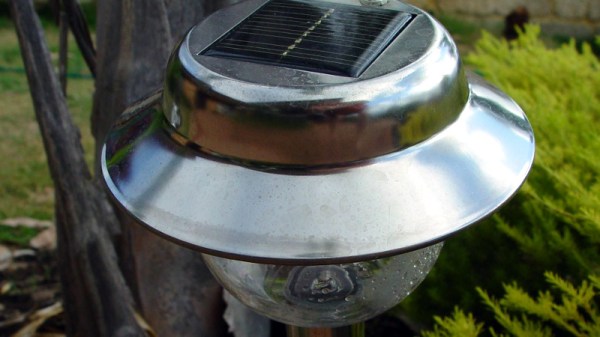
Solar garden lights are just another part of the great trash pile of our age, electronics so cheap as to be disposable. Most of you probably have a set lurking somewhere at home, their batteries maybe exhausted. Internally though they are surprisingly interesting devices. A solar cell, a little boost converter chip, and a little NiCd battery alongside the LED. These are components with potential, as [Randy Elwin] noted with a mind to his ATtiny85 projects.

The YX805A chip he references in his write-up is one of several similar chips that function in effect as joule thieves, extending the available charge in the battery to keep the LED active as long as possible when their solar panel is generating nothing, and turning it off in daylight when the panel can charge. Their problem is that they are designed as joule thieves rather than regulators, so using them as a microcontroller PSU without modification can result in overvoltage.

His solution is to use the device’s solar panel input as a feedback pin from his ATtiny, allowing the microcontroller to keep an eye on its supply voltage and enable or disable the converter as necessary while it keeps running from the reservoir capacitor. Meanwhile the solar panel now charges the NiCd cell through a single diode. It’s not perfect and maybe needs a clamp or something, he notes that there is a condition in which the supply can peak at 8 volts, a level which would kill an ATtiny. But still, we like simple hacks on dollar store parts, so it’s definitely worth further investigation.

This isn’t the first garden light hack we’ve shown you, there was this flashlight, and some LED hacks.

Solar light picture: Leon Brooks [Public domain].

Cement Shelves Double As USB Hub

Some of us are able to get by in life with somewhere between 0 and 1 USB ports. We typically refer to these people as “Mac users”. For the rest of us, too much is never enough, and we find ourselves seeking out expansion cards and hubs and all manner of perverse adapters and dongles. [JackmanWorks] was a man who found himself in need of more connectivity, so he built this beautiful shelf with an integrated 12-port hub.

Material choice is key here, with this build looking resplendent in mahogany and cement. As the core of the build, the USB hub is first disassembled and sealed up to prevent damage from the cement. Hot glue is used to protect the PCB, while electrical tape helps cover the individual ports. The cement is then poured into a form which creates the overarching structure for the shelf, with the USB hub being cast in place. With the cement cured, mahogany boards are then cut and waxed, before installation into the structure. These form the individual shelves which hold phones, hard drives and other USB accessories.

The shelf was designed so that the entire structure is supported through the bottom shelf, which then sits on top of the desktop computer case. It’s an attractive piece, and the weight of the cement construction makes it pleasantly stable in use. It’s rare, but we do occasionally see shelf hacks around these parts. Video after the break.

Continue reading “Cement Shelves Double As USB Hub”

“Vintage” Radio Gets A Modern Makeover

Taking an old piece of gear and cramming it full of modern hardware is a very popular project. In fact, it’s one of the most common things we see here at Hackaday, especially in the Raspberry Pi era. The appeal is obvious: somebody has already done the hard work of designing and building an attractive enclosure, all you need to do is shoehorn your own gear into it. That being said, we know some of our beloved readers get upset when a vintage piece of gear gets sacrificed in the name of progress.

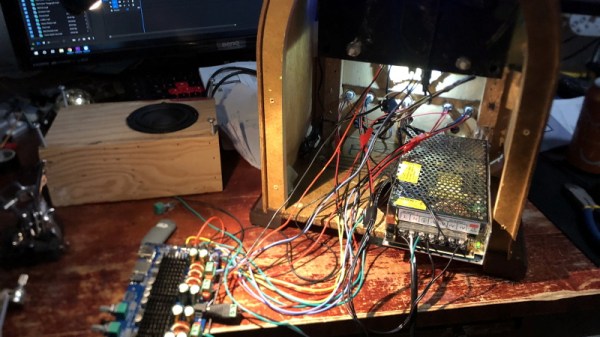
Thankfully, you can put your pitchforks down for this one. The vintage radio [Freshanator] cannibalized to build this Bluetooth speaker is actually a replica made to invoke the classic “cathedral” look. Granted it may still have been older than most of the people reading this right now, but at least it wasn’t actually from the 1930’s.

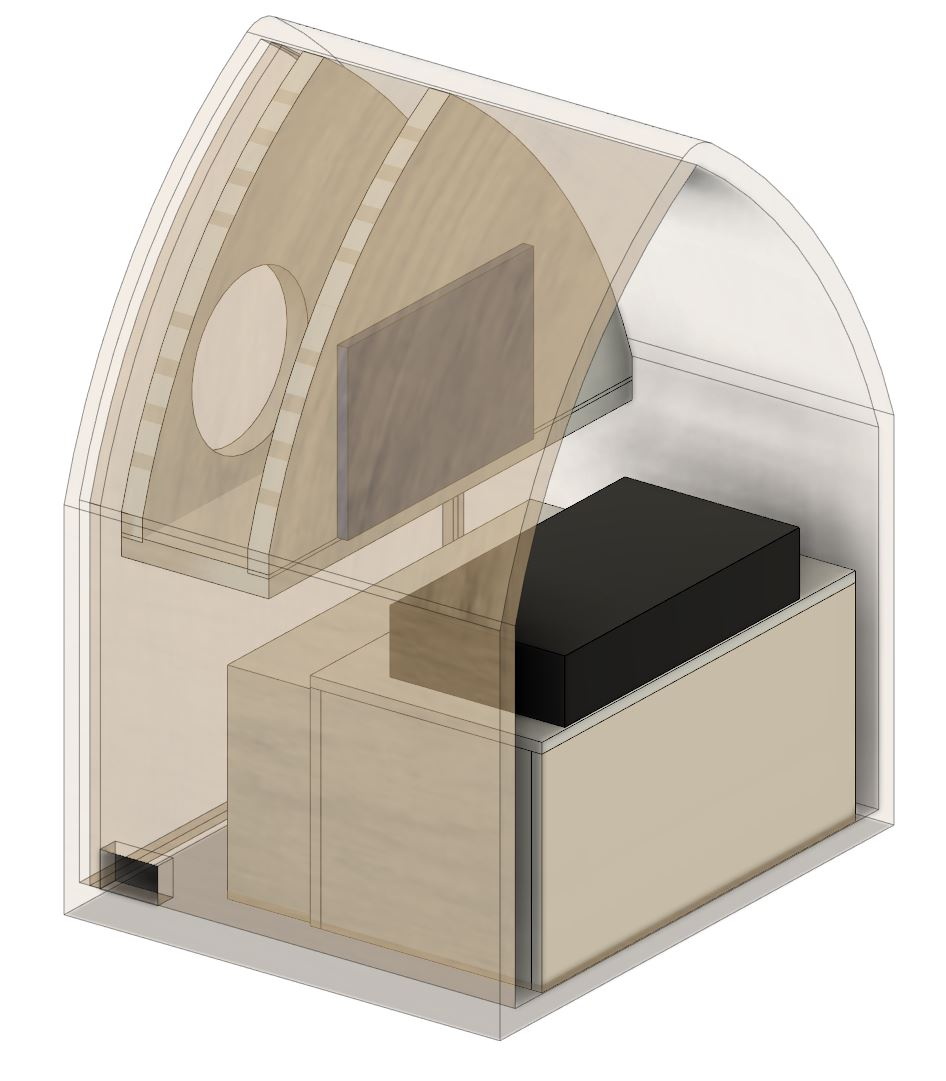
To start the process, [Freshanator] created a 3D model of the inside of the radio so all the components could be laid out virtually before anything was cut or fabricated. This included the design for the speaker box, which was ultimately 3D printed and then coated with a spray-on “liquid rubber” to seal it up. The upfront effort and time to design like this might be high, but it’s an excellent way to help ensure you don’t run into some roadblock halfway through the build.

Driving the speakers is a TPA3116-based amplifier board with integrated Bluetooth receiver, which has all of its buttons broken out to the front for easy access. [Freshanator] even went the extra mile and designed some labels for the front panel buttons to be made on a vinyl cutter. Unfortunately the cutter lacked the precision to make them small enough to actually go on the buttons, so they ended up getting placed above or next to them as space allowed.

The build was wrapped up with a fan installed at the peak of the front speaker grille to keep things cool. Oh, and there are lights. Because there’s always lights. In this case, some blue LEDs and strategically placed EL wire give the whole build an otherworldly glow.

If you’re interested in a having a frustrating quasi-conversation with your vintage looking audio equipment, you could always cram an Echo Dot in there instead. Though if you go that route, you can just 3D print a classic styled enclosure without incurring the wrath of the purists.

A Breadboard Power Supply That’s More Universal Than Most

A favorite project of ours is the humble breadboard power supply. Yes, you can still prototype on breadboards, no, you don’t need an entire bench power supply to prototype on one, and every breadboard made in the last forty years has had the same pattern of holes. There’s plenty of opportunity to improve the breadboard power supply.

One of the best ones we’ve seen yet comes from [John Loeffler]. It’s a simple, constant voltage power supply that’s variable from 0.6 V all the way up to 12 V. It’s powered through a micro USB port, and you get 3.3 V and 5 V rails automagically. There’s even voltage indication.

The mechanical design of this power supply is simple enough, with pins that plug into the detachable power rails on either side of the breadboard. Where it gets interesting is the voltage indication. There’s a resistor ladder and a series of LEDs to indicate the voltage on the variable side of this power supply. Add in some modern switched mode power supply based on the MIC5225 series of chips (a popular regulator that’s very nice for the price) and you have a completely functional power supply hanging off a breadboard.

While it’s not a really nice rack mounted bench power supply that weighs a lot, or even one of the cheapo bench supplies, this does fulfill a need. Sometimes you just need a simple power supply for a breadboard, and this is one of the best ones we’ve seen yet.