Linkage Inferring Software Handwaves Away The Hard Stuff

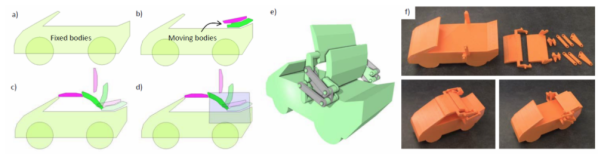
Jokes aside, manually designing linkages that move along specific paths is no easy task. Whether we’re doodling paper sketches or constraining lines in a CAD program, we still need to do the work of actually “imagining” the linkage design. If only there were some sort of tool that would do all that hard imagining work for us! Thankfully, we’re in luck! That’s exactly what researchers [Gen Nishida], [Adrien Bousseau2], and [Daniel G. Aliaga1] at Purdue have done. They’ve designed a software tool that lets us position important bodies in space in particular “key” frames, and then the software simply fills in the linkage for you!

To start the design process, the user inputs a few candidate locations that their solid bodies need to reach in the final linkage path.  From here, these locations get fed to a particle filter. This particle filter seeds thousands of semi-random linkage configurations at small timesteps, selects some of the best-matching ones that most closely approximate the required body locations, removes the lesser-scoring results, re-creates a new set of possible joint configurations based on the best matching ones, and repeats until the tool converges on a linkage that respects our input key frames.

Like a brute force search, this solution takes lots and lots of samples to find a solution, but unlike a brute force search, trials iteratively improve, enabling the software to converge closer and closer to a final solution. Under the hood, the software needs to actually simulate these candidate linkage in order to grade them. It’s in this step that the team wrote in additional checks to remove impossible linkages like self-intersecting joints from this linkage “gene pool” before reseeding them. The result is a tool that does all that trial-and-error scratchwork for you–no brain cycles. For more details, have a peek at their (open access!) paper.

Design software that augments our mechanical design capabilities is a rare gem on these pages, and this one is no exception. If your curious to play with other useful linkages simulating tools, have a go at Linkage Designer. And if you’re in the mood for other tools that fill in the blanks, check out this machine learning algorithm that literally fills in footage between frames in a video feed.

Continue reading “Linkage Inferring Software Handwaves Away The Hard Stuff”

Inputs Of Interest: BIGtrack Mouse Might Make You Squeal

You know me, I like to get my feet involved when I use my computer, which happens pretty much all day every day at this point. My cache of pedal inputs keeps growing like mushrooms in the darkness under my desk: every upper case letter in this post and dozens more have been capitalized with a shift pedal!

Naturally, I’ve thought about what it might be like to mouse with my toes. The more time I can spend with both hands on the keyboard, the better. I started sniffing around for foot-sized trackball candidates, thinking maybe I could just build one with regular mouse guts. Then I found a 15-year-old Golden Tee home edition console at a thrift store. It has a large ball and four buttons, so it seemed ripe for turning into a mouse as-is, or just stealing the ball to build my own. So far, that hasn’t happened, though I did solder a bunch of wires for testing out the controls. Continue reading “Inputs Of Interest: BIGtrack Mouse Might Make You Squeal”

A Digital Guestbook Is A Perfect Hacker Wedding Gift

With his brother’s wedding coming up, [Sebastian] needed a wedding gift. Rather than purchasing something, he elected to build a digital guestbook so guests could share their well-wishes with the happy couple. 

The guestbook has a simple web-based interface, which was accessible over a domain name [Sebastian] registered with the couple’s names ahead of the event. There, users could enter text and draw a friendly message for the digital guestbook. The guestbook itself consists of an ESP32 running a e-ink display, packaged in a tidy 3D printed enclosure featuring the couple’s initials. It regularly queries the web server, and displays the messages it finds on the screen.

It’s a great use of an e-ink display, as it made reading the messages in bright daylight easy where other technologies may have faltered. [Sebastian] was also clever to install some LEDs for the night portion of the reception. We’ve featured a few wedding gifts on these pages before, including this particularly amusing sugar cube. Video after the break.

Continue reading “A Digital Guestbook Is A Perfect Hacker Wedding Gift”

Remoticon Tickets And Workshops Just Dropped

Hackaday Remoticon happens November 6-8 worldwide! The weekend will be packed with virtual activities, and most of them are hands-on workshops that you can participate in from the comfort of your home, lab, garage, basement, lair, or other socially distanced location of your choosing.

The news today is that everyone should register for Remoticon right now, and that we’re opening up registration for about half of the total workshops. More details on the remaining workshops, demos, and some special events will be available in a future article.

Get a Ticket for Remoticon, Then Register for Workshops

Step 1: Register for the Con. What you want to do right now is head over to the Remoticon ticketing page and register for the conference. We need to get a headcount so that our servers don’t melt down during this massive online social event. You can get a ticket for free, or you can choose pay as you wish — scroll to the bottom of the tickets under “Donations” — and those proceeds go to charities that feed, house, or educate people. In these hard times, if you’re in a position to spare a few bucks, please do so.

Step 2: Buy your workshop ticket(s). A workshop isn’t a workshop unless you can ask questions and get help along the way. Workshop tickets are for attendees who want to participate live, interacting with the presenters and other attendees via video chat. We’ve made all workshop tickets $10 as “skin in the game” to help ensure that these limited slots go to good use. Proceeds from workshop tickets will be used to offset the costs of hosting Remoticon.

If there is one request that we get every Supercon, it’s to film the workshops. This year, we can! If you can’t attend a workshop that you’re interested in we plan to record, edit, and publish them all so everyone can follow along at a later date.

The registration page has workshop descriptions listed when you select your ticket, but here are the titles whet your appetite. Thank you to everyone who submitted a workshop proposal, none of this is possible without you, naturally.

  • Basics of RF Emissions Debugging
  • Crowd-Controlled Robots
  • The Hackers Guide to Hardware Debugging
  • How to 3D Print onto Fabric
  • Introduction to Firmware Reverse Engineering
  • Introduction to Modular Synthesis using VCV Rack
  • KiCad to Blender > Photorealistic PCB renders
  • Learn How to Hack a Car
  • Live Breaking into Encrypted 3D Printer Firmware
  • MachineChat – JEDI One – A Universal Sensor Hub
  • PCB Reverse Engineering
  • Prototyping to the Max
  • Soldering, Nothing To Be Afraid Of!
  • Tiny ML
  • Zero to ASIC in Two Hours

Axe Hacks: New Sounds For Your Electric Guitar Beginning From What Makes Them Tick

Creating music is a perfect hobby for anyone into hacking, and the amount of musical hacks and self-made instruments we come across here makes that supremely evident. It’s just a great match: you can either go full-on into engineering mode as music is in the end “just” applied physics, or simply ignore all of the theory and take an artistic approach by simply doing whatever feels right. The sweet spot is of course somewhere in between — a solid grasp of some music theory fundamentals won’t hurt, but too much overthinking eventually will.

The obvious choice to combine a favorite pastime like electronics or programming with creating music would be in the realm of electronic music, and as compelling as building synthesizers sounds, I’ll be going for the next best thing instead: the electric guitar. Despite its general popularity, the enormous potential that lies within the electric guitar is rarely fully utilized. Everyone seems to just focus on amp settings and effect pedals when looking for that special or unique sound, while the guitar itself is seen as this immutable object bestowed on us by the universe with all its predestined, magical characteristics. Toggle a pickup switch, and if we’re feeling extra perky, give that tone pot a little spin, that’s all there is to it.

The thing is, the guitar’s electrical setup — or wiring — in its stock form simply is as boring and generic as it can get. Sure, it’s a safe choice that does the job well enough, but there’s this entirely different world of tonal variety and individual controllability locked inside of it, and all it really takes is a screwdriver and soldering iron to release it. Plus, this might serve as an interesting application area to dive into simple analog electronics, so even if guitars aren’t your thing yet, maybe this will tickle your creativity bone. And if bass is more your thing, well, let me be ignorant and declare that a bass is just a longer guitar with thicker, lower-tuned strings, meaning everything that follows pretty much applies to bass as well, even if I talk about guitars.

However, in order to modify something, it helps to understand how it functions. So today, we’ll only focus on the basics of an electric guitar, i.e. what’s inside them and what defines and affects their tone. But don’t worry, once we have the fundamentals covered, we’ll be all settled to get to the juicy bits next time.

Continue reading “Axe Hacks: New Sounds For Your Electric Guitar Beginning From What Makes Them Tick”

A Monotrack Bike With Only Basic Tools And Parts

Tracked vehicles are cool, but can be quite complicated to build. [XenonJohn] wanted to skip the complexity, so he created Vector, an electric tracked motorcycle using only basic parts and tools. No machine tools required.

If it looks familiar, it’s because it was inspired by [Make It Extreme]’s monotrack motorcycle that we covered last year. [XenonJohn] liked the concept, but wanted one that was simpler to build. That meant ditching the custom machined parts like the wheels and the suspension system. These were replaced with three go cart wheels and axles mounted in pillow blocks, on a simple welded frame. An e-bike battery powers a 500 W golf cart motor that drives the rear wheel. Like [Make It Extreme]’s version, the track is an SUV tire with the sidewall cut off. [XenonJohn] used tin snips to do this, but from personal experience we would recommend a utility knife. This track design will have a tendency to collect debris inside it, so cutting some hole in the tread could help. As with most single wheeled/tracked vehicles, you really don’t want to try and stop quickly.

It looks like this bike works fine in straight lines, but there is room for improvement with the steering. [XenonJohn] has some ideas to do this, which we hope to see some time in the future. Let us know in the comments how you would make it turn better.

[XenonJohn] really like vehicles that can make you face plant. He built quite a few self-balancing motorcycles, one of which was supposedly designed with first responders in mind. It honestly seems more likely to create an emergency than respond to one.

Autonomous Rover Navigates The House With LIDAR

For those wishing to explore robot autonomy, there’s no better way then to learn by doing. [Greg] was in that camp, and decided to build an autonomous rover to roam his house, and learned plenty along the way.

[Greg]’s aims with the project were to build a robot that was capable of navigating his home without external assistance. To do the job, a Raspberry Pi 3 was put in charge, and kitted out with a LIDAR for mapping. Pololu Roboclaw motor controllers are then used to allow the Raspberry Pi to drive the robot’s individual wheel motors, giving the four-wheeled bot skid steering capability.

[Greg] goes into immense detail on the project’s writeup, exploring the code and concepts behind its autonomous abilities. Creating a robot that can navigate using LIDAR is no easy task, but [Greg] does a great job of explaining how it all works, and why.

It’s not the first autonomous rover we’ve seen here, and we’re sure it won’t be the last. If you’ve got your own build coming together in the lab, be sure to let us know. Video after the break.

Continue reading “Autonomous Rover Navigates The House With LIDAR”