A Tale Of Cheap Hard Drives And Expensive Lessons

When it comes to electronic gadgets, I’m a sucker for a good deal. If it’s got a circuit board on the inside and a low enough price tag on the outside, you can be pretty sure I’ll be taking it home with me. So a few years ago, when I saw USB external hard drives on the shelf of a national discount chain for just $10, I couldn’t resist picking one up. What I didn’t realize at the time however, was that I’d be getting more in the bargain than just some extra storage space.

It’s a story that I actually hadn’t thought of for some time — it only came to mind recently after reading about how the rising cost of computer components has pushed more users to the secondhand market than ever before. That makes the lessons from this experience, for both the buyer and the seller, particularly relevant.

What’s in the Box?

It wasn’t just the low price that attracted me to these hard drives, it was also the stated capacity. They were listed as 80 GB, which is an unusually low figure to see on a box in 2026. Obviously nobody is making 80 GB drives these days, so given the price, my first thought was that it would contain a jerry-rigged USB flash drive. But if that was the case, you would expect the capacity to be some power of two.
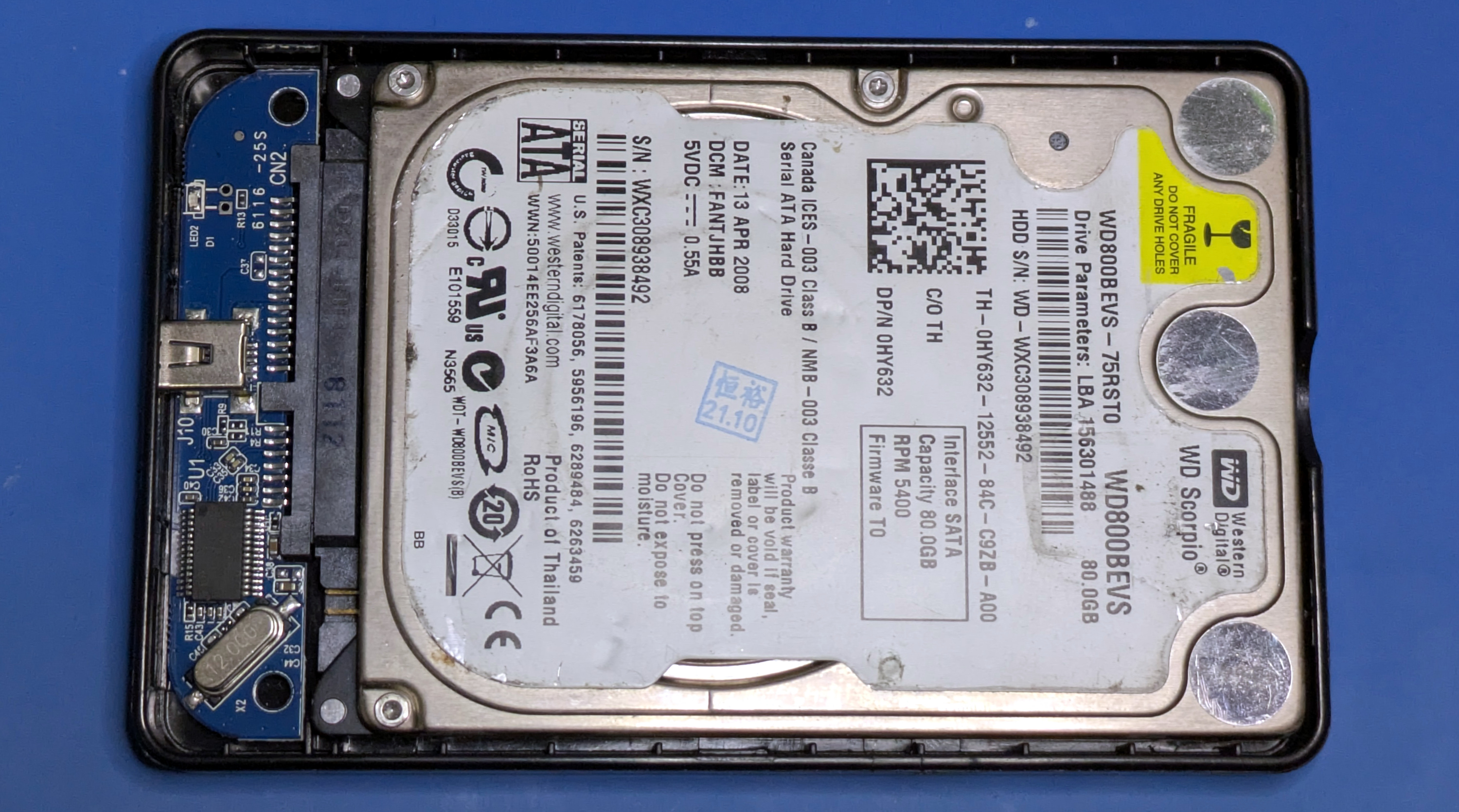
Upon opening up the case, what I found inside was somehow both surprising and incredibly obvious. The last thing I expected to see was an actual spinning hard drive, but only because I lacked the imagination of whoever put this product together. I was thinking in terms of newly manufactured, modern, hardware. Instead, this drive was nearly 20 years old, and must have been available for pennies on the dollar since they were presumably just collecting dust in a warehouse somewhere.

Or at least, that’s what I assumed. After all, surely nobody would have the audacity to take a take a bunch of ancient used hard drives and repackage them as new products…right?

Continue reading “A Tale Of Cheap Hard Drives And Expensive Lessons”

Don’t Trust Password Managers? HIPPO May Be The Answer!

The modern web is a major pain to use without a password manager app. However, using such a service requires you to entrust your precious secrets to a third party. They could also be compromised, then you really are in trouble. You could manage passwords with local software or even a notebook, but that adds cognitive load. You could use the same password across multiple sites to reduce the load, but that would be unwise. Now, however, with the HIPPO system, there is another way.

HIPPO is implemented as a browser extension paired with a central server. The idea is not to store any password anywhere, but to compute them on the fly from a set of secrets. One secret at the server end, and one the user supplies as a passphrase. This works via an oblivious pseudorandom function (OPRF) protocol. Details from the linked site are sparse, but we think we’ve figured it out from other sources.

First, the user-supplied master password is hashed with the site identifier (i.e., the domain), blinded with a random number, and then processed using an OPRF, likely built on an elliptic-curve cryptographic scheme. This ensures the server never receives the raw password. Next, the server applies its own secret key via a Pseudorandom Function (PRF) and sends it back to the client. Obviously, its private key is also never sent raw. Next, the client removes the blinding factor (using the same random number it used when sending) from the original key, producing a site-specific high-entropy secret value that the extension passes to a Key Derivation Function (KDF), which formats it into a suitable form for use as a password. Finally, the extension auto-fills the password into the website form, ready to send to the site you want to access. This password is still unique per site and deterministic, which is how this whole scheme can replace a password database. Neat stuff!

This advantage to this whole scheme means there’s no vault to compromise, no storage requirements, and it generates a strong password for each unique site, meaning no password reuse and a low chance of brute-force cracking. The obvious flaw is that it creates a single point of failure (the HIPPO service) and shifts the risk of compromise from vault cracking the master password, infiltrating the server, or compromising its secret key. It’s an interesting idea for sure, but it doesn’t directly manage 2FA, which is a layer you’d want adding on top to ensure adequate security overall, and of course, it’s not a real, live service yet, but when (or if) it becomes one, we’ll be sure to report back.

Confused by all this? Why not dig into this article first? Or maybe you fancy a DIYable hardware solution?

DOOM On A Fancy Smart Toaster

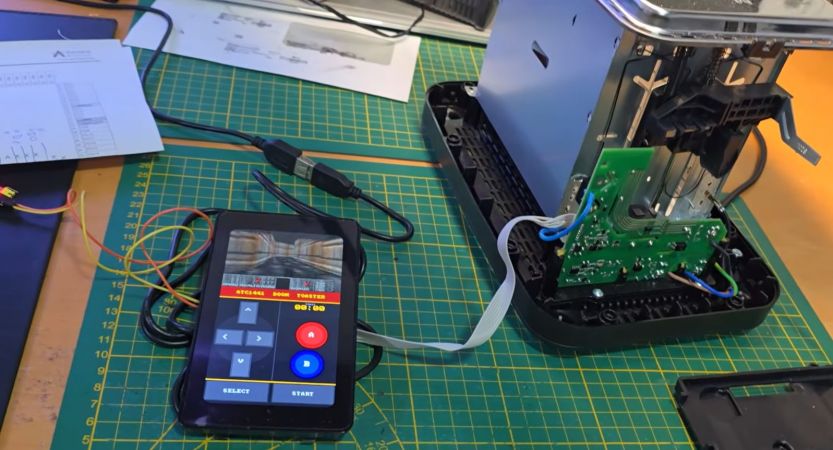
Although toasters should be among the most boring appliances in a household – with perhaps just a focus on making their toasting more deterministic rather than somewhere between ‘still frozen’ and ‘charcoal’ – somehow companies keep churning out toasters that just add very confusing ‘smart’ features. Of course, if a toaster adds a big touch screen and significant processing power, you may as well run DOOM on it, as was [Aaron Christophel]’s reflexive response.

While unboxing the Aeco Toastlab Elite toaster, [Aaron] is positively dumbfounded that they didn’t also add WiFi to the thing. Although on the bright side, that should mean no firmware updates being pushed via the internet. During the disassembly it can be seen that there’s an unpopulated pad for a WiFi chip and an antenna connection, making it clear that the PCB is a general purpose PCB that will see use in other appliances.

The SoC is marked up as a K660L with an external flash chip. Dumping the firmware is very easy, with highly accessible UART that spits out a ‘Welcome to ArtInChip Luban-Lite’ message. After some reverse-engineering the SoC turned out to be a rebranded RISC-V-based ArtInChip D133CxS, with a very usable SDK by the manufacturer. From there it was easy enough to get DOOM to run, with the bonus feature of needing to complete a level before the toaster will give the slice back.

Continue reading DOOM On A Fancy Smart Toaster”