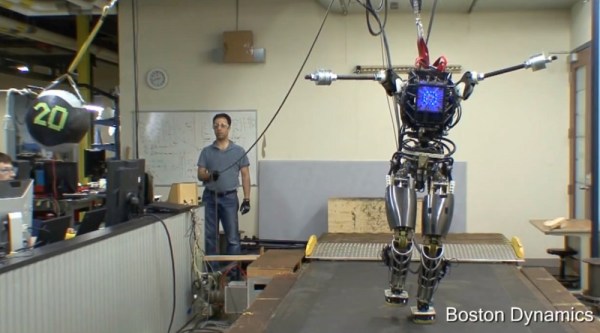
Boston Dynamics Takes WildCat Outside

wildcat

[Boston Dynamics] has released a video of their latest robot, which means it’s time to go hide in bed before this thing comes to get us. The new video features WildCat, which is apparently the evolution of the Cheetah robot we saw last year. Cheetah was an indoor cat, tethered by power, data, and hydraulic lines while running on a treadmill. WildCat has been released to terrorize people explore the great outdoors

Reminiscent of the early videos of BigDog, WildCat is currently powered by an internal combustion engine. The engine drives a hydraulic system, which then actuates the robot’s legs and front/rear pods. The beauty of a system like this is that switching to an electric motor is simple – just replace the IC engine. While we’re sure this would make a much more stealthy cat, weight and run time could be issues. Moving the power system onboard has also slowed down WildCat a bit. Cheetah was able to reach 28 MPH while WildCat can only muster 16 MPH.

WildCat is part of DARPA’s maximum mobility and manipulation program. The research appears to be focused on improving the gaits the robot uses to move at various speeds. The video highlights both bounding and galloping.  Slo-mo sections show all four of WildCat’s legs leaving the ground, which is the suspension phase of a classic gallop gait. Control isn’t perfect yet, as WildCat tumbles at one point in the video.  It gets right back up though – ready for more.

Continue reading “Boston Dynamics Takes WildCat Outside”

(Please Don’t) Build A Jet Engine From A Toilet Paper Holder

Turbo charger Jet Engines have long been considered one of the holy grails of backyard engineering. This is with good reason – they’re hard to build, and even harder to run. Many a turbo has met an untimely end from a hot start or oil starvation. [Colin Furze] however, makes it look easy. [Colin] is a proponent of crazy hacks – we’ve featured him before for his land speed record holding baby carriage, and his pulse jet powered tea kettle.

In his latest video set, [Colin] takes a toilet brush holder, a toilet paper roll holder, a few plumbing fittings, and of course a small turbocharger from the scrap yard. Somehow he converts all of this into a working jet engine. The notable thing here is that there is no welding. Some of the joints are held together with nothing more than duct tape.

Calling this a working jet engine is not really an overstatement. As every backyard jet jockey knows, the first goal of DIY jets (aside from not hurting yourself) is self-sustaining. Turbines are spun up with air hoses, vacuums, or leaf blowers. The trick is to turn the fuel on, remove the air source, and have the turbine continue spinning under its own power. Once this happens, your engine is performing the same “Suck, Squeeze, Bang, Blow” combustion process an F-18 or a 747 uses.

Continue reading “(Please Don’t) Build A Jet Engine From A Toilet Paper Holder”

Home Made CNC Reuses Printer Parts

Do it yourself CNC machines can be never ending projects. Once you get one machine done, you want another. [Mario] found this out when he started work on his second CNC machine, TheMaker2. As its name implies, TheMaker2 is the successor to TheMaker1. It seems that [Mario] was trying to walk the fine line of precision at minimal cost. He wanted a rigid frame, so he chose to go with a moving table, rather than the moving gantry of TheMaker1. The frame is made up of galvanized steel stock, which makes it much stronger than many DIY CNCs out there. [Mario] had a friend weld the steel up for him, we hope he took the proper precautions when welding galvanized material.

Standard threaded rod was used as lead screws, with some very well made anti backlash nuts. Acme thread would have been a better choice here, however [Mario] doesn’t say if acme stock was available to him. Most of the mounts and small parts are made from easily worked PVC sheet stock. Precision rails were scavenged from old Ricoh copiers. Epson printers provided the tubing which became motor couplers.

One negative in this build are the stepper motors. [Mario] used NMB PM55L-048 motors he had pulled from HP printers. These motors have both a wide step angle (7.5 degrees) and a rather anemic torque. Thankfully [Mario] mentions upgrading NEMA 23 motors in the comments of TheMaker2’s instructables page.

Step Into The Box

thebox

Take three industrial robots, two 4’ x 8’ canvases, and several powerful video projectors. Depending on who is doing the robot programming you may end up with a lot of broken glass and splinters, or you may end up with The Box.  The latest video released by the creators project, The Box features industrial robots and projection mapping. We recently featured Disarm from the same channel.

The Box is one of those cases of taking multiple existing technologies and putting them together with breathtaking results. We can’t help but think of the possibilities of systems such as CastAR while watching the video. The robots move two large canvases while projectors display a series of 3D images on them. A third robot moves the camera.

In the behind the scenes video, the creators revealed that the robots are programmed using a Maya plugin. The plugin allowed them to synchronize the robot’s movements along with the animation. The entire video is a complex choreographed dance – even the position of the actor was pre-programmed into Maya.

Continue reading “Step Into The Box”

JTAGulator Finds Debug Interfaces

jtagulator

[Joe Grand] has come up with a tool which we think will be useful to anyone trying to hack a physical device: The JTAGulator. We touched on the JTAGulator briefly during our DEF CON coverage, but it really deserves a more in-depth feature. The JTAGulator is a way to discover On Chip Debug (OCD) interfaces on unfamiliar hardware.

Open any cell phone, router, or just about any moderately complex device today, and you’ll find test points. Quite often at least a few of these test points are the common JTAG / IEEE 1149.1 interface.

JTAG interfaces have 5 basic pins: TDI (Test Data In), TDO (Test Data Out), TCK (Test Clock), and TMS (Test Mode Select), /TRST (Test Reset) (optional).

If you’re looking at a PCB with many test points, which ones are the JTAG pins? Also which test points are which signals? Sometimes the PCB manufacturer will give clues on the silk screen. Other times you’re on your own. [Joe] designed the JTAGulator to help find these pins.

Continue reading “JTAGulator Finds Debug Interfaces”

Electrified Yard Equipment Hauls Grass

mower2

[AmpEater] spent the summer converting yard equipment from internal combustion to electric power. The conversions run from a relatively tame Wheel Horse, to an insane Cub Cadet. The Wheel Horse lost its Kohler engine in favor of a hydraulic pump motor from a crown forklift. 48 volt power is supplied by MK lead acid gel cells. An Alltrax 300 amp controller keeps this horse reigned in.

On his Reddit thread, [AmpEater] says he is especially proud of his Cub Cadet zero turn ride on mower. For those who aren’t up on lawn implement terminology, a “zero turn” means a mower with zero turning radius. Zero turn mowers use two large wheels and tank style steering to turn within their own radius. We bet this style mower would also make a pretty good robot conversion, however [AmpEater’s] zero turn is still setup for cutting the grass.

After pulling the V-twin motor the 48 volt Motenergy ME-1004 was put in place. Batteries are 3 x Enerdel 48V 33 amp hour lithium ion packs. The packs are wired in series to provide 144V nominal. Right about here is where our brain started to melt. A 48V motor on 144V has to mean magic smoke, right? This is where the motor controller magic comes in.

Continue reading “Electrified Yard Equipment Hauls Grass”

LEDs Turn The Heat Up On Flameless Pumpkin Lights

led-peter

When tea lights just won’t do, why not move up to a 5 channel LED candle simulator?

Halloween is fast approaching. Peter’s local hackerspace, The Rabbit Hole had a meeting to carve pumpkins and talk Halloween hacks. After seeing how poorly a tea light illuminated a medium size pumpkin, this hack was born. We’ve seen LED jack-o’-lantern hacks before, but this one was worth a second look.

In true hackerspace style, [Peter] used what was available to him. A PIC12F508 is the heart of the project. The 12X508/9 series has been around for at many years, and is still a great chip to work with. We remember using the ‘C’ version of this chip to bypass region locks on original PlayStation systems. [Peter] created a simple circuit with two basic modes. In “value mode” the 508 drives LED’s directly from its I/O pins. This limits the total output to 60mA. In “premium mode”, some 2N3904 NPN transistors are brought in to handle the current.  This allows the PIC to drive up to 5 LEDs.

Candles can be tricky to simulate with LEDs. [Peter] used 5 independent 16 bit linear feedback shift registers to generate pseudo random bit streams. The effect is quite impressive. A “wind simulation” completes the illusion of a real flame. Continue reading “LEDs Turn The Heat Up On Flameless Pumpkin Lights”