MRRF: Innovating Extruders And Dissolvable Filament

Think laying down molten plastic on a 3D printer is as easy as squeezing plastic filament out of a hot tube? It’s not, and anyone who had a 3D printer in 2009 would tell you as such. There were hobbed bolts that stripped the plastic into a gooey paste, extremely large x carriages that made everything wobbly, and nothing worked as well as it does today.

Technology marches on, and this year’s Midwest RepRap Festival had people showing off the latest advances in pushing plastic, and something that hasn’t seen much use yet – dissolvable filament.

Continue reading “MRRF: Innovating Extruders And Dissolvable Filament”

Teensy Gets A Prop Shield

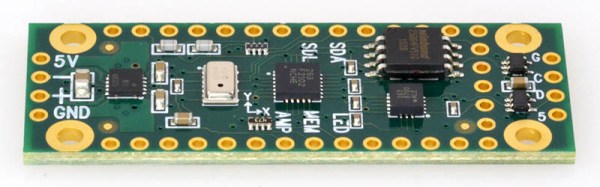
God of microcontrollers and king of electrons [Paul Stoffregen] is famous for his Teensy microcontroller dev boards, and for good reason. If you have a project that does more than blink a few pins, but doesn’t need to run a full Linux build, any one of the Teensy dev boards are a great option. As a dev board, [Paul] has released a few ‘shields’ that add various functionality – for example the audio adapter board that is able to play CD quality audio and perform DSP and FFT operations. Now, [Paul] has launched a new shield designed for interactive light and sound effects on art installations and for the rest of the crew at Burning Man. It’s called the Prop Shield, and adds more sensors, audio amps, and blinkies than a Teensy has ever had.

The Teensy Prop shield is equipped with 10DOF motion sensors, including a FXOS8700 accelerometer/magnetometer, a FXAS21002 gyroscope, and an MPL3115 altimeter and temperature sensor. A two Watt LM48310 audio amplifier can drive 4 or 8 ohm speakers, and 8 Megabytes of Flash memory can hold all the data for audio or a very long string of APA102 individually addressable LEDs.

The combination of motion sensors, audio amplifiers, and LED drivers may seem like an odd combination, but this is a shield for very odd projects. Stage effect, wearables, and handheld props become very easy with this board, and haunted houses are about to get really cool. With the on-board Flash, this board makes for a very capable data logger, and although the altitude sensor only reads pressure up to about 40,000 feet, this could be a very handy board for high altitude balloons.

The Prop Shield is available now in [Paul]’s shop. There are two versions, one ‘wit’ the motion sensors for $19.50, and the other ‘witout’ motion sensors for $8.40. The distinction is based on the Philly Cheesesteak protocol.

For the last few weeks, [Paul] has put the prop shield in the hands of a few dozen beta testers. Their impressions are in a forum thread, and like all of [Paul]’s projects, the response has been very good.

Hackaday Links: March 28, 2016

[Tom] sent this in to be filed under the ‘not a hack’ category, but it’s actually very interesting. It’s the User’s Guide for the Falcon 9 rocket. It includes all the data necessary to put your payload on a Falcon 9 and send it into space. It’s a freakin’ datasheet for a rocket.

A year ago in Japan (and last week worldwide), Nintendo released Pokkén Tournament, a Pokemon fighting game. This game has a new controller, the Pokkén Tournament Pro Pad. There were a few cost-cutting measures in the production of this game pad, and it looks like this controller was supposed to have force feedback and LEDs. If any Pokemon fans want to take this controller apart and install some LEDs and motors just to see what happens, there’s a Hackaday write up in it for you.

There are a lot of options for slicing 3D objects for filament-based 3D printers. Cura, Slic3r, and MatterControl are easily capable of handing all the slicing needs you’ll ever have for a filament 3D printer. For sterolithography (resin) printers, the options for slicing are limited. [skarab] just put together a new slicer for SLA that runs entirely in JavaScript. If anyone wants to turn a Raspi or BeagleBone into a network controller for a resin printer, here’s your starting point. [skarab] will be working on smoothieboard integration soon.

The STM32F4 is an extremely capable ARM microcontroller. It can do VGA at relatively high resolutions, emulate a Game Boy cartridge, and can serve as the engine control unit in a 1996 Ford Aspire. There’s a lot of computing power here, but only one true litmus test: the STM32F4 can run Doom. [floppes] built this implementation of Doom on the STM32F429 Discovery board to run off of an external USB memory stick. The frame rate is at least as good as what it was back in 1993.

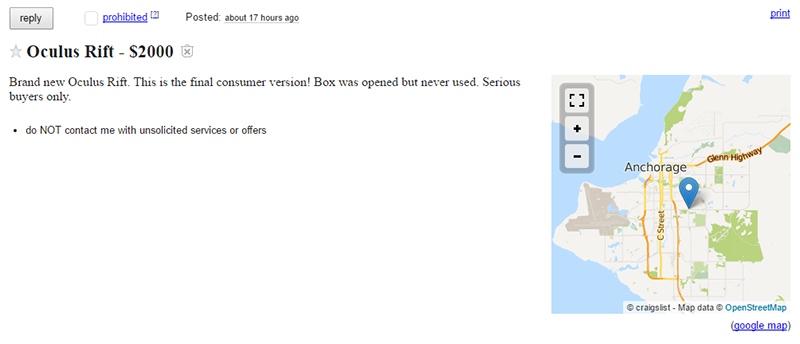
The Oculus Rift has just come to pass, but one lucky consumer got his early. The first person to preorder the Rift, [Ross Martin] of Anchorage, Alaska, got his facehugger directly from [Palmer Luckey] in a PR stunt on Saturday afternoon. Guess what [Ross] is doing with his Rift?

rift

The Hackaday Store Is Having A Sale

The Hackaday Store has been up and running for a year and a half now, sending out Hackaday Omnibus, t-shirts, [Alex Rich]’s Stickvice, and an entire MeArm-y from [Phenoptix]. After eighteen months, the enslaved robots in the warehouse are plotting a rebellion, so we’re stamping that right out with a Spring sale in the Hackaday Store!

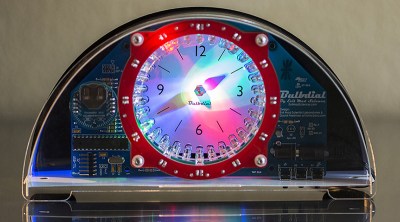
The Bulbdial Clock turns pretty lights into a clock.

For the next two weeks (or while supplies last) you can get up to 30% off a range of toys, tools, and kits including the Crazyflie 2.0 quadcopter, [Travis Goodspeed]’s Facedancer21 GoodFET board, the Bulbdial Clock kit, the mindbending Cordwood Puzzle from [Boldport], and dozens of other items.

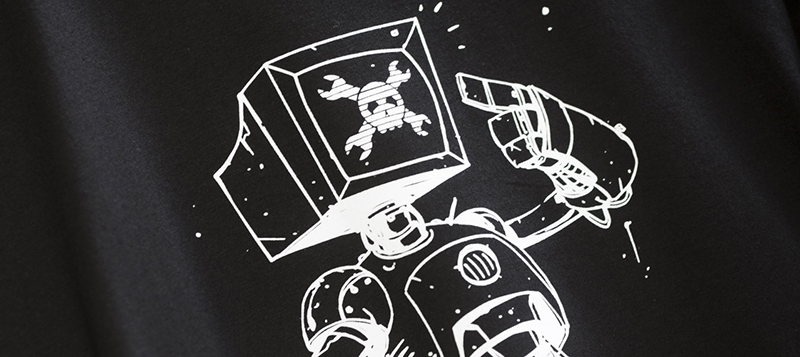
Want some sweet Hackaday swag? The CRT Android and Robot Head tee (limited sizes) are 30% off, as is our women’s fit Hackaday.io t-shirt. The Hackaday edition Trinket Pro, TV-B-Gone, and Huzzah ESP8266 dev board are 10% off, so there’s no excuse not to start your next Hackaday.io project now. Check out the Spring sale today and get yourself a deal.

Shipping is free on US orders over $35, Canadian orders over $50, and International orders over $75 (Unfortunately we’re unable to ship to all countries right now). Sale items are at clearance prices and are final sale. We will only exchange if the item is faulty (if the item is no longer available you will be given store credit).

Buying the CRT Android tee will make you more popular. Consume.


The Pi Zero Mass Storage Picture Frame

The Raspberry Pi Zero – and the not-perpetually-out-of-stock Raspberry Pi A+ – only have one USB port, but behind that port is a lot of functionality. This is an OTG USB port, and just like the USB port on your smartphone, this little plug can become any kind of USB device. Transforming the Pi into a USB gadget allows it to be a serial connection, MIDI device, audio source or sink, or a USB mass storage device.

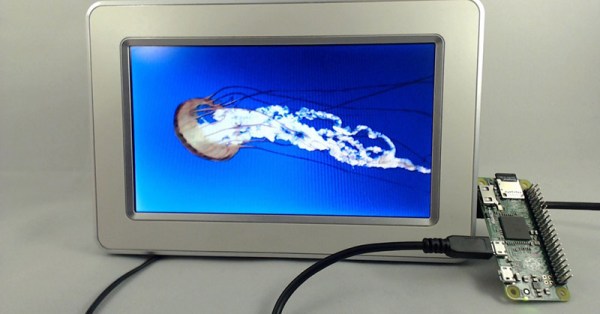
[Francesco] was especially interested in the USB mass storage capability of the Raspberry Pi Zero and built a small project to show off its capabilities. He turned a Pi Zero into the controller for a digital picture frame, constantly displaying all the image files on a small screen.

The build started with [Andrew Mulholland]’s guide for Pi Zero OTG modes, with just a few modifications. When the Pi is plugged into a PC, it automatically becomes a 100 Megabyte USB storage device. You don’t need that much space on a digital picture frame, anyway.

While setting up a digital picture frame is easy enough, there’s still a tremendous amount of untapped potential in using the Pi Zero as a USB gadget. With enough buttons, switches, and sensors, the Pi can become a wearable MIDI device, or with the Pi camera module, an IP webcam. Neat stuff, and we can’t wait to see what the community comes up with next.

Building A Better Game Boy With A Pi

The most collectible Game Boy, by far, would be the Game Boy Micro. This tiny Game Boy is small enough to lose in your pocket. It can only play Game Boy Advance games, the screen is tiny, but just look at the prices on eBay: it’s one of the few bits of consumer electronics that could be seen as an investment in retrospect.

The popularity of the Game Boy Micro, the ability for the Raspberry Pi to emulate old game consoles, and the introduction of the Raspberry Pi Zero could only mean one thing. It’s the PiGrrl Zero, a modern handheld to play all your retro games.

The design goals for the PiGRRL Zero were simple enough: a 2.2 inch 320×240 display, a d-pad, four buttons on the face and two shoulder buttons. There’s a big battery, audio output, and a 3D printed case. This would be somewhat unremarkable if it weren’t for the PCB designed for PiGRRL Zero. It’s designed to be soldered directly onto the Raspberry Pi Zero, taking advantage of the mostly component-free back side of this tiny single board computer.

With this PCB, the Pi Zero is turned into a tiny battery-powered computer running emulations of all the classics. NES, SNES, Sega, and of course Game Boy Advance games are readily playable on this devices, and for a price that’s a fair bit lower than what a mint condition Game Boy Micro goes for. Our judges thought it was cool enough to be one of the winners of the Pi Zero Contest. Check it out!


Raspberry_Pi_LogoSmall

The Raspberry Pi Zero contest is presented by Hackaday and Adafruit. Prizes include Raspberry Pi Zeros from Adafruit and gift cards to The Hackaday Store!
See All the Entries

BlinkenBone Meets The PiDP8

Years ago when the old mainframes made their way out of labs and into the waiting arms of storage closets and surplus stores, a lot got lost. The interesting bits – core memory boards and the like – were cool enough to be saved. Some iconic parts – blinkenlight panels – were stashed away by techs with a respect for our computing history.

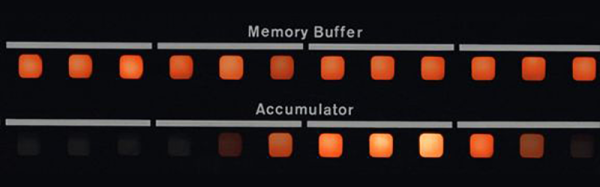
For the last few years, [Jörg] has been making these blinkenlight panels work again with his BlinkenBone project. His work turns a BeagleBone into a control box for old console computers, simulating the old CPUs and circuits, allowing them to work like they did thirty years ago, just without the hundreds of pounds of steel and kilowatts of power. Now, [Jörg] has turned to a much smaller and newer blinkenlight panel, the PiDP-8.

The PiDP-8 is a modern, miniaturized reproduction of the classic PDP 8/I, crafted by [Oscar Vermeulen]. We’ve seen [Oscar]’s PiDP a few times over the last year, including a talk [Oscar] gave at last year’s Hackaday Supercon. Having a simulated interface to a replica computer may seem ridiculous, but it’s a great test case for the interface should any older and rarer blnkenlight panels come out of the woodwork.