Video From Audio And Pure Data

Although graphical programming languages have been around for ages, they haven’t really seen much use outside of an educational setting. One of the few counterexamples of this is Pure Data, and Max MSP, visual programming languages that make music and video development as easy as dropping a few boxes down and drawing lines between them.

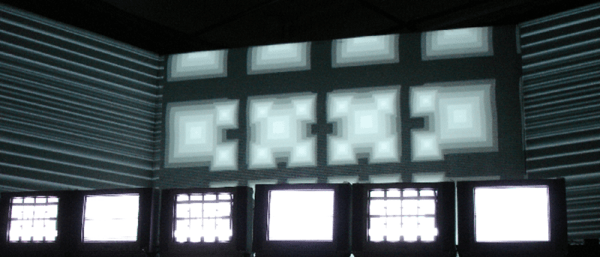
A few years ago, [Thomas] and [Danny] developed a very cool Pure Data audio-visual presentation. The program they developed only generated graphics, but though clever coding they were able to generate a few audio signals from whatever video was coming out of their computer. The project is called TVestroy, and it’s one of the coolest audio-visual presentations you’ll ever see.

The entire program is presented on three large screens and nine CRT televisions. With some extremely clever code and a black box of electronics, the video becomes the audio. Check it out below.

Although this is a relatively old build, [Thomas] thought it would be a good idea to revisit the project now. He’s open sourced most of the Pure Data files, and everything can be downloaded on the project page.

Continue reading “Video From Audio And Pure Data”

The USB Killer, Version 2.0

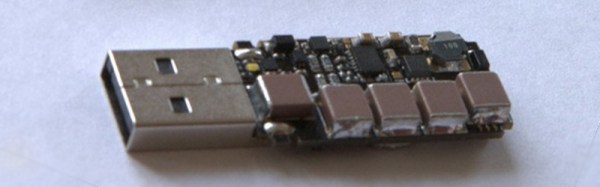
There are a lot of stupid things you can do with the ports on your computer. The best example is the Etherkiller, an RJ45 plug wired directly to a mains cable. Do not plug that into a router. USB is a little trickier, but with a sufficient number of caps, anyone can build a USB killer that will fry any computer (.ru, Google Translatrix)

The USB Killer v2.0 is [Dark Purple]’s second version of this device. The first version was just a small board with a DC/DC converter, a few caps, and a FET. When plugged in to a computer, the converter would charge the caps up to -110V, dump that voltage into the USB signal wires, and repeat the entire process until the computer died. This second version is slightly more refined, and it now dumps -220V directly onto the USB signal wires. Don’t try this at home.

So, does the device work? Most definitely. A poor Thinkpad X60 was destroyed with the USB killer for purposes of demonstration in the video below. This laptop was originally purchased just for the test, but the monster who created the USB killer grew attached to this neat little laptop. There’s a new motherboard on the way, and this laptop will live again.

Continue reading “The USB Killer, Version 2.0”

Makerbot Has Now Cut 36% Of Staff In Last 6 Months

The CEO of Makerbot, [Jonathan Jaglom] announced this week a massive reorganization. Twenty percent of the staff will be laid off, management will be changed, an office will be closed, and perhaps most interestingly, the production of 4th generation of Makerbots will be outsourced to contract manufacturers.

This news comes just months after Makerbot announced its first 20% reduction in staff, and follows on the heels of a class action suit from investors. These are troubling times for Makerbot.

So Goes Makerbot, So Goes The Industry

In the last six months, Makerbot has closed all three of its retail locations in Manhattan, Boston, and Greenwich, CT. It has moved out of one of its office buildings in Industry City, Brooklyn as the company faces a class action suit from investors for possible securities violations. These are by any measure troubling times for anyone at Makerbot.

The 3D printing industry has been forced through the rollercoaster of the hype cycle in the last few years, and where Makerbot goes, media coverage and public perception of 3D printing goes with it. According to pundits, we are now deep in the doldrums of the trough of disillusionment. No one wants to make their own parts for their washing machine, it is said, and 3D printers are finicky devices with limited utility.

Despite these pundits’ projections, the 3D printing industry doubled in 2015. Multiple manufacturers of sub $5000 machines are going gangbusters, and seeing the biggest revenues in the history of their respective companies. By any measure except the one provided by Makerbot, we are still in an era of a vast proliferation of 3D printing.

Makerbot, for better or worse, is a bellweather, and public perception and media attention is highly dependant on the success of Makerbot. The Verge writes – incorrectly – “…The consumer 3D-printing market’s rise has slowed”, and Business Insider writes ‘consumers are beginning to lose interest.’ These are not statements backed up by facts or statistics or even hearsay; they are merely a reflection of the consumer’s disinterest in Makerbot and not of the 3D printing industry of the whole.

Unfortunately, we will not know the extent of how bad it is at Makerbot until Stratasys releases its 2015 financial report sometime in early March next year. Wohlers Report 2016, the definitive guide to the 3D printing industry, will be released sometime around May of next year. Keep one thing in mind: Makerbot did not build the 3D printing industry, and the public perception of Makerbot does not necessarily translate to the public perception of 3D printing.

Controlling Guitar Amps With Servos

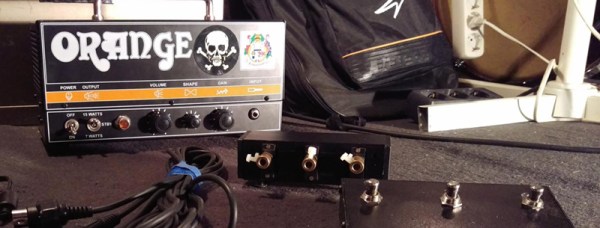
[fichl] plays electric guitar, and with that hobby comes an incredible amount of knob twisting and dial turning. This comes at a cost; he can’t change the settings on his small amp without taking his hands off the guitar. While larger, more expensive amps have multiple channels and footswitches, this tiny amp does not. Instead of upgrading, [fichl] came up with a device that turns his single channel amp into a completely programmable one, with just an Arduino and a handful of servos.

The amp in question – an Orange Dark Terror head – has just three knobs on the front of the chassis, volume, shape, and gain. [fichl] had the idea of controlling these knobs electronically, and the simplest solution he came up with is cheap hobby servos. These servos are mounted in an aluminum box, and mount to the knobs with a few shaft couplings.

The footswitch is the brains of the setup, with three buttons, four LEDs, and a DIN-5 output jack that delivers power, ground, and three PWM signals to the servo box. With the help of an Arduino Nano, [fichl] can change any of the knobs independently, or switch between twelve programmed settings. It’s an interesting setup, and something that could serve as a prototype for a much larger system on a much larger amp.

Heathkit: Live, Die, Repeat

There is no company that has earned more goodwill from electronic tinkering hobbyists than Heathkit. For more than fifty years, Heathkit has been the measure all other electronic kit manufacturers have been compared to. Kits for everything – from televisions to radios to computer terminals – were all sold by Heathkit, and even now, nearly a quarter century since the last kit left the warehouse, there is still a desire for this manufacturer to rise like a phoenix from the ashes. Heathkit lives once more, and this time it might be for real.

In recent years, Heathkit has had a confusing, if not troubled business plan. The company started manufacturing its signature products – electronic kits of every kind – in 1947. Production of these kits ended in 1992, and the company went on for another few years manufacturing educational materials and lighting controls. In 2011, Heathkit said they were back in the kit business, before shutting down a year later.

In 2013, an official Heathkit Facebook page was launched, a reddit AMA was held, and a mysterious stranger in the Hackaday comments section found a geocache placed by someone at Heathkit in a Brooklyn park. Absolutely nothing happened in 2014, or at least no one cared enough to hire a PI, which brings us to today’s announcement: Heathkit lives yet again.

This morning, the president of Heathkit sent a message to the ‘Heathkit Insiders’ email group explaining the goings on and new happenings:

We’ve designed and developed a wide range of entirely new kit products. We authored the manuals for these kits, complete with the beautiful line art you rely on, preserving and respecting our iconic historic Heathkit style. We developed many new inventions and filed patents on them. We relocated Heathkit, and set up a factory, and a warehouse, and offices, in Santa Cruz, California, near Silicon Valley. We built the back office infrastructure, vendor and supply chain relationships, systems, procedures, operations methods, and well-thought-out corporate structure that a manufacturing company needs to support its customers, to allow us to scale instantly the day we resume major kit sales. All this effort enables us to introduce a fleet of new kits and helps ensure Heathkit can grow, prosper, and continue to bring you great new products for a very long time.

The new Heathkit shop features their newest product, the Explorer Jr. AM Radio Receiver kit, a small kit radio available for $150. It’s actually a rather interesting kit with a nice design and an air variable cap for tuning, just like radios from a century ago. Whether anyone will pay $150 for an AM receiver in this century is another question entirely. The 21st century rebirth of Heathkit doesn’t just mean kits; they’re making apps now, with the first release being a crystal design tool for Android.

Virtually everyone in this little corner of the Internet, from Adafruit to Sparkfun, to Make magazine to everyone with a 3D printer owes a debt to Heathkit. This is the company that first turned DIY electronics into a successful business. Heathkit was the first, and they deserve to be recognized as the pioneers of the field.

The Donner Party were pioneers, too; just because you’re breaking new ground doesn’t mean you’re successful. The Heathkit of the 90s shuttered its doors for a reason. The factors behind the 1992 closing – cheap stuff from China, and the fact that not many people want to build their own electronics – are still with us. Still, the market for DIY electronics may be big enough, and Heathkit’s back catalog may be diverse enough that I won’t have to write another ‘Heathkit dies yet again’ post in a year or so. We can only hope.

The World’s First Android Smartphone

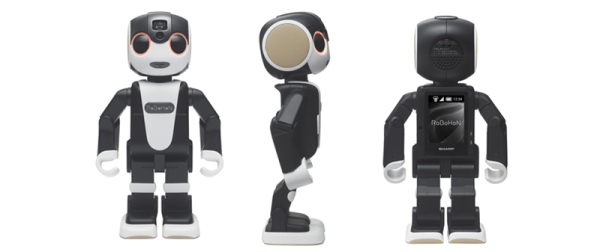
For one reason or another, someone decided smartphones should have personalities. iPhones have Siri, Windows phones have Cortana, but these are just pieces of software, and not a physical representation of a personality. This may soon change with Sharp, with help from famous Japanese roboticist [Tomotaka Takahashi], releasing RoBoHoN, the first robotic smartphone.

RoBoHoN is by any measure a miniature humanoid robot; it can walk on two legs, it can wave its arms, and it can fit into excessively large pockets. This robot is also a phone, and inside its cold soulless chassis is a 2.0″ LCD, camera, pico projector to display movies and pictures on flat surfaces, and the electronics to turn this into a modern, mid-range smartphone.

In the video for RoBoHoN, this friendly little phone can do everything from hail a cab, add stuff to a shopping list, and be the life of the party. According to Akihabara News, Sharp should be releasing this tiny robot sometime in early 2016 but no word yet on price.

Continue reading “The World’s First Android Smartphone”

New Part Day: The BeagleBoard Gets Bigger

Officially, the latest hardware revision we’ve seen from BeagleBoard is the BeagleBone Black, a small board that’s perfect for when you want to interface hardware to a Linux software environment. This last summer, the BeagleBone Green was introduced, and while it’s a newer hardware release, it’s really just a cost-reduced version of the BB Black. Over the entire BeagleBoard family, it’s time for an upgrade.

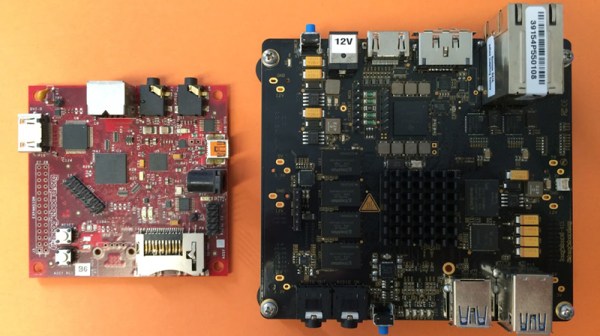
It’s been talked about for more than a year now, but the latest and greatest from the BeagleBoard crew is out. It’s called the BeagleBoard X15, and not only is it an extremely powerful Linux board, it also has more ports than you would ever need.

The new BeagleBoard features a dual-core ARM Cortex A15 running at 1.5GHz. There is 2GB of DDR3L RAM on board, and 4GB of EMMC Flash. Outputs include three USB 3.0 hosts, two Gigabit Ethernet controllers, one eSATA connector, LCD output, two PCIe connectors, and an HDMI connector capable of outputting 1920×1080 at 60 FPS. The entire board is open hardware, with documentation for nearly every device on the board available now. The one exception is the PowerVR SGX544 GPU which has a closed driver, but the FSF has proposed a project to create an open driver for this graphics engine so that could change in the future.

The expected price of the BeagleBoard X15 varies from source to source, but all the numbers fall somewhere in the range of $200 to $240 USD, with more recent estimates falling toward the high end. This board is not meant to be a replacement for the much more popular BeagleBone. While the development and relationship between the ~Board and ~Bone are very much related, the BeagleBone has always and will always be a barebone Linux board, albeit with a few interesting features. The BeagleBoard, on the other hand, includes the kitchen sink. While the BeagleBoard X15 hardware is complete, so far there are less than one hundred boards on the planet. These are going directly to the people responsible for making everything work, afterwards orders from Digikey and Mouser will be filled. General availability should be around November, and certainly by Christmas.

While it’s pricier than the BeagleBone, the Raspberry Pi, or dozens of other ARM Linux boards out there, The BeagleBone has a lot of horsepower and plenty of I/Os. It’s an impressive piece of hardware that out-competes just about everything else available. We can’t wait to see it in the wild, but more importantly we can’t wait to see what people can do with it.

Title image credit: Vladimir Pantelic